{"title":"Cooling the land surface: Ecosystem health and water availability drive the landscape capacity to mitigate climate change","authors":"Jana Müllerová, Erik Šiffel","doi":"10.1016/j.ecolind.2025.113265","DOIUrl":null,"url":null,"abstract":"<div><div>Land surface temperature (LST) is profoundly interlinked with the landscape state, settings and functioning, with the connections being very complex. Although the role of wetlands and (semi)natural habitats, in mitigating climate extremes is generally understood, the mechanisms explaining the thermal patterns in complex landscapes remain unclear. We address this knowledge gap, investigating a link between the dynamics of LST and characteristics of a diverse sandstone landscape, focusing on the role of water features and forest health in alleviating temperature extremes. For our study, we used a model example of a sandstone protected area in the north of the Czech Republic that underwent significant changes during the last decade due to a bark beetle infestation and a consequent forest die-off and wildfire. LST data were obtained from MODIS and Landsat 8 sensors in a cloud-based Google Earth Engine platform. Machine learning regression model enabled us to assess complex multivariable relationships and increase the LST spatial resolution. The results suggest the significant effect of both water availability and ecosystem health on LST, with vegetation indices, land cover and elevation being the main factors. The correlation of the satellite-based LST and in situ measured temperature depended on the canopy cover. The study indicates that in complex landscapes, LST data of high spatial and temporal resolution is necessary to disentangle local patterns and environmental drivers. Satellite data can serve as a reliable means to understand the mechanisms and prepare adaptive management measures to make the landscape more resistant to climate change related threats.</div></div>","PeriodicalId":11459,"journal":{"name":"Ecological Indicators","volume":"172 ","pages":"Article 113265"},"PeriodicalIF":7.0000,"publicationDate":"2025-03-01","publicationTypes":"Journal Article","fieldsOfStudy":null,"isOpenAccess":false,"openAccessPdf":"","citationCount":"0","resultStr":null,"platform":"Semanticscholar","paperid":null,"PeriodicalName":"Ecological Indicators","FirstCategoryId":"93","ListUrlMain":"https://www.sciencedirect.com/science/article/pii/S1470160X25001943","RegionNum":2,"RegionCategory":"环境科学与生态学","ArticlePicture":[],"TitleCN":null,"AbstractTextCN":null,"PMCID":null,"EPubDate":"2025/2/21 0:00:00","PubModel":"Epub","JCR":"Q1","JCRName":"ENVIRONMENTAL SCIENCES","Score":null,"Total":0}
引用次数: 0
Abstract
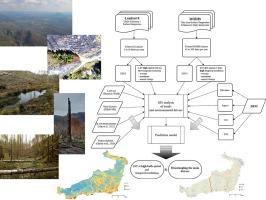
Land surface temperature (LST) is profoundly interlinked with the landscape state, settings and functioning, with the connections being very complex. Although the role of wetlands and (semi)natural habitats, in mitigating climate extremes is generally understood, the mechanisms explaining the thermal patterns in complex landscapes remain unclear. We address this knowledge gap, investigating a link between the dynamics of LST and characteristics of a diverse sandstone landscape, focusing on the role of water features and forest health in alleviating temperature extremes. For our study, we used a model example of a sandstone protected area in the north of the Czech Republic that underwent significant changes during the last decade due to a bark beetle infestation and a consequent forest die-off and wildfire. LST data were obtained from MODIS and Landsat 8 sensors in a cloud-based Google Earth Engine platform. Machine learning regression model enabled us to assess complex multivariable relationships and increase the LST spatial resolution. The results suggest the significant effect of both water availability and ecosystem health on LST, with vegetation indices, land cover and elevation being the main factors. The correlation of the satellite-based LST and in situ measured temperature depended on the canopy cover. The study indicates that in complex landscapes, LST data of high spatial and temporal resolution is necessary to disentangle local patterns and environmental drivers. Satellite data can serve as a reliable means to understand the mechanisms and prepare adaptive management measures to make the landscape more resistant to climate change related threats.
期刊介绍:
The ultimate aim of Ecological Indicators is to integrate the monitoring and assessment of ecological and environmental indicators with management practices. The journal provides a forum for the discussion of the applied scientific development and review of traditional indicator approaches as well as for theoretical, modelling and quantitative applications such as index development. Research into the following areas will be published.
• All aspects of ecological and environmental indicators and indices.
• New indicators, and new approaches and methods for indicator development, testing and use.
• Development and modelling of indices, e.g. application of indicator suites across multiple scales and resources.
• Analysis and research of resource, system- and scale-specific indicators.
• Methods for integration of social and other valuation metrics for the production of scientifically rigorous and politically-relevant assessments using indicator-based monitoring and assessment programs.
• How research indicators can be transformed into direct application for management purposes.
• Broader assessment objectives and methods, e.g. biodiversity, biological integrity, and sustainability, through the use of indicators.
• Resource-specific indicators such as landscape, agroecosystems, forests, wetlands, etc.




 京公网安备 11010802042870号
京ICP备2023020795号-1
京公网安备 11010802042870号
京ICP备2023020795号-1

 分享
分享
 求助内容:
求助内容: 应助结果提醒方式:
 扫码关注我们
