José Eduardo Pachano , Cristina Nuevo-Gallardo , Carlos Fernández Bandera
{"title":"An empirical comparison of a calibrated white-box versus multiple LSTM black-box building energy models","authors":"José Eduardo Pachano , Cristina Nuevo-Gallardo , Carlos Fernández Bandera","doi":"10.1016/j.enbuild.2025.115485","DOIUrl":null,"url":null,"abstract":"<div><div>Building energy simulation plays a critical role in establishing the impact of new energy conservation measures (ECMs) in buildings, in recent years it has become a go-to tool when developing sustainable energy saving solutions in modern architecture. The present study explores the energy performance gap in building energy models (BEMs), specifically a series of black-box Long Short-Term Memory (LSTM) BEMs and a traditional white-box or physical model, by comparing their simulated energy consumption results against real data measured in-situ. It evaluates different LSTM case studies that integrate climate, building operation, and explore different configurations of the data provided by Heating, Ventilation and Air Conditioning (HVAC) subsystems as input variables. The black-box LSTM models are trained on time series data collected from the building, and their performance is compared against a calibrated white-box model. The study emphasizes the importance of data quality and quantity when training black-box models. It highlights the physical white-box model's stability and reliability in predicting energy consumption, noting that these qualities come at the cost of significantly longer development and computer processing times than its black-box counterparts. To this aim, two validation periods are evaluated: the first considers winter conditions between January and March 2020, and the second includes spring conditions in April 2019. Among the case studies, only one configuration surpassed the white-box model's performance, requiring twice as much data at a finer resolution. This model reached an NMBE of -4.140%, CV(RMSE) of 12.570%, and R<sup>2</sup> of 84.398% for the winter checking period, and an NMBE of -1.797%, CV(RMSE) of 10.799% with an R<sup>2</sup> of 96.268% for spring checking period; both meeting international standards of IPMVP. The findings also suggest that LSTM BEM hyper-parameter calibration could improve the models adaptability and robustness, ensuring that simulations remain reliable across different operating conditions of the building's life-cycle.</div></div>","PeriodicalId":11641,"journal":{"name":"Energy and Buildings","volume":"333 ","pages":"Article 115485"},"PeriodicalIF":7.1000,"publicationDate":"2025-02-19","publicationTypes":"Journal Article","fieldsOfStudy":null,"isOpenAccess":false,"openAccessPdf":"","citationCount":"0","resultStr":null,"platform":"Semanticscholar","paperid":null,"PeriodicalName":"Energy and Buildings","FirstCategoryId":"5","ListUrlMain":"https://www.sciencedirect.com/science/article/pii/S0378778825002154","RegionNum":2,"RegionCategory":"工程技术","ArticlePicture":[],"TitleCN":null,"AbstractTextCN":null,"PMCID":null,"EPubDate":"","PubModel":"","JCR":"Q1","JCRName":"CONSTRUCTION & BUILDING TECHNOLOGY","Score":null,"Total":0}
引用次数: 0
Abstract
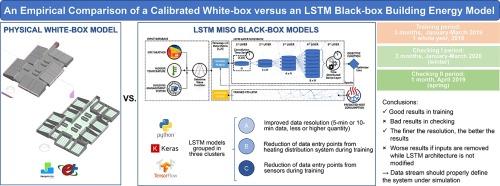
Building energy simulation plays a critical role in establishing the impact of new energy conservation measures (ECMs) in buildings, in recent years it has become a go-to tool when developing sustainable energy saving solutions in modern architecture. The present study explores the energy performance gap in building energy models (BEMs), specifically a series of black-box Long Short-Term Memory (LSTM) BEMs and a traditional white-box or physical model, by comparing their simulated energy consumption results against real data measured in-situ. It evaluates different LSTM case studies that integrate climate, building operation, and explore different configurations of the data provided by Heating, Ventilation and Air Conditioning (HVAC) subsystems as input variables. The black-box LSTM models are trained on time series data collected from the building, and their performance is compared against a calibrated white-box model. The study emphasizes the importance of data quality and quantity when training black-box models. It highlights the physical white-box model's stability and reliability in predicting energy consumption, noting that these qualities come at the cost of significantly longer development and computer processing times than its black-box counterparts. To this aim, two validation periods are evaluated: the first considers winter conditions between January and March 2020, and the second includes spring conditions in April 2019. Among the case studies, only one configuration surpassed the white-box model's performance, requiring twice as much data at a finer resolution. This model reached an NMBE of -4.140%, CV(RMSE) of 12.570%, and R2 of 84.398% for the winter checking period, and an NMBE of -1.797%, CV(RMSE) of 10.799% with an R2 of 96.268% for spring checking period; both meeting international standards of IPMVP. The findings also suggest that LSTM BEM hyper-parameter calibration could improve the models adaptability and robustness, ensuring that simulations remain reliable across different operating conditions of the building's life-cycle.
期刊介绍:
An international journal devoted to investigations of energy use and efficiency in buildings
Energy and Buildings is an international journal publishing articles with explicit links to energy use in buildings. The aim is to present new research results, and new proven practice aimed at reducing the energy needs of a building and improving indoor environment quality.



 京公网安备 11010802042870号
京ICP备2023020795号-1
京公网安备 11010802042870号
京ICP备2023020795号-1

 分享
分享
 求助内容:
求助内容: 应助结果提醒方式:
 扫码关注我们
