{"title":"Boosting Phosphorescent Performance by a Three-Component Doping of Coumarin Derivatives, Metal Salts Into Polyvinyl Alcohol","authors":"Hua Feng, Zhongmin Su, Fushun Liang","doi":"10.1002/macp.202400406","DOIUrl":null,"url":null,"abstract":"<p>Multi-component doping has become an effective way to achieve efficient room-temperature phosphorescence. In this paper, green phosphorescence emission from coumarin derivatives, i.e., coumarin-3-carboxylic acid (CCA) and coumarin-3-carboxylic ester (CEt) are activated by doping them into polyvinyl alcohol (PVA) matrix (two component doping). Then, a series of metal salts (Ca<sup>2+</sup>, Al<sup>3+</sup>, Mn<sup>2+</sup>, and Zn<sup>2+</sup>) are added as the third component to construct three-component doping system, with the aim to further improve the phosphorescence properties of the polymer films. Among them, CaCl<sub>2</sub> can significantly increase the emission intensity (9.2 times), prolong the phosphorescence lifetime (up to 361 ms), and increase the phosphorescence quantum yield (from 1.02% to 9.19%). The results indicated that RTP emission can be activated by inhibiting the non-radiative transition of coumarin derivatives embedded in the rigid PVA matrix. RTP performance can be further enhanced relying on the coordination effect between the coumarin guests and the metal salts. This study provides a simple and effective three-component doping method for boosting polymer film-based phosphorescence performance.</p>","PeriodicalId":18054,"journal":{"name":"Macromolecular Chemistry and Physics","volume":"226 4","pages":""},"PeriodicalIF":2.7000,"publicationDate":"2024-11-27","publicationTypes":"Journal Article","fieldsOfStudy":null,"isOpenAccess":false,"openAccessPdf":"","citationCount":"0","resultStr":null,"platform":"Semanticscholar","paperid":null,"PeriodicalName":"Macromolecular Chemistry and Physics","FirstCategoryId":"92","ListUrlMain":"https://onlinelibrary.wiley.com/doi/10.1002/macp.202400406","RegionNum":4,"RegionCategory":"化学","ArticlePicture":[],"TitleCN":null,"AbstractTextCN":null,"PMCID":null,"EPubDate":"","PubModel":"","JCR":"Q3","JCRName":"POLYMER SCIENCE","Score":null,"Total":0}
引用次数: 0
Abstract
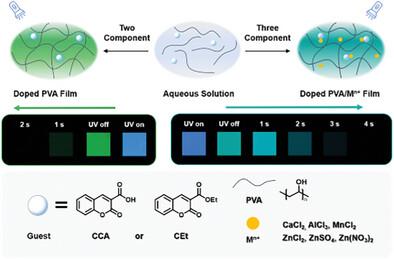
Multi-component doping has become an effective way to achieve efficient room-temperature phosphorescence. In this paper, green phosphorescence emission from coumarin derivatives, i.e., coumarin-3-carboxylic acid (CCA) and coumarin-3-carboxylic ester (CEt) are activated by doping them into polyvinyl alcohol (PVA) matrix (two component doping). Then, a series of metal salts (Ca2+, Al3+, Mn2+, and Zn2+) are added as the third component to construct three-component doping system, with the aim to further improve the phosphorescence properties of the polymer films. Among them, CaCl2 can significantly increase the emission intensity (9.2 times), prolong the phosphorescence lifetime (up to 361 ms), and increase the phosphorescence quantum yield (from 1.02% to 9.19%). The results indicated that RTP emission can be activated by inhibiting the non-radiative transition of coumarin derivatives embedded in the rigid PVA matrix. RTP performance can be further enhanced relying on the coordination effect between the coumarin guests and the metal salts. This study provides a simple and effective three-component doping method for boosting polymer film-based phosphorescence performance.
期刊介绍:
Macromolecular Chemistry and Physics publishes in all areas of polymer science - from chemistry, physical chemistry, and physics of polymers to polymers in materials science. Beside an attractive mixture of high-quality Full Papers, Trends, and Highlights, the journal offers a unique article type dedicated to young scientists – Talent.



 京公网安备 11010802042870号
京ICP备2023020795号-1
京公网安备 11010802042870号
京ICP备2023020795号-1

 分享
分享
 求助内容:
求助内容: 应助结果提醒方式:
 扫码关注我们
