{"title":"Flexible Composites of Barium Sulfate Modified by Tannic Acid Using Glycerol/Starch for X-Ray Shielding Applications","authors":"Ryoma Tokonami, Minoru Osanai, Masahiro Hosoda, Shinji Tokonami, Tatsuhiro Takahashi","doi":"10.1002/macp.202400273","DOIUrl":null,"url":null,"abstract":"<p>This study investigates the X-ray shielding properties and mechanical properties of barium sulfate (BaSO<sub>4</sub>) composites based on a biodegradable matrix composed of glycerol and starch. In addition, tannic acid (TA) is used for surface modification of the BaSO<sub>4</sub>. Increasing the amount of BaSO<sub>4</sub> is necessary to improve the composite's X-ray shielding properties; however, as the amount of BaSO<sub>4</sub> increases, the composite becomes harder. The purpose of this research is to prepare a flexible X-ray-shielding composite even when a large amount of filler is added. TA easily coats the BaSO<sub>4</sub> surface, and its presence is confirmed by Fourier transform infrared spectroscopy and thermogravimetric analysis. Elongation of the composites composed of glycerol, starch, and BaSO<sub>4</sub> is increased by 50% because of the formation of hydrogen bonds between the hydroxyl groups of glycerol and starch and those of TA. Consequently, the fracture behavior changed from brittle fracture to ductile fracture. However, the X-ray shielding properties are not changed by the surface modification with TA. The use of glycerol, starch, and BaSO<sub>4</sub> is a new approach to the development of biodegradable radiation shielding materials. In addition, as a surface-modification agent, TA is environmentally friendly. All of the composites are prepared from natural materials.</p>","PeriodicalId":18054,"journal":{"name":"Macromolecular Chemistry and Physics","volume":"226 4","pages":""},"PeriodicalIF":2.7000,"publicationDate":"2024-09-28","publicationTypes":"Journal Article","fieldsOfStudy":null,"isOpenAccess":false,"openAccessPdf":"","citationCount":"0","resultStr":null,"platform":"Semanticscholar","paperid":null,"PeriodicalName":"Macromolecular Chemistry and Physics","FirstCategoryId":"92","ListUrlMain":"https://onlinelibrary.wiley.com/doi/10.1002/macp.202400273","RegionNum":4,"RegionCategory":"化学","ArticlePicture":[],"TitleCN":null,"AbstractTextCN":null,"PMCID":null,"EPubDate":"","PubModel":"","JCR":"Q3","JCRName":"POLYMER SCIENCE","Score":null,"Total":0}
引用次数: 0
Abstract
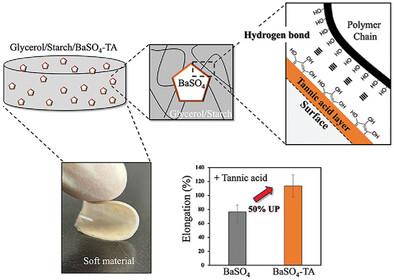
This study investigates the X-ray shielding properties and mechanical properties of barium sulfate (BaSO4) composites based on a biodegradable matrix composed of glycerol and starch. In addition, tannic acid (TA) is used for surface modification of the BaSO4. Increasing the amount of BaSO4 is necessary to improve the composite's X-ray shielding properties; however, as the amount of BaSO4 increases, the composite becomes harder. The purpose of this research is to prepare a flexible X-ray-shielding composite even when a large amount of filler is added. TA easily coats the BaSO4 surface, and its presence is confirmed by Fourier transform infrared spectroscopy and thermogravimetric analysis. Elongation of the composites composed of glycerol, starch, and BaSO4 is increased by 50% because of the formation of hydrogen bonds between the hydroxyl groups of glycerol and starch and those of TA. Consequently, the fracture behavior changed from brittle fracture to ductile fracture. However, the X-ray shielding properties are not changed by the surface modification with TA. The use of glycerol, starch, and BaSO4 is a new approach to the development of biodegradable radiation shielding materials. In addition, as a surface-modification agent, TA is environmentally friendly. All of the composites are prepared from natural materials.
期刊介绍:
Macromolecular Chemistry and Physics publishes in all areas of polymer science - from chemistry, physical chemistry, and physics of polymers to polymers in materials science. Beside an attractive mixture of high-quality Full Papers, Trends, and Highlights, the journal offers a unique article type dedicated to young scientists – Talent.



 京公网安备 11010802042870号
京ICP备2023020795号-1
京公网安备 11010802042870号
京ICP备2023020795号-1

 分享
分享
 求助内容:
求助内容: 应助结果提醒方式:
 扫码关注我们
