Ang Li, Jia-Le Li, Jin-Meng Zhang, Jing-Yi Ma, Yi-Xian Wu
{"title":"In Situ Synthesis of Chemically Stable Hybrid Co-Networks of Poly(thioctic Acid) with Fe3+ via Controlled/Living Cationic Ring-Opening Polymerization","authors":"Ang Li, Jia-Le Li, Jin-Meng Zhang, Jing-Yi Ma, Yi-Xian Wu","doi":"10.1002/marc.202401115","DOIUrl":null,"url":null,"abstract":"<p>The novel chemically stable hybrid co-networks (PTA-Fe) of poly(thioctic acid) coordinated with molar content (<i>C</i><sub>Fe</sub>) of 1%∼12% Fe<sup>3+</sup> generated from [FeCl<sub>4</sub>·POH]<sup>−</sup> can be in situ synthesized via controlled/living cationic ring-opening polymerization of <i>α</i>-thioctic acid (TA) with <i>tert</i>-butyl chloride(BCl)/FeCl<sub>3</sub>/isopropanol(POH) initiating system at 0 °C. The polymerizations are all in first order with respect to monomer, initiator and co-initiator. The resulting PTAs with desired molecular weights and relatively narrow unimodal molecular weight distribution can be obtained via quantitative initiation by changing [BCl]<sub>0</sub>. The livingness of polymerization without chain transfer and termination is confirmed from the linear relationship between molecular weights of the resulting PTAs and polymer yields and the unchanged average polymer chains during polymerization process by Incremental Monomer Addition and All Monomer In techniques. The possible mechanism of the above polymerization is proposed. Interestingly, it is found that the PTA-Fe hybrids can behave chemically stable during storage at room temperature for 24 months when <i>C</i><sub>Fe</sub> ≥ 6.9%. To the best of the knowledge, it is the first example of in situ green synthesis of PTA-Fe hybrid co-networks with excellent chemical stability. The PTA-Fe hybrids would have potential application in the field of elastomer, adhesive and self-healing materials.</p>","PeriodicalId":205,"journal":{"name":"Macromolecular Rapid Communications","volume":"46 10","pages":""},"PeriodicalIF":4.3000,"publicationDate":"2025-02-20","publicationTypes":"Journal Article","fieldsOfStudy":null,"isOpenAccess":false,"openAccessPdf":"","citationCount":"0","resultStr":null,"platform":"Semanticscholar","paperid":null,"PeriodicalName":"Macromolecular Rapid Communications","FirstCategoryId":"92","ListUrlMain":"https://onlinelibrary.wiley.com/doi/10.1002/marc.202401115","RegionNum":3,"RegionCategory":"化学","ArticlePicture":[],"TitleCN":null,"AbstractTextCN":null,"PMCID":null,"EPubDate":"","PubModel":"","JCR":"Q2","JCRName":"POLYMER SCIENCE","Score":null,"Total":0}
引用次数: 0
Abstract
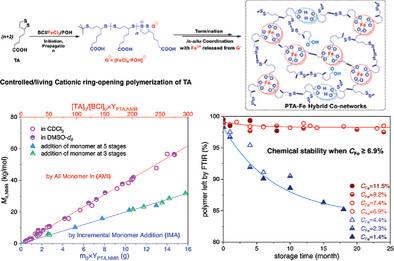
The novel chemically stable hybrid co-networks (PTA-Fe) of poly(thioctic acid) coordinated with molar content (CFe) of 1%∼12% Fe3+ generated from [FeCl4·POH]− can be in situ synthesized via controlled/living cationic ring-opening polymerization of α-thioctic acid (TA) with tert-butyl chloride(BCl)/FeCl3/isopropanol(POH) initiating system at 0 °C. The polymerizations are all in first order with respect to monomer, initiator and co-initiator. The resulting PTAs with desired molecular weights and relatively narrow unimodal molecular weight distribution can be obtained via quantitative initiation by changing [BCl]0. The livingness of polymerization without chain transfer and termination is confirmed from the linear relationship between molecular weights of the resulting PTAs and polymer yields and the unchanged average polymer chains during polymerization process by Incremental Monomer Addition and All Monomer In techniques. The possible mechanism of the above polymerization is proposed. Interestingly, it is found that the PTA-Fe hybrids can behave chemically stable during storage at room temperature for 24 months when CFe ≥ 6.9%. To the best of the knowledge, it is the first example of in situ green synthesis of PTA-Fe hybrid co-networks with excellent chemical stability. The PTA-Fe hybrids would have potential application in the field of elastomer, adhesive and self-healing materials.
期刊介绍:
Macromolecular Rapid Communications publishes original research in polymer science, ranging from chemistry and physics of polymers to polymers in materials science and life sciences.



 京公网安备 11010802042870号
京ICP备2023020795号-1
京公网安备 11010802042870号
京ICP备2023020795号-1

 分享
分享
 求助内容:
求助内容: 应助结果提醒方式:
 扫码关注我们
