Antibody-level Bacteria Grabbing by “Mechanic Invasion” of Bioinspired Hedgehog Artificial Mesoporous Nanostructure for Hierarchical Dynamic Identification and Light-Response Sterilization
{"title":"Antibody-level Bacteria Grabbing by “Mechanic Invasion” of Bioinspired Hedgehog Artificial Mesoporous Nanostructure for Hierarchical Dynamic Identification and Light-Response Sterilization","authors":"Sijie Liu, Rui Shu, Huilin Jia, Kexin Wang, Biao Wang, Jiayi Zhang, Jing Sun, Nosirjon Sattorov, Kamoljon Burkhonovich Makhmudov, Maojun Jin, Jianlong Wang","doi":"10.1002/adma.202416906","DOIUrl":null,"url":null,"abstract":"<p>The interactions exploration between microorganisms and nanostructures are pivotal steps toward advanced applications, but the antibody-level bacteria grabbing is limited by the poor understanding of interface identification mechanisms in small-sized systems. Herein, the de novo design of a bioinspired hedgehog artificial mesoporous nanostructure (core–shell mesoporous Au@Pt (mAPt)) are proposed to investigate the association between the topography design and efficient bacteria grabbing. These observations indicate that virus-like spiky topography compensates for the obstacles faced by small-sized materials for bacteria grabbing, including the lack of requisite microscopic cavities and sufficient contact area. Molecular dynamics simulation reveals that spiky topography with heightened mechano-invasiveness (6.56 × 10<sup>3</sup> KJ mol<sup>−1</sup>) facilitates antibody-level bacteria grabbing, attributed to the “mechanic invasion”-induced hierarchical dynamic identification ranging from rough surface contact to penetration fixation. Furthermore, light reflectance and finite element calculation confirmed that mAPt exhibits near-superblack characteristic and plasmonic hot spot, facilitating enhanced photothermal conversion with power dissipation density at 2.04 × 10<sup>21</sup> W m<sup>−3</sup>. After integrating the hierarchical dynamic identification with enhanced light response, mAPt enables advanced applications in immunoassay with 50-fold sensitivity enhancement and over 99.99% in vitro photothermal sterilization. It is anticipated that this novel biomimetic design provides a deeper understanding of bacteria grabbing and a promising paradigm for bacteria combating.</p>","PeriodicalId":114,"journal":{"name":"Advanced Materials","volume":"37 15","pages":""},"PeriodicalIF":26.8000,"publicationDate":"2025-02-19","publicationTypes":"Journal Article","fieldsOfStudy":null,"isOpenAccess":false,"openAccessPdf":"","citationCount":"0","resultStr":null,"platform":"Semanticscholar","paperid":null,"PeriodicalName":"Advanced Materials","FirstCategoryId":"88","ListUrlMain":"https://advanced.onlinelibrary.wiley.com/doi/10.1002/adma.202416906","RegionNum":1,"RegionCategory":"材料科学","ArticlePicture":[],"TitleCN":null,"AbstractTextCN":null,"PMCID":null,"EPubDate":"","PubModel":"","JCR":"Q1","JCRName":"CHEMISTRY, MULTIDISCIPLINARY","Score":null,"Total":0}
引用次数: 0
Abstract
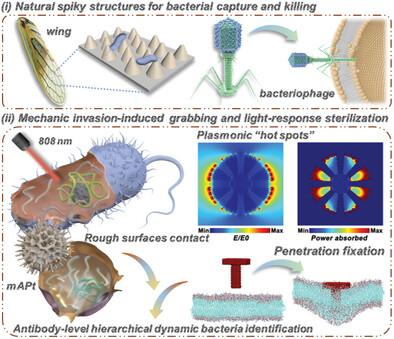
The interactions exploration between microorganisms and nanostructures are pivotal steps toward advanced applications, but the antibody-level bacteria grabbing is limited by the poor understanding of interface identification mechanisms in small-sized systems. Herein, the de novo design of a bioinspired hedgehog artificial mesoporous nanostructure (core–shell mesoporous Au@Pt (mAPt)) are proposed to investigate the association between the topography design and efficient bacteria grabbing. These observations indicate that virus-like spiky topography compensates for the obstacles faced by small-sized materials for bacteria grabbing, including the lack of requisite microscopic cavities and sufficient contact area. Molecular dynamics simulation reveals that spiky topography with heightened mechano-invasiveness (6.56 × 10³ KJ mol−1) facilitates antibody-level bacteria grabbing, attributed to the “mechanic invasion”-induced hierarchical dynamic identification ranging from rough surface contact to penetration fixation. Furthermore, light reflectance and finite element calculation confirmed that mAPt exhibits near-superblack characteristic and plasmonic hot spot, facilitating enhanced photothermal conversion with power dissipation density at 2.04 × 10²¹ W m−3. After integrating the hierarchical dynamic identification with enhanced light response, mAPt enables advanced applications in immunoassay with 50-fold sensitivity enhancement and over 99.99% in vitro photothermal sterilization. It is anticipated that this novel biomimetic design provides a deeper understanding of bacteria grabbing and a promising paradigm for bacteria combating.
期刊介绍:
Advanced Materials, one of the world's most prestigious journals and the foundation of the Advanced portfolio, is the home of choice for best-in-class materials science for more than 30 years. Following this fast-growing and interdisciplinary field, we are considering and publishing the most important discoveries on any and all materials from materials scientists, chemists, physicists, engineers as well as health and life scientists and bringing you the latest results and trends in modern materials-related research every week.







 京公网安备 11010802042870号
京ICP备2023020795号-1
京公网安备 11010802042870号
京ICP备2023020795号-1

 分享
分享
 求助内容:
求助内容: 应助结果提醒方式:
 扫码关注我们
