Belinda Fuss, Tania Shelby-James, Sharon Lawn, Paul Worley, Sam Manger, Caroline Phegan, Megan Rattray
{"title":"A qualitative exploration of the perceived barriers and enablers of providing mental health care in rural Australian general practice.","authors":"Belinda Fuss, Tania Shelby-James, Sharon Lawn, Paul Worley, Sam Manger, Caroline Phegan, Megan Rattray","doi":"10.1177/13558196251319654","DOIUrl":null,"url":null,"abstract":"<p><p><b>Objectives:</b> General practice plays an important role in delivering and supporting mental health care within communities, particularly for those living in rural areas where access to specialised support is limited. This study sought to understand the barriers and facilitators to providing mental health care in rural Australian general practices. <b>Methods:</b> A descriptive qualitative study was undertaken involving online interviews with 14 staff at three rural Australian general practices between June and September 2023. Participants included nurses (<i>n</i> = 4), GPs, (<i>n</i> = 4), reception staff (<i>n</i> = 3) and practice managers (<i>n</i> = 3). Data were analysed using inductive thematic analysis. <b>Results:</b> Our analysis identified three themes: (i) systemic challenges and supportive infrastructure; (ii) health care personnel factors; and (iii) patient characteristics and preferences. Systemic challenges included limited access to services and specialist support, and challenges with information transmission, while the clinic location and set-up were seen as beneficial. Health care personnel factors included interpersonal needs and challenges, time constraints and how to balance care needs, and the difficulties of attracting and retaining a local workforce. Patient characteristics and preferences included societal stigma and individual hesitancy, lack of awareness, understanding and education around mental health and willingness and affordability of travel and using technology. <b>Conclusions:</b> Rural general practice in Australia faces a range of barriers and enablers that shape the provision of mental health care. To address these challenges, collaboration across various sectors will be required. Improving infrastructure, better resource allocation, addressing workforce shortages, reducing stigma, enhancing mental health literacy, and ensuring the accessibility of mental health care services are all crucial steps. It will be important to align policy goals across sectors to improve the delivery of mental health care in rural general practice in Australia.</p>","PeriodicalId":15953,"journal":{"name":"Journal of Health Services Research & Policy","volume":" ","pages":"218-226"},"PeriodicalIF":2.7000,"publicationDate":"2025-10-01","publicationTypes":"Journal Article","fieldsOfStudy":null,"isOpenAccess":false,"openAccessPdf":"https://www.ncbi.nlm.nih.gov/pmc/articles/PMC12411677/pdf/","citationCount":"0","resultStr":null,"platform":"Semanticscholar","paperid":null,"PeriodicalName":"Journal of Health Services Research & Policy","FirstCategoryId":"3","ListUrlMain":"https://doi.org/10.1177/13558196251319654","RegionNum":4,"RegionCategory":"医学","ArticlePicture":[],"TitleCN":null,"AbstractTextCN":null,"PMCID":null,"EPubDate":"2025/2/20 0:00:00","PubModel":"Epub","JCR":"Q3","JCRName":"HEALTH POLICY & SERVICES","Score":null,"Total":0}
引用次数: 0
Abstract
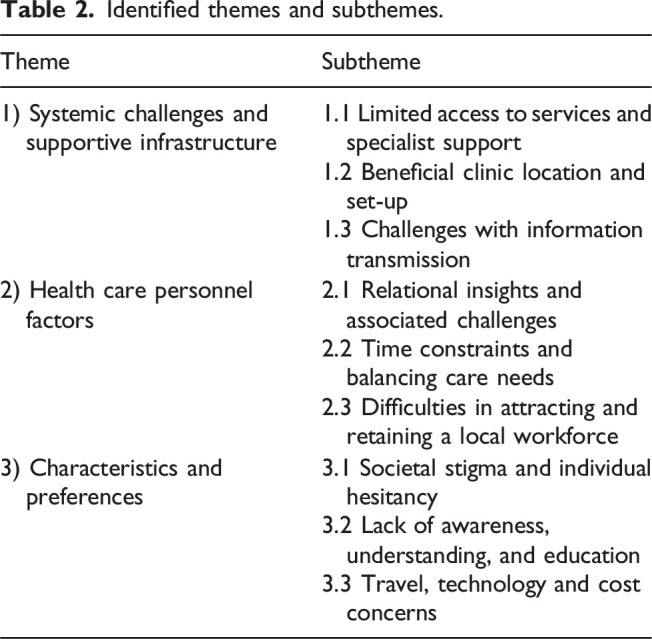
Objectives: General practice plays an important role in delivering and supporting mental health care within communities, particularly for those living in rural areas where access to specialised support is limited. This study sought to understand the barriers and facilitators to providing mental health care in rural Australian general practices. Methods: A descriptive qualitative study was undertaken involving online interviews with 14 staff at three rural Australian general practices between June and September 2023. Participants included nurses (n = 4), GPs, (n = 4), reception staff (n = 3) and practice managers (n = 3). Data were analysed using inductive thematic analysis. Results: Our analysis identified three themes: (i) systemic challenges and supportive infrastructure; (ii) health care personnel factors; and (iii) patient characteristics and preferences. Systemic challenges included limited access to services and specialist support, and challenges with information transmission, while the clinic location and set-up were seen as beneficial. Health care personnel factors included interpersonal needs and challenges, time constraints and how to balance care needs, and the difficulties of attracting and retaining a local workforce. Patient characteristics and preferences included societal stigma and individual hesitancy, lack of awareness, understanding and education around mental health and willingness and affordability of travel and using technology. Conclusions: Rural general practice in Australia faces a range of barriers and enablers that shape the provision of mental health care. To address these challenges, collaboration across various sectors will be required. Improving infrastructure, better resource allocation, addressing workforce shortages, reducing stigma, enhancing mental health literacy, and ensuring the accessibility of mental health care services are all crucial steps. It will be important to align policy goals across sectors to improve the delivery of mental health care in rural general practice in Australia.
期刊介绍:
Journal of Health Services Research & Policy provides a unique opportunity to explore the ideas, policies and decisions shaping health services throughout the world. Edited and peer-reviewed by experts in the field and with a high academic standard and multidisciplinary approach, readers will gain a greater understanding of the current issues in healthcare policy and research. The journal"s strong international editorial advisory board also ensures that readers obtain a truly global and insightful perspective.




 京公网安备 11010802042870号
京ICP备2023020795号-1
京公网安备 11010802042870号
京ICP备2023020795号-1

 分享
分享
 求助内容:
求助内容: 应助结果提醒方式:
 扫码关注我们
