{"title":"A 5-lncRNA signature predicts clinical prognosis and demonstrates a different mRNA expression in adult soft tissue sarcoma.","authors":"Ye Yao, Xiaojuan Wang, Ziwei Zhao, Zhipeng Li","doi":"10.21037/tcr-24-203","DOIUrl":null,"url":null,"abstract":"<p><strong>Background: </strong>Adult soft tissue sarcoma (SARC) is a highly aggressive malignancy. A growing number of long non-coding RNAs (lncRNAs) have been linked to malignancies, and many researchers consider lncRNAs potential biomarkers for prognosis. However, there is limited evidence available to determine the role of lncRNAs in the prognosis of SARC. In this study, we collected The Cancer Genome Atlas (TCGA) data to identify prognosis-related lncRNAs for SARC and explore the relationship between lncRNAs and gene expression.</p><p><strong>Methods: </strong>TCGA datasets, which included 259 samples, served as data sources in this study. Univariable Cox regression analysis, robust analysis, and multivariable Cox regression analysis were used to construct a 5-lncRNA signature Cox regression model. Then, based on the median risk score, high- and low-risk groups were identified. The Kaplan-Meier method was applied to survival analysis in the training set, testing set, complete set, and different pathological type sets. To explore the relationship between lncRNAs and messenger RNAs (mRNAs), differentially expressed mRNAs (DEmRNAs) between the high- and low-risk groups were identified. The function of DEmRNAs was predicted using Gene Ontology (GO) and Kyoto Encyclopedia of Genes and Genomes (KEGG) enrichment analyses. The relationships between the 5 lncRNAs and DEmRNAs were calculated using the Spearman correlation coefficient. A total of 18 DEmRNAs that showed a strong correlation with risk score (|Spearman's r|>0.6) in leiomyosarcoma (LMS) samples were identified, and a protein-protein interaction (PPI) network was built using the Search Tool for the Retrieval of Interacting Genes/Proteins (STRING) database.</p><p><strong>Results: </strong>A Cox regression model was built in this study with the risk score= (-0.5698*<i>AC018645.2</i>) + 0.1732*<i>LINC02454</i> + 0.387*<i>ERICD</i> + 0.6262*<i>DSCR9</i> + 0.9781*<i>AL031770.1</i>. The study found that this 5-lncRNA signature could predict prognosis well, especially in LMS, a subtype of SARC, with P value =1.19e-06 [hazard ratio (HR) 6.134, 95% confidence interval (CI): 2.951-12.752]. Additionally, 44 DEmRNAs were observed between the high- and low-risk groups, and the expression levels of DEmRNAs in LMS samples differed from other pathology types. The PPI network analysis revealed that <i>MYH11</i>, <i>MYLK</i>, and <i>CNN1</i> were the most important hub genes among the 18 DEmRNAs, all of which are essential for muscle function.</p><p><strong>Conclusions: </strong>In this study, a predictive clinical model for SARC was successfully established, showing better prediction accuracy in patients with LMS. Importantly, we identified <i>MYH11</i>, <i>MYLK</i>, and <i>CNN1</i> as potential therapeutic targets for SARC.</p>","PeriodicalId":23216,"journal":{"name":"Translational cancer research","volume":"14 1","pages":"179-196"},"PeriodicalIF":1.7000,"publicationDate":"2025-01-31","publicationTypes":"Journal Article","fieldsOfStudy":null,"isOpenAccess":false,"openAccessPdf":"https://www.ncbi.nlm.nih.gov/pmc/articles/PMC11833409/pdf/","citationCount":"0","resultStr":null,"platform":"Semanticscholar","paperid":null,"PeriodicalName":"Translational cancer research","FirstCategoryId":"3","ListUrlMain":"https://doi.org/10.21037/tcr-24-203","RegionNum":4,"RegionCategory":"医学","ArticlePicture":[],"TitleCN":null,"AbstractTextCN":null,"PMCID":null,"EPubDate":"2025/1/23 0:00:00","PubModel":"Epub","JCR":"Q4","JCRName":"ONCOLOGY","Score":null,"Total":0}
引用次数: 0
Abstract
Background: Adult soft tissue sarcoma (SARC) is a highly aggressive malignancy. A growing number of long non-coding RNAs (lncRNAs) have been linked to malignancies, and many researchers consider lncRNAs potential biomarkers for prognosis. However, there is limited evidence available to determine the role of lncRNAs in the prognosis of SARC. In this study, we collected The Cancer Genome Atlas (TCGA) data to identify prognosis-related lncRNAs for SARC and explore the relationship between lncRNAs and gene expression.
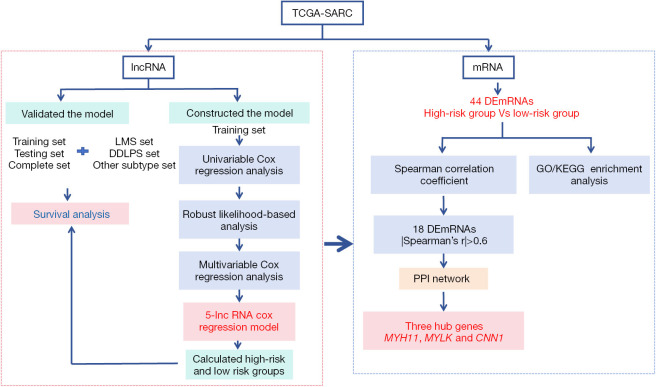
Methods: TCGA datasets, which included 259 samples, served as data sources in this study. Univariable Cox regression analysis, robust analysis, and multivariable Cox regression analysis were used to construct a 5-lncRNA signature Cox regression model. Then, based on the median risk score, high- and low-risk groups were identified. The Kaplan-Meier method was applied to survival analysis in the training set, testing set, complete set, and different pathological type sets. To explore the relationship between lncRNAs and messenger RNAs (mRNAs), differentially expressed mRNAs (DEmRNAs) between the high- and low-risk groups were identified. The function of DEmRNAs was predicted using Gene Ontology (GO) and Kyoto Encyclopedia of Genes and Genomes (KEGG) enrichment analyses. The relationships between the 5 lncRNAs and DEmRNAs were calculated using the Spearman correlation coefficient. A total of 18 DEmRNAs that showed a strong correlation with risk score (|Spearman's r|>0.6) in leiomyosarcoma (LMS) samples were identified, and a protein-protein interaction (PPI) network was built using the Search Tool for the Retrieval of Interacting Genes/Proteins (STRING) database.
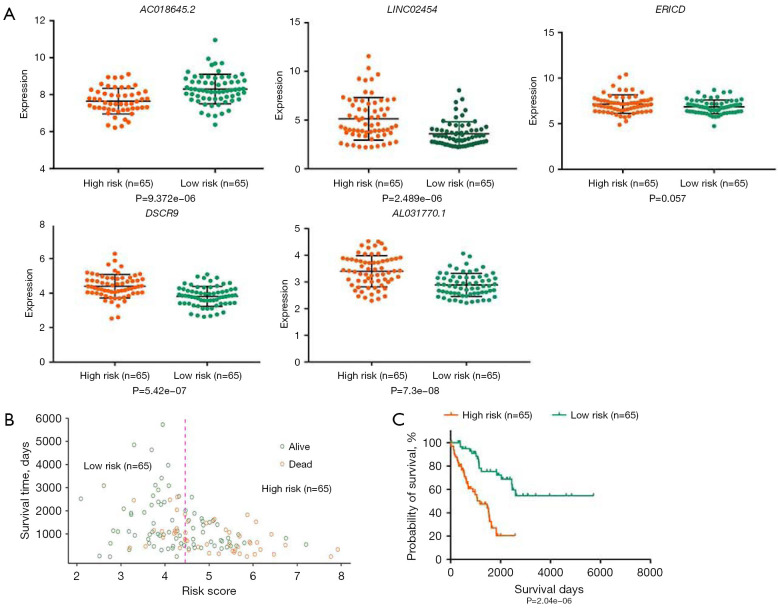
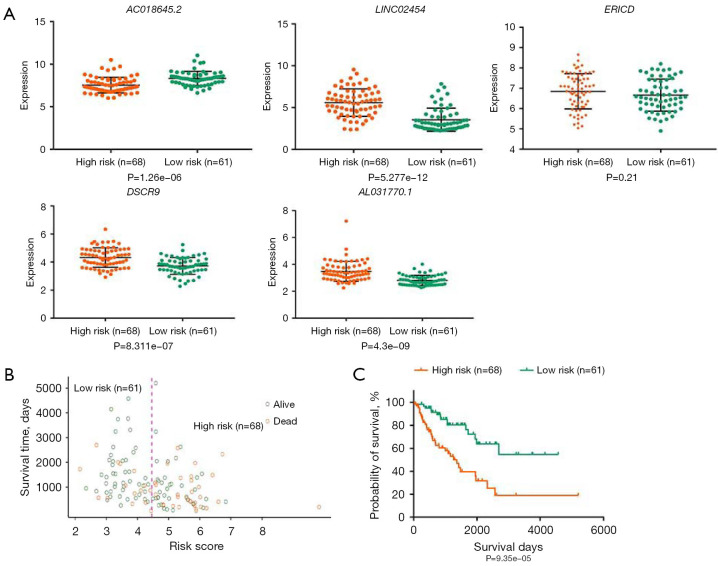
Results: A Cox regression model was built in this study with the risk score= (-0.5698*AC018645.2) + 0.1732*LINC02454 + 0.387*ERICD + 0.6262*DSCR9 + 0.9781*AL031770.1. The study found that this 5-lncRNA signature could predict prognosis well, especially in LMS, a subtype of SARC, with P value =1.19e-06 [hazard ratio (HR) 6.134, 95% confidence interval (CI): 2.951-12.752]. Additionally, 44 DEmRNAs were observed between the high- and low-risk groups, and the expression levels of DEmRNAs in LMS samples differed from other pathology types. The PPI network analysis revealed that MYH11, MYLK, and CNN1 were the most important hub genes among the 18 DEmRNAs, all of which are essential for muscle function.
Conclusions: In this study, a predictive clinical model for SARC was successfully established, showing better prediction accuracy in patients with LMS. Importantly, we identified MYH11, MYLK, and CNN1 as potential therapeutic targets for SARC.
期刊介绍:
Translational Cancer Research (Transl Cancer Res TCR; Print ISSN: 2218-676X; Online ISSN 2219-6803; http://tcr.amegroups.com/) is an Open Access, peer-reviewed journal, indexed in Science Citation Index Expanded (SCIE). TCR publishes laboratory studies of novel therapeutic interventions as well as clinical trials which evaluate new treatment paradigms for cancer; results of novel research investigations which bridge the laboratory and clinical settings including risk assessment, cellular and molecular characterization, prevention, detection, diagnosis and treatment of human cancers with the overall goal of improving the clinical care of cancer patients. The focus of TCR is original, peer-reviewed, science-based research that successfully advances clinical medicine toward the goal of improving patients'' quality of life. The editors and an international advisory group of scientists and clinician-scientists as well as other experts will hold TCR articles to the high-quality standards. We accept Original Articles as well as Review Articles, Editorials and Brief Articles.




 京公网安备 11010802042870号
京ICP备2023020795号-1
京公网安备 11010802042870号
京ICP备2023020795号-1

 分享
分享
 求助内容:
求助内容: 应助结果提醒方式:
 扫码关注我们
