{"title":"Association between surrogate indices of fatty liver and the risk of colorectal cancer: a cross-sectional United States study.","authors":"Chenyuan Shi, Chao Yuan, Yifei Hao, Zheng Zhou, Yigang Zhang","doi":"10.21037/tcr-24-1444","DOIUrl":null,"url":null,"abstract":"<p><strong>Background: </strong>The presence of fatty liver (FL) has been suggested to influence the incidence of colorectal cancer (CRC). This study aimed to evaluate the predictive utility of six alternative indices of FL-namely, liver fat percentage (PLF), lipid accumulation product (LAP), hepatic steatosis index (HSI), United States fatty liver index (USFLI), fatty liver index (FLI), and Zhejiang University index (ZJU)-in assessing the risk of CRC. We aimed to determine their effectiveness in predicting CRC risk by comparing these surrogate indices.</p><p><strong>Methods: </strong>Data for this study were derived from the National Health and Nutrition Examination Survey (NHANES) conducted between 2003 and 2018, focusing on adults over 20 years old. The six FLIs were calculated using established methodologies outlined in prior research. To identify key variables, the Boruta algorithm was employed. The relationships between FLIs and CRC risk were assessed using multivariable logistic regression, generalized linear models (GLMs), and restricted cubic spline (RCS) models. Additionally, subgroup analyses were performed to investigate the effects of potential confounders.</p><p><strong>Results: </strong>Among the 16,250 individuals surveyed, 96 were diagnosed with CRC. Those with CRC exhibited significantly higher levels of PLF (4.65 <i>vs.</i> 3.31, P=0.004), LAP (55.63 <i>vs.</i> 42.34, P=0.04), USFLI (23.22 <i>vs.</i> 17.83, P<0.001), and FLI (58.16 <i>vs.</i> 50.86, P=0.048) compared to individuals without CRC. Multivariate logistic regression and RCS analyses indicated that, of the six indices, only USFLI was significantly associated with an increased risk of CRC. Notably, further stratification of USFLI revealed that this association was consistently stronger in individuals aged over 65 years [odds ratio (OR) =1.023; 95% confidence interval (CI): 1.005-1.041; P=0.01] and among non-smokers (OR =1.018; 95% CI: 1.003-1.033; P=0.02) after adjusting for multiple confounders.</p><p><strong>Conclusions: </strong>The USFLI index demonstrated a more significant association with the risk of CRC compared to the other five alternative FLIs, highlighting its potential utility in predicting CRC risk in clinical settings.</p>","PeriodicalId":23216,"journal":{"name":"Translational cancer research","volume":"14 1","pages":"313-326"},"PeriodicalIF":1.7000,"publicationDate":"2025-01-31","publicationTypes":"Journal Article","fieldsOfStudy":null,"isOpenAccess":false,"openAccessPdf":"https://www.ncbi.nlm.nih.gov/pmc/articles/PMC11833385/pdf/","citationCount":"0","resultStr":null,"platform":"Semanticscholar","paperid":null,"PeriodicalName":"Translational cancer research","FirstCategoryId":"3","ListUrlMain":"https://doi.org/10.21037/tcr-24-1444","RegionNum":4,"RegionCategory":"医学","ArticlePicture":[],"TitleCN":null,"AbstractTextCN":null,"PMCID":null,"EPubDate":"2025/1/23 0:00:00","PubModel":"Epub","JCR":"Q4","JCRName":"ONCOLOGY","Score":null,"Total":0}
引用次数: 0
Abstract
Background: The presence of fatty liver (FL) has been suggested to influence the incidence of colorectal cancer (CRC). This study aimed to evaluate the predictive utility of six alternative indices of FL-namely, liver fat percentage (PLF), lipid accumulation product (LAP), hepatic steatosis index (HSI), United States fatty liver index (USFLI), fatty liver index (FLI), and Zhejiang University index (ZJU)-in assessing the risk of CRC. We aimed to determine their effectiveness in predicting CRC risk by comparing these surrogate indices.
Methods: Data for this study were derived from the National Health and Nutrition Examination Survey (NHANES) conducted between 2003 and 2018, focusing on adults over 20 years old. The six FLIs were calculated using established methodologies outlined in prior research. To identify key variables, the Boruta algorithm was employed. The relationships between FLIs and CRC risk were assessed using multivariable logistic regression, generalized linear models (GLMs), and restricted cubic spline (RCS) models. Additionally, subgroup analyses were performed to investigate the effects of potential confounders.
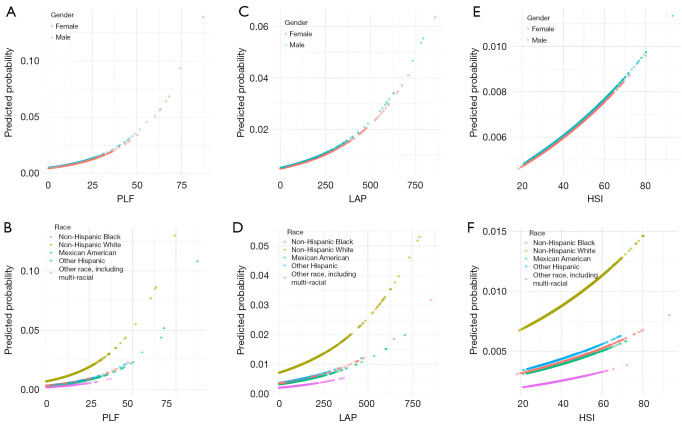
Results: Among the 16,250 individuals surveyed, 96 were diagnosed with CRC. Those with CRC exhibited significantly higher levels of PLF (4.65 vs. 3.31, P=0.004), LAP (55.63 vs. 42.34, P=0.04), USFLI (23.22 vs. 17.83, P<0.001), and FLI (58.16 vs. 50.86, P=0.048) compared to individuals without CRC. Multivariate logistic regression and RCS analyses indicated that, of the six indices, only USFLI was significantly associated with an increased risk of CRC. Notably, further stratification of USFLI revealed that this association was consistently stronger in individuals aged over 65 years [odds ratio (OR) =1.023; 95% confidence interval (CI): 1.005-1.041; P=0.01] and among non-smokers (OR =1.018; 95% CI: 1.003-1.033; P=0.02) after adjusting for multiple confounders.
Conclusions: The USFLI index demonstrated a more significant association with the risk of CRC compared to the other five alternative FLIs, highlighting its potential utility in predicting CRC risk in clinical settings.
期刊介绍:
Translational Cancer Research (Transl Cancer Res TCR; Print ISSN: 2218-676X; Online ISSN 2219-6803; http://tcr.amegroups.com/) is an Open Access, peer-reviewed journal, indexed in Science Citation Index Expanded (SCIE). TCR publishes laboratory studies of novel therapeutic interventions as well as clinical trials which evaluate new treatment paradigms for cancer; results of novel research investigations which bridge the laboratory and clinical settings including risk assessment, cellular and molecular characterization, prevention, detection, diagnosis and treatment of human cancers with the overall goal of improving the clinical care of cancer patients. The focus of TCR is original, peer-reviewed, science-based research that successfully advances clinical medicine toward the goal of improving patients'' quality of life. The editors and an international advisory group of scientists and clinician-scientists as well as other experts will hold TCR articles to the high-quality standards. We accept Original Articles as well as Review Articles, Editorials and Brief Articles.





 京公网安备 11010802042870号
京ICP备2023020795号-1
京公网安备 11010802042870号
京ICP备2023020795号-1

 分享
分享
 求助内容:
求助内容: 应助结果提醒方式:
 扫码关注我们
