Seth A Berkowitz, Aileen Ochoa, Myklynn LaPoint, Marlena L Kuhn, Jenine Dankovchik, Jenna M Donovan, Mufeng Gao, Sanjay Basu, Michael G Hudgens, Rachel Gold
{"title":"Transportation Barriers and Diabetes Outcomes: A Longitudinal Analysis.","authors":"Seth A Berkowitz, Aileen Ochoa, Myklynn LaPoint, Marlena L Kuhn, Jenine Dankovchik, Jenna M Donovan, Mufeng Gao, Sanjay Basu, Michael G Hudgens, Rachel Gold","doi":"10.1177/21501319251320709","DOIUrl":null,"url":null,"abstract":"<p><strong>Objective: </strong>To estimate associations between transportation barriers and diabetes outcomes.</p><p><strong>Methods: </strong>Longitudinal cohort study; 86 977 adults with type 2 diabetes mellitus in community-based health centers were assessed for transportation barriers, with up to 36 months of follow-up after initial assessment. We compared scenarios in which individuals did not experience transportation barriers to scenarios in which they did, to estimate differences in mean hemoglobin a1c (HbA1c), systolic and diastolic blood pressure (SBP and DBP), and LDL cholesterol. For analysis, we used targeted minimum loss estimation at the following timepoints after initial transportation barrier assessment: 12 (primary), 6, 18, 24, 30, and 36 months. The study period was June 24, 2016 to April 30, 2023.</p><p><strong>Results: </strong>We estimated that if participants did not experience transportation barriers, mean HbA1c would have been 0.09% lower (95% CI = -0.14% to -0.04%, <i>P</i> = .0002) at 12 months, compared to a scenario in which they did experience transportation barriers. These results were similar at other time points. We also estimated that absence of transportation barriers was associated with, at 12 months, lower SBP (-0.6mm Hg, 95% CI = -1.0mm Hg to -0.2mm Hg, <i>P</i> = .004) and DBP (-0.3mm Hg, 95% CI = -0.5mm Hg to -0.1mm Hg, <i>P</i> = .02), but not LDL (-1.1mg/dL, 95% CI = -2.6 mg/dL to 0.5 mg/dL, <i>P</i> = .19). Results at other time points for SBP, DBP, and LDL outcomes were similar.</p><p><strong>Conclusions: </strong>Absence of transportation barriers was associated with slightly lower hemoglobin A1c and blood pressure, but the small magnitude of the differences suggests that also addressing other factors may be needed to improve diabetes outcomes more meaningfully.</p>","PeriodicalId":46723,"journal":{"name":"Journal of Primary Care and Community Health","volume":"16 ","pages":"21501319251320709"},"PeriodicalIF":2.5000,"publicationDate":"2025-01-01","publicationTypes":"Journal Article","fieldsOfStudy":null,"isOpenAccess":false,"openAccessPdf":"https://www.ncbi.nlm.nih.gov/pmc/articles/PMC11840852/pdf/","citationCount":"0","resultStr":null,"platform":"Semanticscholar","paperid":null,"PeriodicalName":"Journal of Primary Care and Community Health","FirstCategoryId":"1085","ListUrlMain":"https://doi.org/10.1177/21501319251320709","RegionNum":0,"RegionCategory":null,"ArticlePicture":[],"TitleCN":null,"AbstractTextCN":null,"PMCID":null,"EPubDate":"","PubModel":"","JCR":"Q1","JCRName":"PRIMARY HEALTH CARE","Score":null,"Total":0}
引用次数: 0
Abstract
Objective: To estimate associations between transportation barriers and diabetes outcomes.
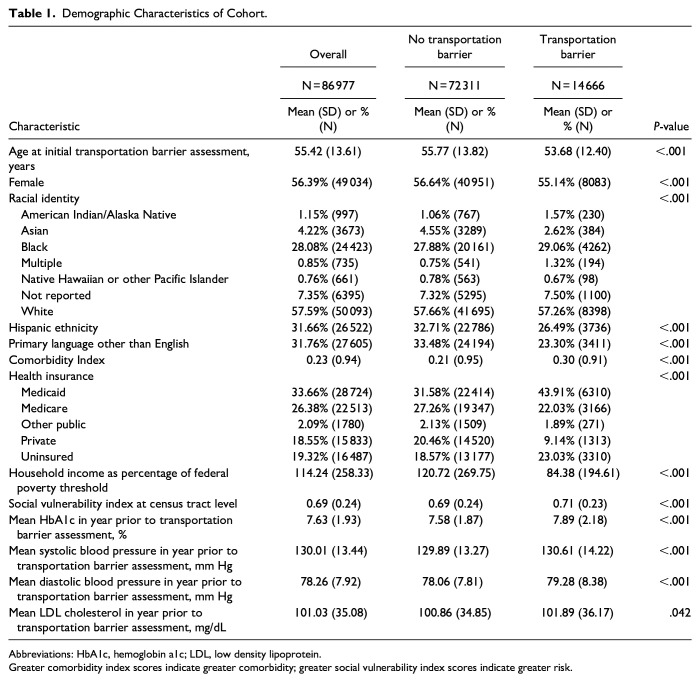
Methods: Longitudinal cohort study; 86 977 adults with type 2 diabetes mellitus in community-based health centers were assessed for transportation barriers, with up to 36 months of follow-up after initial assessment. We compared scenarios in which individuals did not experience transportation barriers to scenarios in which they did, to estimate differences in mean hemoglobin a1c (HbA1c), systolic and diastolic blood pressure (SBP and DBP), and LDL cholesterol. For analysis, we used targeted minimum loss estimation at the following timepoints after initial transportation barrier assessment: 12 (primary), 6, 18, 24, 30, and 36 months. The study period was June 24, 2016 to April 30, 2023.
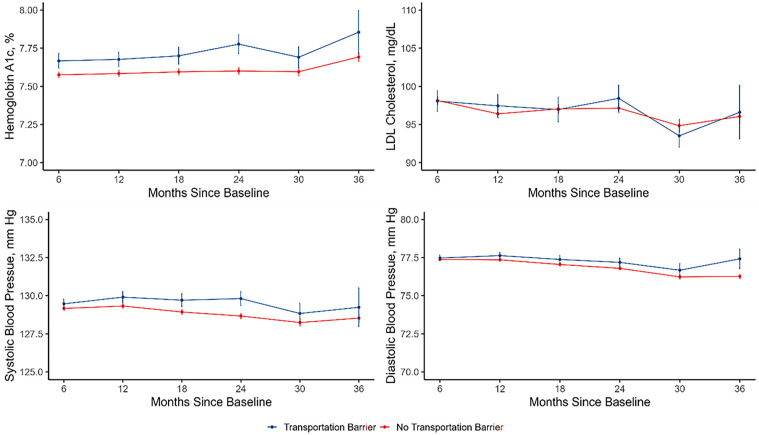
Results: We estimated that if participants did not experience transportation barriers, mean HbA1c would have been 0.09% lower (95% CI = -0.14% to -0.04%, P = .0002) at 12 months, compared to a scenario in which they did experience transportation barriers. These results were similar at other time points. We also estimated that absence of transportation barriers was associated with, at 12 months, lower SBP (-0.6mm Hg, 95% CI = -1.0mm Hg to -0.2mm Hg, P = .004) and DBP (-0.3mm Hg, 95% CI = -0.5mm Hg to -0.1mm Hg, P = .02), but not LDL (-1.1mg/dL, 95% CI = -2.6 mg/dL to 0.5 mg/dL, P = .19). Results at other time points for SBP, DBP, and LDL outcomes were similar.
Conclusions: Absence of transportation barriers was associated with slightly lower hemoglobin A1c and blood pressure, but the small magnitude of the differences suggests that also addressing other factors may be needed to improve diabetes outcomes more meaningfully.






 京公网安备 11010802042870号
京ICP备2023020795号-1
京公网安备 11010802042870号
京ICP备2023020795号-1

 分享
分享
 求助内容:
求助内容: 应助结果提醒方式:
 扫码关注我们
