Maria Grazia Ronga, Flavia Gesualdi, Anthony Bonfrate, Annalisa Patriarca, Régis Ferrand, Gilles Créhange, Irène Buvat, Ludovic De Marzi
{"title":"Comparison of secondary radiation dose between pencil beam scanning and scattered delivery for proton and VHEE radiotherapy","authors":"Maria Grazia Ronga, Flavia Gesualdi, Anthony Bonfrate, Annalisa Patriarca, Régis Ferrand, Gilles Créhange, Irène Buvat, Ludovic De Marzi","doi":"10.1002/mp.17700","DOIUrl":null,"url":null,"abstract":"<div>\n \n \n <section>\n \n <h3> Background</h3>\n \n <p>Very high-energy electrons (VHEEs) in radiotherapy may offer several potential advantages over conventional electron beams and other techniques, for example, the fact that they can be used at ultra-high dose rates (UHDRs), therefore enabling FLASH radiotherapy. However, the production of secondary particles at high energies (50–200 MeV) has yet to be studied in detail for this technique currently under development.</p>\n </section>\n \n <section>\n \n <h3> Purpose</h3>\n \n <p>The aim of this work was to examine the secondary dose produced by VHEEs, with particular emphasis on bremsstrahlung photons and neutrons, for two beam delivery systems (double scattering [DS] and pencil beam scanning [PBS]).</p>\n </section>\n \n <section>\n \n <h3> Methods</h3>\n \n <p>The electron, X-ray, and neutron doses arising from two beam delivery systems (DS or PBS) were computed using Monte Carlo (MC) simulations in the TOPAS (TOol for PArticle Simulation)/Geant4 toolkit, and a preliminary assessment of the secondary dose for a clinical VHEE treatment was performed using a whole-body phantom. An evaluation of the secondary dose produced by this preliminary design of a VHEE nozzle set in a clinical proton facility was performed, taking into account realistic PBS or DS nozzle configurations.</p>\n </section>\n \n <section>\n \n <h3> Results</h3>\n \n <p>The mean doses received by a patient undergoing DS-VHEE irradiation were found to be up to 5.3-fold and 6.8-fold higher for in-field or out-of-field organs for photons and neutrons, respectively, compared to the PBS-VHEE plan. The results for the secondary neutron dose in intracranial treatments also demonstrate the characteristic of VHEE compared to proton beams for reducing the out-of-field secondary neutron dose. The dose to the public area that could be delivered to meet regulatory limits surrounding a possible treatment room in a proton therapy facility was assessed. A regulatory limit of 0.5 µSv/h would give a restriction of 49 and 83 Gy per patient and per fraction for DS and PBS, respectively.</p>\n </section>\n \n <section>\n \n <h3> Conclusions</h3>\n \n <p>This work describes a method to simulate and compare secondary radiation doses resulting from scattered, scanned VHEE or proton therapy treatments. The results indicate that a conventionally shielded proton therapy room results in acceptable public doses for a preliminary VHEE design and could be of interest for radiation protection purposes and for similar setups. Other facilities with differing layouts may, however, lead to different conclusions, requiring further studies.</p>\n </section>\n </div>","PeriodicalId":18384,"journal":{"name":"Medical physics","volume":"52 6","pages":"4775-4784"},"PeriodicalIF":3.2000,"publicationDate":"2025-02-19","publicationTypes":"Journal Article","fieldsOfStudy":null,"isOpenAccess":false,"openAccessPdf":"https://onlinelibrary.wiley.com/doi/epdf/10.1002/mp.17700","citationCount":"0","resultStr":null,"platform":"Semanticscholar","paperid":null,"PeriodicalName":"Medical physics","FirstCategoryId":"3","ListUrlMain":"https://aapm.onlinelibrary.wiley.com/doi/10.1002/mp.17700","RegionNum":2,"RegionCategory":"医学","ArticlePicture":[],"TitleCN":null,"AbstractTextCN":null,"PMCID":null,"EPubDate":"","PubModel":"","JCR":"Q1","JCRName":"RADIOLOGY, NUCLEAR MEDICINE & MEDICAL IMAGING","Score":null,"Total":0}
引用次数: 0
Abstract
Background
Very high-energy electrons (VHEEs) in radiotherapy may offer several potential advantages over conventional electron beams and other techniques, for example, the fact that they can be used at ultra-high dose rates (UHDRs), therefore enabling FLASH radiotherapy. However, the production of secondary particles at high energies (50–200 MeV) has yet to be studied in detail for this technique currently under development.
Purpose
The aim of this work was to examine the secondary dose produced by VHEEs, with particular emphasis on bremsstrahlung photons and neutrons, for two beam delivery systems (double scattering [DS] and pencil beam scanning [PBS]).
Methods
The electron, X-ray, and neutron doses arising from two beam delivery systems (DS or PBS) were computed using Monte Carlo (MC) simulations in the TOPAS (TOol for PArticle Simulation)/Geant4 toolkit, and a preliminary assessment of the secondary dose for a clinical VHEE treatment was performed using a whole-body phantom. An evaluation of the secondary dose produced by this preliminary design of a VHEE nozzle set in a clinical proton facility was performed, taking into account realistic PBS or DS nozzle configurations.
Results
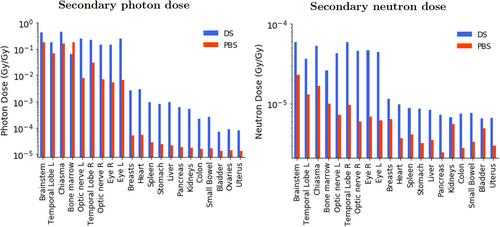
The mean doses received by a patient undergoing DS-VHEE irradiation were found to be up to 5.3-fold and 6.8-fold higher for in-field or out-of-field organs for photons and neutrons, respectively, compared to the PBS-VHEE plan. The results for the secondary neutron dose in intracranial treatments also demonstrate the characteristic of VHEE compared to proton beams for reducing the out-of-field secondary neutron dose. The dose to the public area that could be delivered to meet regulatory limits surrounding a possible treatment room in a proton therapy facility was assessed. A regulatory limit of 0.5 µSv/h would give a restriction of 49 and 83 Gy per patient and per fraction for DS and PBS, respectively.
Conclusions
This work describes a method to simulate and compare secondary radiation doses resulting from scattered, scanned VHEE or proton therapy treatments. The results indicate that a conventionally shielded proton therapy room results in acceptable public doses for a preliminary VHEE design and could be of interest for radiation protection purposes and for similar setups. Other facilities with differing layouts may, however, lead to different conclusions, requiring further studies.
期刊介绍:
Medical Physics publishes original, high impact physics, imaging science, and engineering research that advances patient diagnosis and therapy through contributions in 1) Basic science developments with high potential for clinical translation 2) Clinical applications of cutting edge engineering and physics innovations 3) Broadly applicable and innovative clinical physics developments
Medical Physics is a journal of global scope and reach. By publishing in Medical Physics your research will reach an international, multidisciplinary audience including practicing medical physicists as well as physics- and engineering based translational scientists. We work closely with authors of promising articles to improve their quality.