Camilla Di Mino, Thomas F. Headen, Nadir S. Basma, David J. Buckley, Patrick L. Cullen, Martin C. Wilding, Milo S. P. Shaffer, Neal T. Skipper, Adam J. Clancy, Christopher A. Howard
{"title":"Intermediate-range solvent templating and counterion behaviour at charged carbon nanotube surfaces","authors":"Camilla Di Mino, Thomas F. Headen, Nadir S. Basma, David J. Buckley, Patrick L. Cullen, Martin C. Wilding, Milo S. P. Shaffer, Neal T. Skipper, Adam J. Clancy, Christopher A. Howard","doi":"10.1038/s41565-025-01865-9","DOIUrl":null,"url":null,"abstract":"The ordering of ions and solvent molecules around nanostructures is of profound fundamental importance, from understanding biological processes to the manipulation of nanomaterials to optimizing electrochemical devices. Classical models commonly used to describe these systems treat the solvent simplistically, an approach that endures, in part, due to the extreme difficulty of attaining experimental measurements that challenge this approximation. Here we perform total neutron scattering experiments on model systems—concentrated amide solutions of negatively charged carbon nanotubes and sodium counterions—and measure remarkably complex intermediate-range molecular solvent ordering. The charged surface orders the solvents up to ∼40 Å, even beyond its dense concentric solvation shells. Notably, the molecular orientation of solvent in direct contact with the nanotube surface itself is distinct, lying near-parallel and not interacting with desolvated sodium counterions. In contrast, beyond this layer the ordering of solvent is perpendicular to the surface. Our results underscore the critical importance of multibody interactions in solvated nanoscale systems and charged surfaces, highlighting competing ion/surface solvation effects. Neutron scattering on a model system of highly concentrated solutions of charged carbon nanotubes reveals a strong solvent ordering up to ∼40 Å around the charged nanoscale surface.","PeriodicalId":18915,"journal":{"name":"Nature nanotechnology","volume":"20 5","pages":"639-645"},"PeriodicalIF":34.9000,"publicationDate":"2025-02-21","publicationTypes":"Journal Article","fieldsOfStudy":null,"isOpenAccess":false,"openAccessPdf":"https://www.nature.comhttps://www.nature.com/articles/s41565-025-01865-9.pdf","citationCount":"0","resultStr":null,"platform":"Semanticscholar","paperid":null,"PeriodicalName":"Nature nanotechnology","FirstCategoryId":"88","ListUrlMain":"https://www.nature.com/articles/s41565-025-01865-9","RegionNum":1,"RegionCategory":"材料科学","ArticlePicture":[],"TitleCN":null,"AbstractTextCN":null,"PMCID":null,"EPubDate":"","PubModel":"","JCR":"Q1","JCRName":"MATERIALS SCIENCE, MULTIDISCIPLINARY","Score":null,"Total":0}
引用次数: 0
Abstract
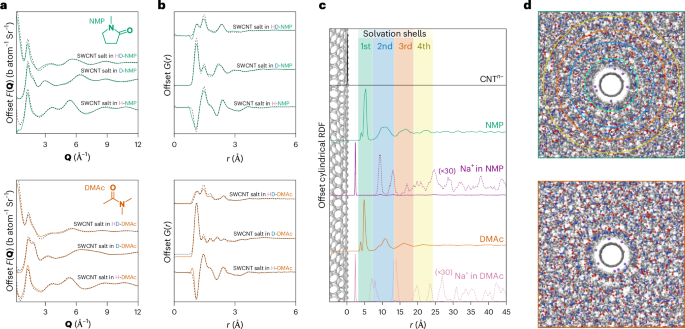
The ordering of ions and solvent molecules around nanostructures is of profound fundamental importance, from understanding biological processes to the manipulation of nanomaterials to optimizing electrochemical devices. Classical models commonly used to describe these systems treat the solvent simplistically, an approach that endures, in part, due to the extreme difficulty of attaining experimental measurements that challenge this approximation. Here we perform total neutron scattering experiments on model systems—concentrated amide solutions of negatively charged carbon nanotubes and sodium counterions—and measure remarkably complex intermediate-range molecular solvent ordering. The charged surface orders the solvents up to ∼40 Å, even beyond its dense concentric solvation shells. Notably, the molecular orientation of solvent in direct contact with the nanotube surface itself is distinct, lying near-parallel and not interacting with desolvated sodium counterions. In contrast, beyond this layer the ordering of solvent is perpendicular to the surface. Our results underscore the critical importance of multibody interactions in solvated nanoscale systems and charged surfaces, highlighting competing ion/surface solvation effects. Neutron scattering on a model system of highly concentrated solutions of charged carbon nanotubes reveals a strong solvent ordering up to ∼40 Å around the charged nanoscale surface.
期刊介绍:
Nature Nanotechnology is a prestigious journal that publishes high-quality papers in various areas of nanoscience and nanotechnology. The journal focuses on the design, characterization, and production of structures, devices, and systems that manipulate and control materials at atomic, molecular, and macromolecular scales. It encompasses both bottom-up and top-down approaches, as well as their combinations.
Furthermore, Nature Nanotechnology fosters the exchange of ideas among researchers from diverse disciplines such as chemistry, physics, material science, biomedical research, engineering, and more. It promotes collaboration at the forefront of this multidisciplinary field. The journal covers a wide range of topics, from fundamental research in physics, chemistry, and biology, including computational work and simulations, to the development of innovative devices and technologies for various industrial sectors such as information technology, medicine, manufacturing, high-performance materials, energy, and environmental technologies. It includes coverage of organic, inorganic, and hybrid materials.




 京公网安备 11010802042870号
京ICP备2023020795号-1
京公网安备 11010802042870号
京ICP备2023020795号-1

 分享
分享
 求助内容:
求助内容: 应助结果提醒方式:
 扫码关注我们
