{"title":"Bioinspired Materials for Controlling Mineral Adhesion: From Innovation Design to Diverse Applications","authors":"Wei Chen, Jingxin Meng, Shutao Wang","doi":"10.1021/acsnano.4c16946","DOIUrl":null,"url":null,"abstract":"The advancement of controllable mineral adhesion materials has significantly impacted various sectors, including industrial production, energy utilization, biomedicine, construction engineering, food safety, and environmental management. Natural biological materials exhibit distinctive and controllable adhesion properties that inspire the design of artificial systems for controlling mineral adhesion. In recent decades, researchers have sought to create bioinspired materials that effectively regulate mineral adhesion, significantly accelerating the development of functional materials across various emerging fields. Herein, we review recent advances in bioinspired materials for controlling mineral adhesion, including bioinspired mineralized materials and bioinspired antiscaling materials. First, a systematic overview of biological materials that exhibit controllable mineral adhesion in nature is provided. Then, the mechanism of mineral adhesion and the latest adhesion characterization between minerals and material surfaces are introduced. Later, the latest advances in bioinspired materials designed for controlling mineral adhesion are presented, ranging from the molecular level to micro/nanostructures, including bioinspired mineralized materials and bioinspired antiscaling materials. Additionally, recent applications of these bioinspired materials in emerging fields are discussed, such as industrial production, energy utilization, biomedicine, construction engineering, and environmental management, highlighting their roles in promoting or inhibiting aspects. Finally, we summarize the ongoing challenges and offer a perspective on the future of this charming field.","PeriodicalId":21,"journal":{"name":"ACS Nano","volume":"50 1","pages":""},"PeriodicalIF":16.0000,"publicationDate":"2025-02-20","publicationTypes":"Journal Article","fieldsOfStudy":null,"isOpenAccess":false,"openAccessPdf":"","citationCount":"0","resultStr":null,"platform":"Semanticscholar","paperid":null,"PeriodicalName":"ACS Nano","FirstCategoryId":"88","ListUrlMain":"https://doi.org/10.1021/acsnano.4c16946","RegionNum":1,"RegionCategory":"材料科学","ArticlePicture":[],"TitleCN":null,"AbstractTextCN":null,"PMCID":null,"EPubDate":"","PubModel":"","JCR":"Q1","JCRName":"CHEMISTRY, MULTIDISCIPLINARY","Score":null,"Total":0}
引用次数: 0
Abstract
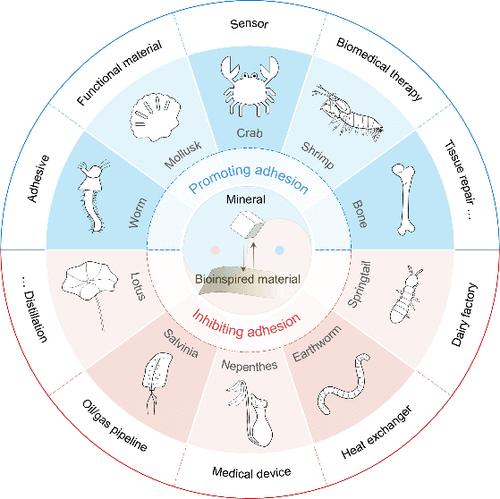
The advancement of controllable mineral adhesion materials has significantly impacted various sectors, including industrial production, energy utilization, biomedicine, construction engineering, food safety, and environmental management. Natural biological materials exhibit distinctive and controllable adhesion properties that inspire the design of artificial systems for controlling mineral adhesion. In recent decades, researchers have sought to create bioinspired materials that effectively regulate mineral adhesion, significantly accelerating the development of functional materials across various emerging fields. Herein, we review recent advances in bioinspired materials for controlling mineral adhesion, including bioinspired mineralized materials and bioinspired antiscaling materials. First, a systematic overview of biological materials that exhibit controllable mineral adhesion in nature is provided. Then, the mechanism of mineral adhesion and the latest adhesion characterization between minerals and material surfaces are introduced. Later, the latest advances in bioinspired materials designed for controlling mineral adhesion are presented, ranging from the molecular level to micro/nanostructures, including bioinspired mineralized materials and bioinspired antiscaling materials. Additionally, recent applications of these bioinspired materials in emerging fields are discussed, such as industrial production, energy utilization, biomedicine, construction engineering, and environmental management, highlighting their roles in promoting or inhibiting aspects. Finally, we summarize the ongoing challenges and offer a perspective on the future of this charming field.
期刊介绍:
ACS Nano, published monthly, serves as an international forum for comprehensive articles on nanoscience and nanotechnology research at the intersections of chemistry, biology, materials science, physics, and engineering. The journal fosters communication among scientists in these communities, facilitating collaboration, new research opportunities, and advancements through discoveries. ACS Nano covers synthesis, assembly, characterization, theory, and simulation of nanostructures, nanobiotechnology, nanofabrication, methods and tools for nanoscience and nanotechnology, and self- and directed-assembly. Alongside original research articles, it offers thorough reviews, perspectives on cutting-edge research, and discussions envisioning the future of nanoscience and nanotechnology.



 京公网安备 11010802042870号
京ICP备2023020795号-1
京公网安备 11010802042870号
京ICP备2023020795号-1

 分享
分享
 求助内容:
求助内容: 应助结果提醒方式:
 扫码关注我们
