{"title":"Caloric restriction prevents inheritance of polycystic ovary syndrome through oocyte-mediated DNA methylation reprogramming","authors":"Yue Liu, Yi Dong, Yonghui Jiang, Shan Han, Xin Liu, Xin Xu, Aiqing Zhu, Zihe Zhao, Yuan Gao, Yang Zou, Chuanxin Zhang, Yuehong Bian, Yuqing Zhang, Jiang Liu, Shigang Zhao, Han Zhao, Zi-Jiang Chen","doi":"10.1016/j.cmet.2025.01.014","DOIUrl":null,"url":null,"abstract":"Polycystic ovary syndrome (PCOS) is a prevalent metabolic and reproductive endocrine disorder with strong heritability. However, the independent role of oocytes in mediating this heritability remains unclear. Utilizing <em>in vitro</em> fertilization-embryo transfer and surrogacy, we demonstrated that oocytes from androgen-exposed mice (F1) transmitted PCOS-like traits to F2 and F3 generations. Notably, caloric restriction (CR) in F1 or F2 effectively prevented this transmission by restoring disrupted DNA methylation in oocyte genes related to insulin secretion and AMPK signaling pathways. Further detection in adult tissues of offspring revealed dysregulated DNA methylation and expression of those genes (e.g., <em>Adcy3</em>, <em>Gnas</em>, and <em>Srebf1</em>) were reversed by maternal CR. Moreover, similar benefits of CR were observed in aberrant embryonic methylome of women with PCOS. These findings elucidate the essential role of CR in preventing PCOS transmission via methylation reprogramming, emphasizing the importance of preconception metabolic management for women with PCOS.","PeriodicalId":9840,"journal":{"name":"Cell metabolism","volume":"25 1","pages":""},"PeriodicalIF":30.9000,"publicationDate":"2025-02-21","publicationTypes":"Journal Article","fieldsOfStudy":null,"isOpenAccess":false,"openAccessPdf":"","citationCount":"0","resultStr":null,"platform":"Semanticscholar","paperid":null,"PeriodicalName":"Cell metabolism","FirstCategoryId":"99","ListUrlMain":"https://doi.org/10.1016/j.cmet.2025.01.014","RegionNum":1,"RegionCategory":"生物学","ArticlePicture":[],"TitleCN":null,"AbstractTextCN":null,"PMCID":null,"EPubDate":"","PubModel":"","JCR":"Q1","JCRName":"CELL BIOLOGY","Score":null,"Total":0}
引用次数: 0
Abstract
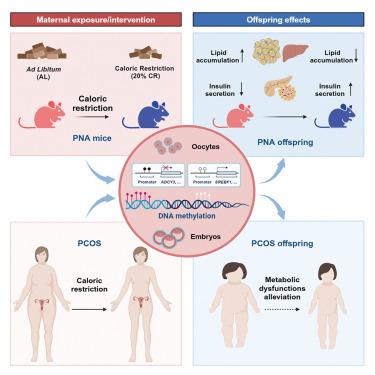
Polycystic ovary syndrome (PCOS) is a prevalent metabolic and reproductive endocrine disorder with strong heritability. However, the independent role of oocytes in mediating this heritability remains unclear. Utilizing in vitro fertilization-embryo transfer and surrogacy, we demonstrated that oocytes from androgen-exposed mice (F1) transmitted PCOS-like traits to F2 and F3 generations. Notably, caloric restriction (CR) in F1 or F2 effectively prevented this transmission by restoring disrupted DNA methylation in oocyte genes related to insulin secretion and AMPK signaling pathways. Further detection in adult tissues of offspring revealed dysregulated DNA methylation and expression of those genes (e.g., Adcy3, Gnas, and Srebf1) were reversed by maternal CR. Moreover, similar benefits of CR were observed in aberrant embryonic methylome of women with PCOS. These findings elucidate the essential role of CR in preventing PCOS transmission via methylation reprogramming, emphasizing the importance of preconception metabolic management for women with PCOS.
期刊介绍:
Cell Metabolism is a top research journal established in 2005 that focuses on publishing original and impactful papers in the field of metabolic research.It covers a wide range of topics including diabetes, obesity, cardiovascular biology, aging and stress responses, circadian biology, and many others.
Cell Metabolism aims to contribute to the advancement of metabolic research by providing a platform for the publication and dissemination of high-quality research and thought-provoking articles.




 京公网安备 11010802042870号
京ICP备2023020795号-1
京公网安备 11010802042870号
京ICP备2023020795号-1

 分享
分享
 求助内容:
求助内容: 应助结果提醒方式:
 扫码关注我们
