Xiaoyi Qi , Siyu Xu , Ling Zhang , Qianqian Cao , Longquan Zhang , Xiaoguo Shi , Yawei Gu , Chen Wang
{"title":"NiFe2O4@MoS2 heterojunction induces the changes of PMS activation mode in PMS/Vis system for the directed generation of 1O2","authors":"Xiaoyi Qi , Siyu Xu , Ling Zhang , Qianqian Cao , Longquan Zhang , Xiaoguo Shi , Yawei Gu , Chen Wang","doi":"10.1016/j.seppur.2025.132175","DOIUrl":null,"url":null,"abstract":"<div><div>Peroxymonosulfate-based advanced oxidation is a promising approach for water treatment, but how to simply achieve the efficient PMS activation is still a great challenge. In this study, NiFe<sub>2</sub>O<sub>4</sub>@MoS<sub>2</sub> heterojunction was synthesized via hydrothermal method to achieve rapid degradation of sulfadiazine (SDZ) in the synergistic PMS/Visible light photocatalysis system (PMS/Vis). Almost complete elimination of sulfadiazine (SDZ) can be accomplished in 8 min (k<sub>obs</sub> of 0.4038 min<sup>−1</sup>), and forming a synergistic SDZ degradation mechanism including a predominant non-radical pathway (<sup>1</sup>O<sub>2</sub>) and complementary radical pathway (⋅O<sub>2</sub><sup>–</sup>). The special heterojunction structure of NiFe<sub>2</sub>O<sub>4</sub>@MoS<sub>2</sub> could induce the directional separation of photogenerated carriers under visible light. Unlike the conventional transition metal-activated PMS process, the photogenerated electron-hole pairs of NiFe<sub>2</sub>O<sub>4</sub>@MoS<sub>2</sub> could serve as ceaseless PMS activator for ROS generation. The photocatalytic-assisted PMS system (PMS/Vis system) simultaneously solves the problems of variable metal cycling and ion solubilization in the traditional transition metal-activated PMS process, and enhances the material stability. LC-MS analysis identifies products and degradation pathways during SDZ reactions. Ecotoxicity assessment and total organic carbon results confirmed the degradation and mineralization of SDZ. This study shed light on the understanding of innovative heterostructured photocatalysts for enhanced PMS oxidation processes.</div></div>","PeriodicalId":427,"journal":{"name":"Separation and Purification Technology","volume":"363 ","pages":"Article 132175"},"PeriodicalIF":9.0000,"publicationDate":"2025-08-14","publicationTypes":"Journal Article","fieldsOfStudy":null,"isOpenAccess":false,"openAccessPdf":"","citationCount":"0","resultStr":null,"platform":"Semanticscholar","paperid":null,"PeriodicalName":"Separation and Purification Technology","FirstCategoryId":"5","ListUrlMain":"https://www.sciencedirect.com/science/article/pii/S1383586625007725","RegionNum":1,"RegionCategory":"工程技术","ArticlePicture":[],"TitleCN":null,"AbstractTextCN":null,"PMCID":null,"EPubDate":"2025/2/20 0:00:00","PubModel":"Epub","JCR":"Q1","JCRName":"ENGINEERING, CHEMICAL","Score":null,"Total":0}
引用次数: 0
Abstract
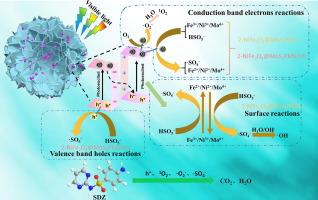
Peroxymonosulfate-based advanced oxidation is a promising approach for water treatment, but how to simply achieve the efficient PMS activation is still a great challenge. In this study, NiFe2O4@MoS2 heterojunction was synthesized via hydrothermal method to achieve rapid degradation of sulfadiazine (SDZ) in the synergistic PMS/Visible light photocatalysis system (PMS/Vis). Almost complete elimination of sulfadiazine (SDZ) can be accomplished in 8 min (kobs of 0.4038 min−1), and forming a synergistic SDZ degradation mechanism including a predominant non-radical pathway (1O2) and complementary radical pathway (⋅O2–). The special heterojunction structure of NiFe2O4@MoS2 could induce the directional separation of photogenerated carriers under visible light. Unlike the conventional transition metal-activated PMS process, the photogenerated electron-hole pairs of NiFe2O4@MoS2 could serve as ceaseless PMS activator for ROS generation. The photocatalytic-assisted PMS system (PMS/Vis system) simultaneously solves the problems of variable metal cycling and ion solubilization in the traditional transition metal-activated PMS process, and enhances the material stability. LC-MS analysis identifies products and degradation pathways during SDZ reactions. Ecotoxicity assessment and total organic carbon results confirmed the degradation and mineralization of SDZ. This study shed light on the understanding of innovative heterostructured photocatalysts for enhanced PMS oxidation processes.
基于过氧单硫酸盐的深度氧化是一种很有前途的水处理方法,但如何简单高效地实现PMS活化仍然是一个很大的挑战。本研究通过水热法合成NiFe2O4@MoS2异质结,在PMS/可见光协同催化体系(PMS/Vis)中实现磺胺嘧啶(SDZ)的快速降解。磺胺嘧啶(SDZ)在8 min (kobs为0.4038 min−1)内几乎完全降解,形成了以非自由基途径(1O2)为主、自由基途径(⋅O2 -)互补的SDZ协同降解机制。NiFe2O4@MoS2特殊的异质结结构可以诱导光生载流子在可见光下的定向分离。与传统的过渡金属激活的PMS工艺不同,NiFe2O4@MoS2光生成的电子-空穴对可以作为不断生成ROS的PMS激活剂。光催化辅助PMS系统(PMS/Vis系统)同时解决了传统过渡金属活化PMS工艺中可变金属循环和离子增溶的问题,提高了材料的稳定性。LC-MS分析确定了SDZ反应的产物和降解途径。生态毒性评价和总有机碳结果证实了SDZ的降解和矿化作用。本研究揭示了新型异质结构光催化剂在PMS氧化过程中的应用。
期刊介绍:
Separation and Purification Technology is a premier journal committed to sharing innovative methods for separation and purification in chemical and environmental engineering, encompassing both homogeneous solutions and heterogeneous mixtures. Our scope includes the separation and/or purification of liquids, vapors, and gases, as well as carbon capture and separation techniques. However, it's important to note that methods solely intended for analytical purposes are not within the scope of the journal. Additionally, disciplines such as soil science, polymer science, and metallurgy fall outside the purview of Separation and Purification Technology. Join us in advancing the field of separation and purification methods for sustainable solutions in chemical and environmental engineering.




 京公网安备 11010802042870号
京ICP备2023020795号-1
京公网安备 11010802042870号
京ICP备2023020795号-1

 分享
分享
 求助内容:
求助内容: 应助结果提醒方式:
 扫码关注我们
