Jianbin Li , Xi Xi , Shike Li , Sixing Wu , Ting Qiao
{"title":"DPP-GAN: A decentralized and privacy-preserving GAN system for collaborative smart meter data generation","authors":"Jianbin Li , Xi Xi , Shike Li , Sixing Wu , Ting Qiao","doi":"10.1016/j.enbuild.2025.115489","DOIUrl":null,"url":null,"abstract":"<div><div>Energy demand management, especially energy consumption analysis, is crucial for rational energy allocation and monitoring consumption behaviors. Data privacy and regulatory issues limit the sharing of smart meter data among power companies, challenging the acquisition of sufficient training data. Generating synthetic data through generative adversarial networks (GANs) offers an effective alternative to sharing and using real data. However, the limited quantity and diversity of data samples hinder power companies from independently training well-performing GAN models. To solve the above problems, this paper proposes DPP-GAN, a distributed and privacy-preserving GAN system for collaborative smart meter data generation. Specifically, DPP-GAN aggregates dispersed resources through federated learning (FL) to enrich the global GAN model, generating usable data without actual data transmission. Meanwhile, considering the security risks FL faces, such as single point of failure and poisoning attacks, blockchain is employed to store and share local training models in a decentralized manner. It also performs validity verification and aggregation operations through the consensus algorithm to ensure secure joint learning. In addition, a new adaptive weighted model aggregation method and an incentive mechanism are presented to aggregate and reward with reference to local model contributions, enhancing the performance of the global generative model. Simulation results on real-world datasets demonstrate that DPP-GAN maintains high model generation performance while ensuring data privacy and overall security. The generated smart meter data effectively captures the temporal and periodic characteristics of real data, providing essential data support for research and applications in efficient energy management of smart grids.</div></div>","PeriodicalId":11641,"journal":{"name":"Energy and Buildings","volume":"333 ","pages":"Article 115489"},"PeriodicalIF":7.1000,"publicationDate":"2025-02-19","publicationTypes":"Journal Article","fieldsOfStudy":null,"isOpenAccess":false,"openAccessPdf":"","citationCount":"0","resultStr":null,"platform":"Semanticscholar","paperid":null,"PeriodicalName":"Energy and Buildings","FirstCategoryId":"5","ListUrlMain":"https://www.sciencedirect.com/science/article/pii/S0378778825002191","RegionNum":2,"RegionCategory":"工程技术","ArticlePicture":[],"TitleCN":null,"AbstractTextCN":null,"PMCID":null,"EPubDate":"","PubModel":"","JCR":"Q1","JCRName":"CONSTRUCTION & BUILDING TECHNOLOGY","Score":null,"Total":0}
引用次数: 0
Abstract
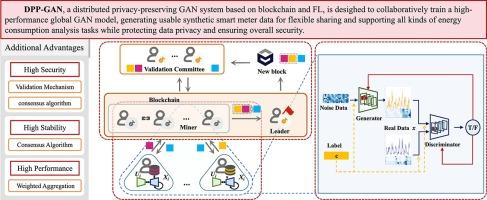
Energy demand management, especially energy consumption analysis, is crucial for rational energy allocation and monitoring consumption behaviors. Data privacy and regulatory issues limit the sharing of smart meter data among power companies, challenging the acquisition of sufficient training data. Generating synthetic data through generative adversarial networks (GANs) offers an effective alternative to sharing and using real data. However, the limited quantity and diversity of data samples hinder power companies from independently training well-performing GAN models. To solve the above problems, this paper proposes DPP-GAN, a distributed and privacy-preserving GAN system for collaborative smart meter data generation. Specifically, DPP-GAN aggregates dispersed resources through federated learning (FL) to enrich the global GAN model, generating usable data without actual data transmission. Meanwhile, considering the security risks FL faces, such as single point of failure and poisoning attacks, blockchain is employed to store and share local training models in a decentralized manner. It also performs validity verification and aggregation operations through the consensus algorithm to ensure secure joint learning. In addition, a new adaptive weighted model aggregation method and an incentive mechanism are presented to aggregate and reward with reference to local model contributions, enhancing the performance of the global generative model. Simulation results on real-world datasets demonstrate that DPP-GAN maintains high model generation performance while ensuring data privacy and overall security. The generated smart meter data effectively captures the temporal and periodic characteristics of real data, providing essential data support for research and applications in efficient energy management of smart grids.
期刊介绍:
An international journal devoted to investigations of energy use and efficiency in buildings
Energy and Buildings is an international journal publishing articles with explicit links to energy use in buildings. The aim is to present new research results, and new proven practice aimed at reducing the energy needs of a building and improving indoor environment quality.



 京公网安备 11010802042870号
京ICP备2023020795号-1
京公网安备 11010802042870号
京ICP备2023020795号-1

 分享
分享
 求助内容:
求助内容: 应助结果提醒方式:
 扫码关注我们
