Monil Khera, Kevin Arbuckle, Francis Mwanguhya, Michael A Cant, Hazel J Nichols
{"title":"Reproduction is driven by seasonal environmental variation in an equatorial mammal, the banded mongoose (<i>Mungos mungo</i>).","authors":"Monil Khera, Kevin Arbuckle, Francis Mwanguhya, Michael A Cant, Hazel J Nichols","doi":"10.1093/beheco/araf007","DOIUrl":null,"url":null,"abstract":"<p><p>Reproduction is an energetically costly activity and so is often timed to occur when conditions are most favorable. However, human-induced changes in long-term, seasonal, and short-term climatic conditions have imposed negative consequences for reproduction across a range of mammals. Whilst the effect of climate change on reproduction in temperate species is well known, its effect on equatorial species is comparatively understudied. We used long-term ecological data (~20 yr) to investigate the impact of changes in rainfall and temperature on reproduction in an equatorial mammal, the banded mongoose (<i>Mungos mungo</i>). After controlling for the effects of group-size, we found that more females were pregnant and gave birth following periods of high seasonal rainfall, pregnancies increased at higher seasonal temperatures, and births increased with long-term rainfall. This is likely beneficial as high rainfall is positively associated with pup growth and survival. Females cannot, however, carry and raise pups over the course of a single wet season, so females face a trade-off in reproductive timing between maximizing resource availability during gestation or the early life of pups, but not both. Since the duration of the wet seasons is predicted to increase with climate change, the optimum conditions for banded mongoose reproduction may be extended. However, the potential benefits of extended wet seasons may be counteracted by the negative impacts of high temperatures on pup growth and survival. Our results highlight the importance of seasonality in reproduction of tropical mammals and the complex impacts of anthropogenic climate change on recruitment in equatorial species.</p>","PeriodicalId":8840,"journal":{"name":"Behavioral Ecology","volume":"36 2","pages":"araf007"},"PeriodicalIF":2.2000,"publicationDate":"2025-01-31","publicationTypes":"Journal Article","fieldsOfStudy":null,"isOpenAccess":false,"openAccessPdf":"https://www.ncbi.nlm.nih.gov/pmc/articles/PMC11840749/pdf/","citationCount":"0","resultStr":null,"platform":"Semanticscholar","paperid":null,"PeriodicalName":"Behavioral Ecology","FirstCategoryId":"93","ListUrlMain":"https://doi.org/10.1093/beheco/araf007","RegionNum":3,"RegionCategory":"环境科学与生态学","ArticlePicture":[],"TitleCN":null,"AbstractTextCN":null,"PMCID":null,"EPubDate":"2025/3/1 0:00:00","PubModel":"eCollection","JCR":"Q2","JCRName":"BEHAVIORAL SCIENCES","Score":null,"Total":0}
引用次数: 0
Abstract
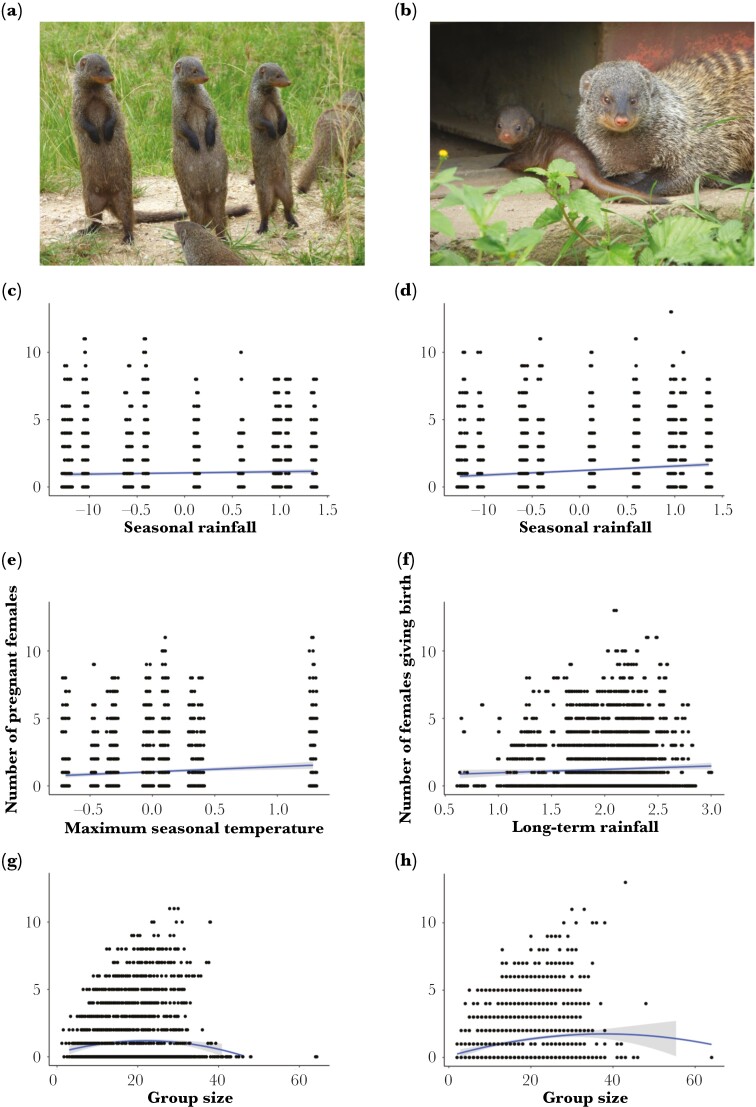
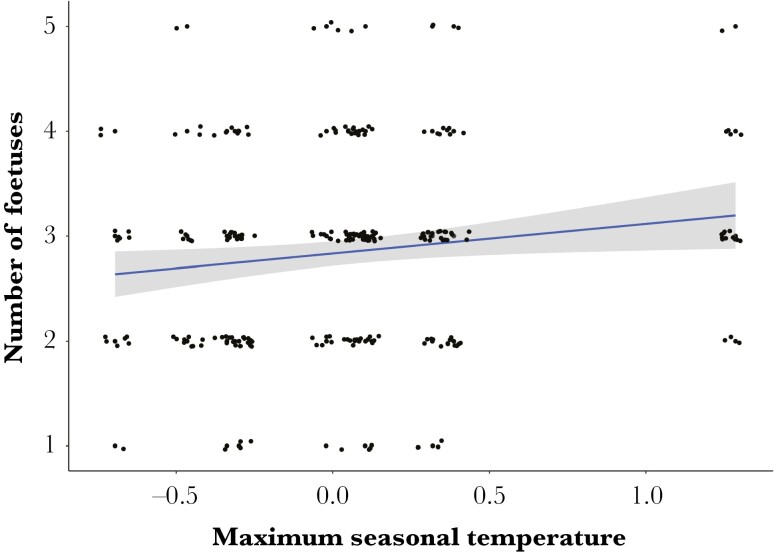
Reproduction is an energetically costly activity and so is often timed to occur when conditions are most favorable. However, human-induced changes in long-term, seasonal, and short-term climatic conditions have imposed negative consequences for reproduction across a range of mammals. Whilst the effect of climate change on reproduction in temperate species is well known, its effect on equatorial species is comparatively understudied. We used long-term ecological data (~20 yr) to investigate the impact of changes in rainfall and temperature on reproduction in an equatorial mammal, the banded mongoose (Mungos mungo). After controlling for the effects of group-size, we found that more females were pregnant and gave birth following periods of high seasonal rainfall, pregnancies increased at higher seasonal temperatures, and births increased with long-term rainfall. This is likely beneficial as high rainfall is positively associated with pup growth and survival. Females cannot, however, carry and raise pups over the course of a single wet season, so females face a trade-off in reproductive timing between maximizing resource availability during gestation or the early life of pups, but not both. Since the duration of the wet seasons is predicted to increase with climate change, the optimum conditions for banded mongoose reproduction may be extended. However, the potential benefits of extended wet seasons may be counteracted by the negative impacts of high temperatures on pup growth and survival. Our results highlight the importance of seasonality in reproduction of tropical mammals and the complex impacts of anthropogenic climate change on recruitment in equatorial species.
期刊介绍:
Studies on the whole range of behaving organisms, including plants, invertebrates, vertebrates, and humans, are included.
Behavioral Ecology construes the field in its broadest sense to include 1) the use of ecological and evolutionary processes to explain the occurrence and adaptive significance of behavior patterns; 2) the use of behavioral processes to predict ecological patterns, and 3) empirical, comparative analyses relating behavior to the environment in which it occurs.




 京公网安备 11010802042870号
京ICP备2023020795号-1
京公网安备 11010802042870号
京ICP备2023020795号-1

 分享
分享
 求助内容:
求助内容: 应助结果提醒方式:
 扫码关注我们
