Comparison of artificial intelligence and logistic regression models for mortality prediction in acute respiratory distress syndrome: a systematic review and meta-analysis.
Yang He, Ning Liu, Jie Yang, Yucai Hong, Hongying Ni, Zhongheng Zhang
{"title":"Comparison of artificial intelligence and logistic regression models for mortality prediction in acute respiratory distress syndrome: a systematic review and meta-analysis.","authors":"Yang He, Ning Liu, Jie Yang, Yucai Hong, Hongying Ni, Zhongheng Zhang","doi":"10.1186/s40635-024-00706-8","DOIUrl":null,"url":null,"abstract":"<p><strong>Background: </strong>The application of artificial intelligence (AI) in predicting the mortality of acute respiratory distress syndrome (ARDS) has garnered significant attention. However, there is still a lack of evidence-based support for its specific diagnostic performance. Thus, this systematic review and meta-analysis was conducted to evaluate the effectiveness of AI algorithms in predicting ARDS mortality.</p><p><strong>Method: </strong>We conducted a comprehensive electronic search across Web of Science, Embase, PubMed, Scopus, and EBSCO databases up to April 28, 2024. The QUADAS-2 tool was used to assess the risk of bias in the included articles. A bivariate mixed-effects model was applied for the meta-analysis. Sensitivity analysis, meta-regression analysis, and tests for heterogeneity were also performed.</p><p><strong>Results: </strong>Eight studies were included in the analysis. The sensitivity, specificity, and summarized receiver operating characteristic (SROC) of the AI-based model in the validation set were 0.89 (95% CI 0.79-0.95), 0.72 (95% CI 0.65-0.78), and 0.84 (95% CI 0.80-0.87), respectively. For the logistic regression (LR) model, the sensitivity, specificity, and SROC were 0.78 (95% CI 0.74-0.82), 0.68 (95% CI 0.60-0.76), and 0.81 (95% CI 0.77-0.84). The AI model demonstrated superior predictive accuracy compared to the LR model. Notably, the predictive model performed better in patients with moderate to severe ARDS (SAUC: 0.84 [95% CI 0.80-0.87] vs. 0.81 [95% CI 0.77-0.84]).</p><p><strong>Conclusion: </strong>The AI algorithms showed superior performance in predicting the mortality of ARDS patients and demonstrated strong potential for clinical application. Additionally, we found that for ARDS, a highly heterogeneous condition, the accuracy of the model is influenced by the severity of the disease.</p>","PeriodicalId":13750,"journal":{"name":"Intensive Care Medicine Experimental","volume":"13 1","pages":"23"},"PeriodicalIF":2.8000,"publicationDate":"2025-02-21","publicationTypes":"Journal Article","fieldsOfStudy":null,"isOpenAccess":false,"openAccessPdf":"https://www.ncbi.nlm.nih.gov/pmc/articles/PMC11845658/pdf/","citationCount":"0","resultStr":null,"platform":"Semanticscholar","paperid":null,"PeriodicalName":"Intensive Care Medicine Experimental","FirstCategoryId":"1085","ListUrlMain":"https://doi.org/10.1186/s40635-024-00706-8","RegionNum":0,"RegionCategory":null,"ArticlePicture":[],"TitleCN":null,"AbstractTextCN":null,"PMCID":null,"EPubDate":"","PubModel":"","JCR":"Q2","JCRName":"CRITICAL CARE MEDICINE","Score":null,"Total":0}
引用次数: 0
Abstract
Background: The application of artificial intelligence (AI) in predicting the mortality of acute respiratory distress syndrome (ARDS) has garnered significant attention. However, there is still a lack of evidence-based support for its specific diagnostic performance. Thus, this systematic review and meta-analysis was conducted to evaluate the effectiveness of AI algorithms in predicting ARDS mortality.
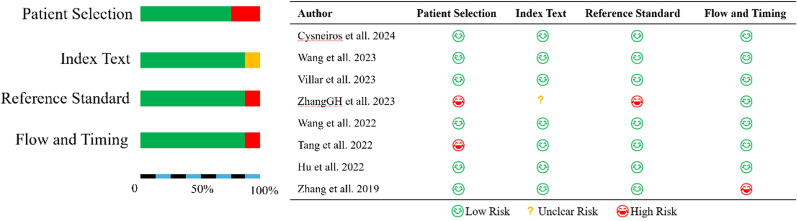
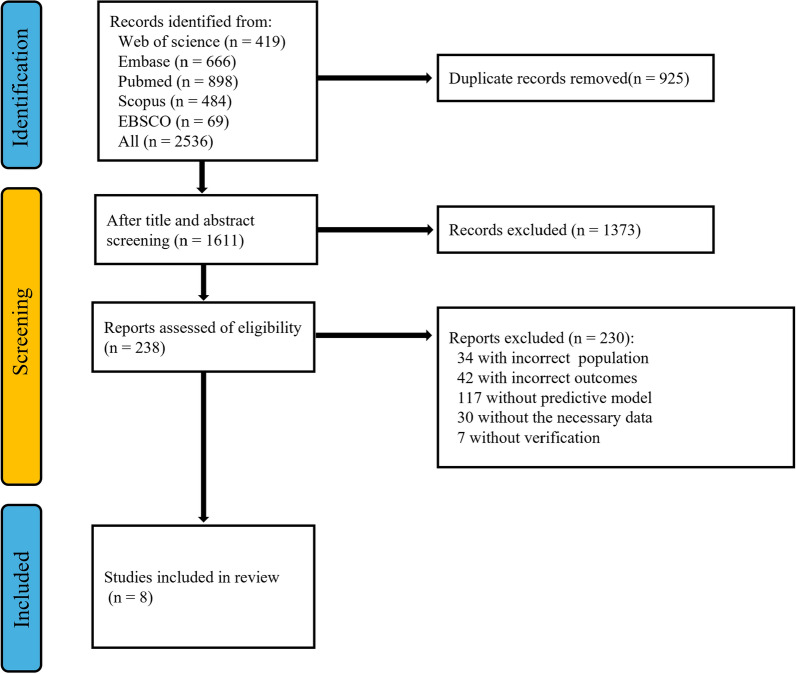
Method: We conducted a comprehensive electronic search across Web of Science, Embase, PubMed, Scopus, and EBSCO databases up to April 28, 2024. The QUADAS-2 tool was used to assess the risk of bias in the included articles. A bivariate mixed-effects model was applied for the meta-analysis. Sensitivity analysis, meta-regression analysis, and tests for heterogeneity were also performed.
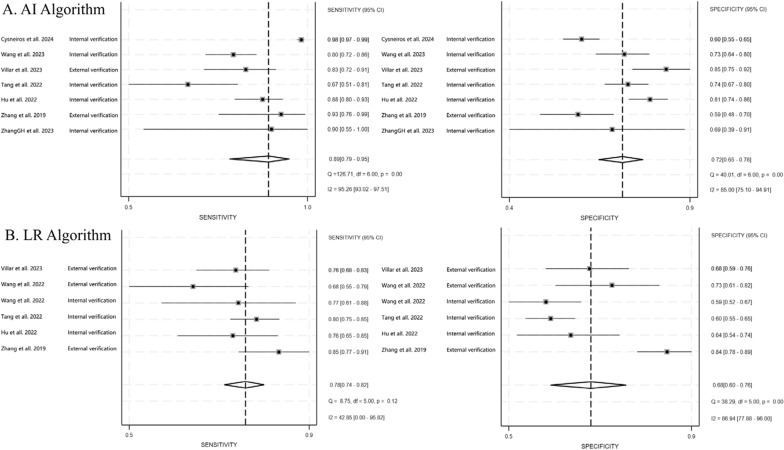
Results: Eight studies were included in the analysis. The sensitivity, specificity, and summarized receiver operating characteristic (SROC) of the AI-based model in the validation set were 0.89 (95% CI 0.79-0.95), 0.72 (95% CI 0.65-0.78), and 0.84 (95% CI 0.80-0.87), respectively. For the logistic regression (LR) model, the sensitivity, specificity, and SROC were 0.78 (95% CI 0.74-0.82), 0.68 (95% CI 0.60-0.76), and 0.81 (95% CI 0.77-0.84). The AI model demonstrated superior predictive accuracy compared to the LR model. Notably, the predictive model performed better in patients with moderate to severe ARDS (SAUC: 0.84 [95% CI 0.80-0.87] vs. 0.81 [95% CI 0.77-0.84]).
Conclusion: The AI algorithms showed superior performance in predicting the mortality of ARDS patients and demonstrated strong potential for clinical application. Additionally, we found that for ARDS, a highly heterogeneous condition, the accuracy of the model is influenced by the severity of the disease.
背景:人工智能(AI)在急性呼吸窘迫综合征(ARDS)死亡率预测中的应用已引起广泛关注。然而,目前仍缺乏证据支持其具体的诊断性能。因此,本系统综述和荟萃分析旨在评估人工智能算法在预测ARDS死亡率方面的有效性。方法:对Web of Science、Embase、PubMed、Scopus和EBSCO数据库进行了全面的电子检索,检索时间截止到2024年4月28日。采用QUADAS-2工具评估纳入文章的偏倚风险。采用双变量混合效应模型进行meta分析。还进行了敏感性分析、meta回归分析和异质性检验。结果:8项研究被纳入分析。验证集中基于人工智能的模型的敏感性、特异性和总结受试者工作特征(SROC)分别为0.89 (95% CI 0.79 ~ 0.95)、0.72 (95% CI 0.65 ~ 0.78)和0.84 (95% CI 0.80 ~ 0.87)。对于logistic回归(LR)模型,敏感性、特异性和SROC分别为0.78 (95% CI 0.74-0.82)、0.68 (95% CI 0.60-0.76)和0.81 (95% CI 0.77-0.84)。与LR模型相比,AI模型显示出更高的预测准确性。值得注意的是,该预测模型在中重度ARDS患者中表现更好(SAUC: 0.84 [95% CI 0.80-0.87] vs. 0.81 [95% CI 0.77-0.84])。结论:人工智能算法在ARDS患者死亡率预测方面具有较好的效果,具有较强的临床应用潜力。此外,我们发现对于ARDS(一种高度异质性的疾病),模型的准确性受到疾病严重程度的影响。



 京公网安备 11010802042870号
京ICP备2023020795号-1
京公网安备 11010802042870号
京ICP备2023020795号-1

 分享
分享
 求助内容:
求助内容: 应助结果提醒方式:
 扫码关注我们
