{"title":"Effects of Progressive Resistance Training After Hip Fracture: A Systematic Review.","authors":"Pablo Soro-García, Noelia González-Gálvez","doi":"10.3390/jfmk10010054","DOIUrl":null,"url":null,"abstract":"<p><p>Hip fracture presents high morbidity, mortality, and healthcare costs. Some programs have focused on the effect of progressive strength work on post-hip fracture recovery. Therefore, the objective of this systematic review was to understand the effect of a progressive resistance training program on different variables in adults after hip fracture. This review includes randomized controlled trials that apply progressive strength programs in subjects after a hip fracture. The selected databases are PubMed, Cochrane Central Register of Controlled Trials (CENTRAL), and Ebsco. A total of 7 studies were selected after screening. These studies were published between 2005 and 2022. Most of the research included adults over 65 years of age, showing a mean age of 77.80 years. In the majority of cases, the programs are applied between 3 and 12 months post-fracture. The most commonly applied intervention time is 3 months. The intervention time of the programs typically lasts for 3 months and includes 3-4 lower limb exercises involving, mainly hip and knee movements. All the investigations assess functional capacity and nearly all research the strength. It is shown that the intensity of strength work progresses from 60 to 80% of 1RM. Progressive strength training programs in post-hip fracture patients generally show an improvement in functional capacity, strength, balance, walking speed, flexibility, and cardiorespiratory fitness. However, the effects on independence, quality of life, self-reported physical disability, depression, and cognitive ability do not show conclusive results, and there is little research in this regard.</p>","PeriodicalId":16052,"journal":{"name":"Journal of Functional Morphology and Kinesiology","volume":"10 1","pages":""},"PeriodicalIF":2.5000,"publicationDate":"2025-02-02","publicationTypes":"Journal Article","fieldsOfStudy":null,"isOpenAccess":false,"openAccessPdf":"https://www.ncbi.nlm.nih.gov/pmc/articles/PMC11843970/pdf/","citationCount":"0","resultStr":null,"platform":"Semanticscholar","paperid":null,"PeriodicalName":"Journal of Functional Morphology and Kinesiology","FirstCategoryId":"1085","ListUrlMain":"https://doi.org/10.3390/jfmk10010054","RegionNum":0,"RegionCategory":null,"ArticlePicture":[],"TitleCN":null,"AbstractTextCN":null,"PMCID":null,"EPubDate":"","PubModel":"","JCR":"Q1","JCRName":"SPORT SCIENCES","Score":null,"Total":0}
引用次数: 0
Abstract
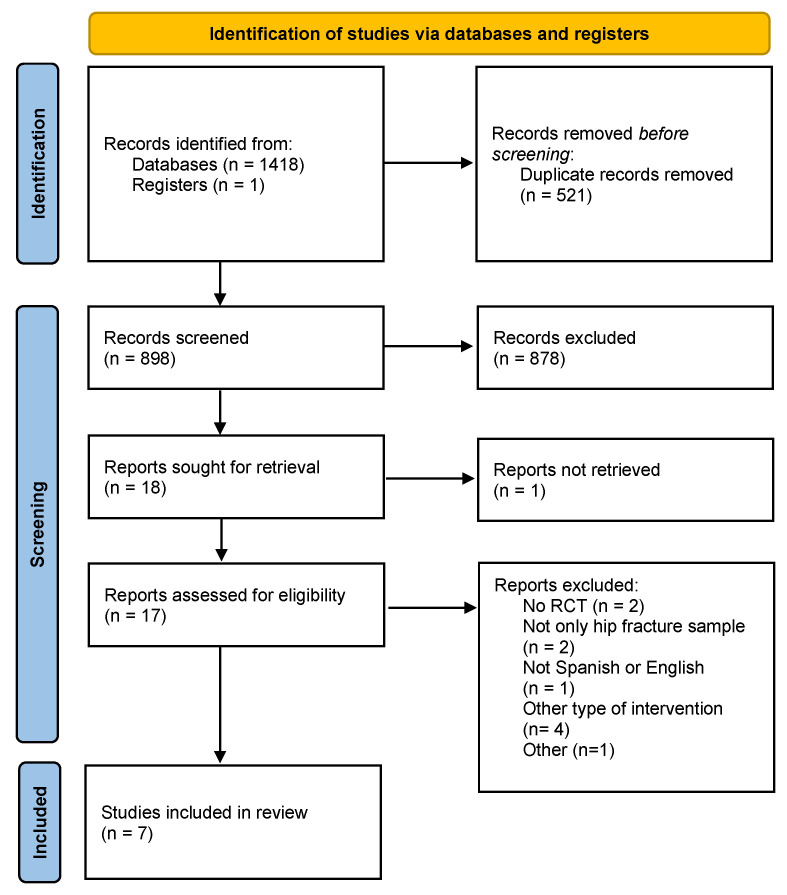
Hip fracture presents high morbidity, mortality, and healthcare costs. Some programs have focused on the effect of progressive strength work on post-hip fracture recovery. Therefore, the objective of this systematic review was to understand the effect of a progressive resistance training program on different variables in adults after hip fracture. This review includes randomized controlled trials that apply progressive strength programs in subjects after a hip fracture. The selected databases are PubMed, Cochrane Central Register of Controlled Trials (CENTRAL), and Ebsco. A total of 7 studies were selected after screening. These studies were published between 2005 and 2022. Most of the research included adults over 65 years of age, showing a mean age of 77.80 years. In the majority of cases, the programs are applied between 3 and 12 months post-fracture. The most commonly applied intervention time is 3 months. The intervention time of the programs typically lasts for 3 months and includes 3-4 lower limb exercises involving, mainly hip and knee movements. All the investigations assess functional capacity and nearly all research the strength. It is shown that the intensity of strength work progresses from 60 to 80% of 1RM. Progressive strength training programs in post-hip fracture patients generally show an improvement in functional capacity, strength, balance, walking speed, flexibility, and cardiorespiratory fitness. However, the effects on independence, quality of life, self-reported physical disability, depression, and cognitive ability do not show conclusive results, and there is little research in this regard.





 京公网安备 11010802042870号
京ICP备2023020795号-1
京公网安备 11010802042870号
京ICP备2023020795号-1

 分享
分享
 求助内容:
求助内容: 应助结果提醒方式:
 扫码关注我们
