Eduardo Guzmán-Muñoz, Yeny Concha-Cisternas, Guillermo Méndez-Rebolledo, Manuel Vásquez-Muñoz, Pablo Valdés-Badilla, Tomás Herrera-Valenzuela, Cristian Núñez-Espinosa, Jordan Hernández-Martínez
{"title":"Relationship Between Body Mass Index and Fat Mass Percentage with Proprioception in Children.","authors":"Eduardo Guzmán-Muñoz, Yeny Concha-Cisternas, Guillermo Méndez-Rebolledo, Manuel Vásquez-Muñoz, Pablo Valdés-Badilla, Tomás Herrera-Valenzuela, Cristian Núñez-Espinosa, Jordan Hernández-Martínez","doi":"10.3390/jfmk10010059","DOIUrl":null,"url":null,"abstract":"<p><strong>Background/objectives: </strong>Childhood obesity is linked to motor and sensorimotor impairments, including proprioceptive deficits. While research has predominantly focused on lower limb proprioception, less is known about the impact on upper limbs. This study investigated the relationship between body mass index, body fat percentage, and proprioception of children aged 11-12 years.</p><p><strong>Methods: </strong>A quantitative, correlational, observational design was employed. BMI was calculated from weight and height measurements, body fat percentage was assessed via bioelectrical impedance analysis, and proprioception was measured using an active repositioning test with inertial sensors in 44 children.</p><p><strong>Results: </strong>Significant correlations were found between BMI and positional errors in the shoulder (r = 0.64, <i>p</i> < 0.001), elbow (r = 0.36, <i>p</i> = 0.007), and knee (r = 0.42, <i>p</i> = 0.002). Regarding body fat percentage, significant correlations were observed with positional errors in the shoulder (r = 0.28, <i>p</i> = 0.031), elbow (r = 0.46, <i>p</i> < 0.001), and knee (r = 0.29, <i>p</i> = 0.030). Regression analysis showed that BMI and body fat percentage significantly predicted positional errors in the shoulder, elbow, and knee. In the shoulder joint, girls demonstrated lower positional errors compared to boys, influenced by both BMI (β = -1.36, <i>p</i> = 0.015) and body fat percentage (β = -3.00, <i>p</i> < 0.001).</p><p><strong>Conclusions: </strong>Higher BMI and body fat percentage are associated with shoulder, elbow, and knee joint proprioceptive deficits. Interventions targeting weight reduction and proprioceptive training may mitigate these deficits and promote sensorimotor function in children.</p>","PeriodicalId":16052,"journal":{"name":"Journal of Functional Morphology and Kinesiology","volume":"10 1","pages":""},"PeriodicalIF":2.5000,"publicationDate":"2025-02-09","publicationTypes":"Journal Article","fieldsOfStudy":null,"isOpenAccess":false,"openAccessPdf":"https://www.ncbi.nlm.nih.gov/pmc/articles/PMC11843859/pdf/","citationCount":"0","resultStr":null,"platform":"Semanticscholar","paperid":null,"PeriodicalName":"Journal of Functional Morphology and Kinesiology","FirstCategoryId":"1085","ListUrlMain":"https://doi.org/10.3390/jfmk10010059","RegionNum":0,"RegionCategory":null,"ArticlePicture":[],"TitleCN":null,"AbstractTextCN":null,"PMCID":null,"EPubDate":"","PubModel":"","JCR":"Q1","JCRName":"SPORT SCIENCES","Score":null,"Total":0}
引用次数: 0
Abstract
Background/objectives: Childhood obesity is linked to motor and sensorimotor impairments, including proprioceptive deficits. While research has predominantly focused on lower limb proprioception, less is known about the impact on upper limbs. This study investigated the relationship between body mass index, body fat percentage, and proprioception of children aged 11-12 years.
Methods: A quantitative, correlational, observational design was employed. BMI was calculated from weight and height measurements, body fat percentage was assessed via bioelectrical impedance analysis, and proprioception was measured using an active repositioning test with inertial sensors in 44 children.
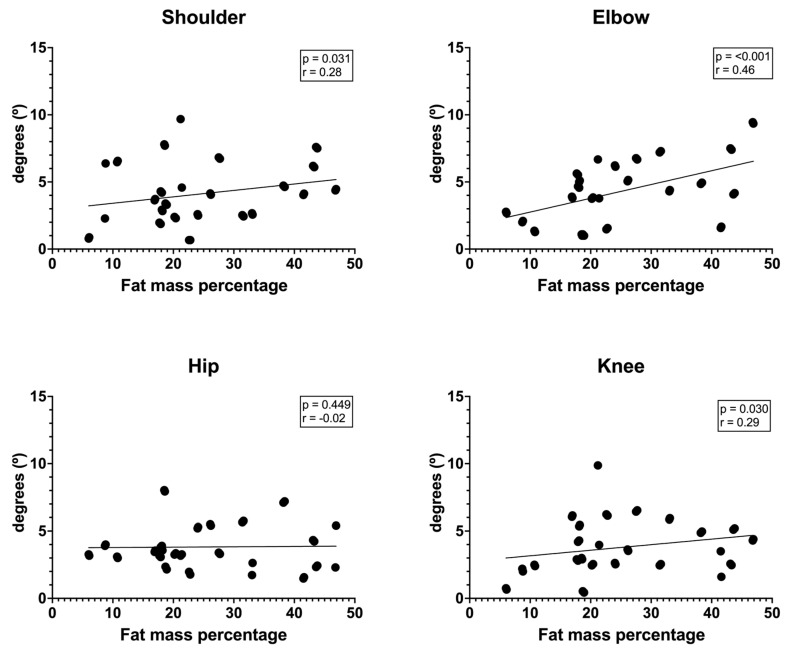
Results: Significant correlations were found between BMI and positional errors in the shoulder (r = 0.64, p < 0.001), elbow (r = 0.36, p = 0.007), and knee (r = 0.42, p = 0.002). Regarding body fat percentage, significant correlations were observed with positional errors in the shoulder (r = 0.28, p = 0.031), elbow (r = 0.46, p < 0.001), and knee (r = 0.29, p = 0.030). Regression analysis showed that BMI and body fat percentage significantly predicted positional errors in the shoulder, elbow, and knee. In the shoulder joint, girls demonstrated lower positional errors compared to boys, influenced by both BMI (β = -1.36, p = 0.015) and body fat percentage (β = -3.00, p < 0.001).
Conclusions: Higher BMI and body fat percentage are associated with shoulder, elbow, and knee joint proprioceptive deficits. Interventions targeting weight reduction and proprioceptive training may mitigate these deficits and promote sensorimotor function in children.





 京公网安备 11010802042870号
京ICP备2023020795号-1
京公网安备 11010802042870号
京ICP备2023020795号-1

 分享
分享
 求助内容:
求助内容: 应助结果提醒方式:
 扫码关注我们
