Wan Hao , Minnan Chang , Di Shi , Chenxi Yun , Jun Li , Haitao Guo , Xiao Lin
{"title":"Therapeutic targets in aging-related osteoarthritis: A focus on the extracellular matrix homeostasis","authors":"Wan Hao , Minnan Chang , Di Shi , Chenxi Yun , Jun Li , Haitao Guo , Xiao Lin","doi":"10.1016/j.lfs.2025.123487","DOIUrl":null,"url":null,"abstract":"<div><div>Osteoarthritis (OA) represents a globally prevalent degenerative bone diseases and is the primary contributors to pain and disability among middle-aged and elderly people, thereby imposing significant social and economic burdens. When articular cartilage is in the aging environment, epigenetic modifications, DNA damage and mitochondrial dysfunction lead to cell senescence. Chondrocyte senescence has been identified as a pivotal event in this metabolic dysregulation of the extracellular matrix (ECM). It can affect the composition and structure of ECM, and the mechanical and biological signals transmitted by ECM to senescent chondrocytes affect their physiology and pathology. Over the past few decades, the role of ECM in aging-related OA has received increasing attention. In this review, we summarize the changes of cartilage's major ECM (type II collagen and aggrecan) and the interaction between aging and ECM in OA, and explore therapeutic strategies targeting cartilagae ECM, such as noncoding RNAs, small-molecule drugs, and mesenchymal stem cell (MSC)-derived extracellular vesicles for OA. The aim of this study was to elucidate the potential benefits of ECM-based therapies as novel strategies for the management of OA diseases.</div></div>","PeriodicalId":18122,"journal":{"name":"Life sciences","volume":"368 ","pages":"Article 123487"},"PeriodicalIF":5.1000,"publicationDate":"2025-05-01","publicationTypes":"Journal Article","fieldsOfStudy":null,"isOpenAccess":false,"openAccessPdf":"","citationCount":"0","resultStr":null,"platform":"Semanticscholar","paperid":null,"PeriodicalName":"Life sciences","FirstCategoryId":"3","ListUrlMain":"https://www.sciencedirect.com/science/article/pii/S0024320525001201","RegionNum":2,"RegionCategory":"医学","ArticlePicture":[],"TitleCN":null,"AbstractTextCN":null,"PMCID":null,"EPubDate":"2025/2/18 0:00:00","PubModel":"Epub","JCR":"Q1","JCRName":"MEDICINE, RESEARCH & EXPERIMENTAL","Score":null,"Total":0}
引用次数: 0
Abstract
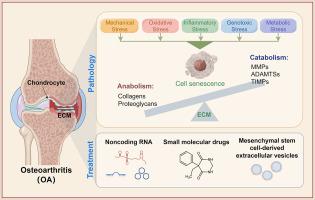
Osteoarthritis (OA) represents a globally prevalent degenerative bone diseases and is the primary contributors to pain and disability among middle-aged and elderly people, thereby imposing significant social and economic burdens. When articular cartilage is in the aging environment, epigenetic modifications, DNA damage and mitochondrial dysfunction lead to cell senescence. Chondrocyte senescence has been identified as a pivotal event in this metabolic dysregulation of the extracellular matrix (ECM). It can affect the composition and structure of ECM, and the mechanical and biological signals transmitted by ECM to senescent chondrocytes affect their physiology and pathology. Over the past few decades, the role of ECM in aging-related OA has received increasing attention. In this review, we summarize the changes of cartilage's major ECM (type II collagen and aggrecan) and the interaction between aging and ECM in OA, and explore therapeutic strategies targeting cartilagae ECM, such as noncoding RNAs, small-molecule drugs, and mesenchymal stem cell (MSC)-derived extracellular vesicles for OA. The aim of this study was to elucidate the potential benefits of ECM-based therapies as novel strategies for the management of OA diseases.
期刊介绍:
Life Sciences is an international journal publishing articles that emphasize the molecular, cellular, and functional basis of therapy. The journal emphasizes the understanding of mechanism that is relevant to all aspects of human disease and translation to patients. All articles are rigorously reviewed.
The Journal favors publication of full-length papers where modern scientific technologies are used to explain molecular, cellular and physiological mechanisms. Articles that merely report observations are rarely accepted. Recommendations from the Declaration of Helsinki or NIH guidelines for care and use of laboratory animals must be adhered to. Articles should be written at a level accessible to readers who are non-specialists in the topic of the article themselves, but who are interested in the research. The Journal welcomes reviews on topics of wide interest to investigators in the life sciences. We particularly encourage submission of brief, focused reviews containing high-quality artwork and require the use of mechanistic summary diagrams.



 京公网安备 11010802042870号
京ICP备2023020795号-1
京公网安备 11010802042870号
京ICP备2023020795号-1

 分享
分享
 求助内容:
求助内容: 应助结果提醒方式:
 扫码关注我们
