Jennifer I Crook, Nicholas A Giordano, Joseph E Mathias, Tatiana Getz, Sarah Febres-Cordero
{"title":"Evaluating Stigma Toward Individuals With Substance Use Disorder Among Prelicensure Nursing Students.","authors":"Jennifer I Crook, Nicholas A Giordano, Joseph E Mathias, Tatiana Getz, Sarah Febres-Cordero","doi":"10.1097/NNE.0000000000001770","DOIUrl":null,"url":null,"abstract":"<p><strong>Background: </strong>Seventeen percent of individuals in the United States live with substance use disorder (SUD). Nursing curricula may not adequately address SUD, and stigma can impact care.</p><p><strong>Purpose: </strong>This project aimed to measure stigma toward people with SUD among nursing students.</p><p><strong>Methods: </strong>Surveys were administered to prelicensure nursing students. Stigma was measured using the Opening Minds Provider Attitudes Toward Opioid-Use Scale. Students were asked about personal experience with SUD and perceived adequacy of SUD-related curricula.</p><p><strong>Results: </strong>A total of 193 students participated. The mean stigma score was 31.35. Those with personal experience had lower stigma scores than those without ([95% CI 2.26-9.23]; P value = .0014). Most students (71.0%) desired to see content from individuals with lived experience incorporated into curriculum.</p><p><strong>Conclusion: </strong>Addressing stigma in SUD education is critical for improving future patient care. Nursing schools should consider incorporating stigma-reducing content, including perspectives from individuals with lived experiences, into SUD curricula.</p>","PeriodicalId":54706,"journal":{"name":"Nurse Educator","volume":"50 2","pages":"79-83"},"PeriodicalIF":3.0000,"publicationDate":"2025-03-01","publicationTypes":"Journal Article","fieldsOfStudy":null,"isOpenAccess":false,"openAccessPdf":"https://www.ncbi.nlm.nih.gov/pmc/articles/PMC11850012/pdf/","citationCount":"0","resultStr":null,"platform":"Semanticscholar","paperid":null,"PeriodicalName":"Nurse Educator","FirstCategoryId":"3","ListUrlMain":"https://doi.org/10.1097/NNE.0000000000001770","RegionNum":3,"RegionCategory":"医学","ArticlePicture":[],"TitleCN":null,"AbstractTextCN":null,"PMCID":null,"EPubDate":"2024/11/12 0:00:00","PubModel":"Epub","JCR":"Q1","JCRName":"NURSING","Score":null,"Total":0}
引用次数: 0
Abstract
Background: Seventeen percent of individuals in the United States live with substance use disorder (SUD). Nursing curricula may not adequately address SUD, and stigma can impact care.
Purpose: This project aimed to measure stigma toward people with SUD among nursing students.
Methods: Surveys were administered to prelicensure nursing students. Stigma was measured using the Opening Minds Provider Attitudes Toward Opioid-Use Scale. Students were asked about personal experience with SUD and perceived adequacy of SUD-related curricula.
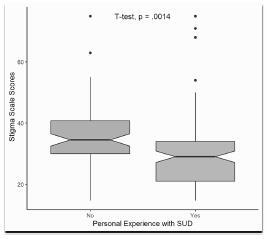
Results: A total of 193 students participated. The mean stigma score was 31.35. Those with personal experience had lower stigma scores than those without ([95% CI 2.26-9.23]; P value = .0014). Most students (71.0%) desired to see content from individuals with lived experience incorporated into curriculum.
Conclusion: Addressing stigma in SUD education is critical for improving future patient care. Nursing schools should consider incorporating stigma-reducing content, including perspectives from individuals with lived experiences, into SUD curricula.
背景:17%的美国人患有物质使用障碍(SUD)。护理课程可能没有充分解决SUD问题,而且耻辱感会影响护理。目的:本研究旨在了解护生对SUD患者的耻辱感。方法:对护生进行问卷调查。使用开放思想提供者对阿片类药物使用的态度量表来测量耻辱感。学生被问及与SUD相关课程的个人经历和是否足够。结果:共193名学生参与。平均污名得分为31.35分。有个人经历的人的污名得分低于没有个人经历的人([95% CI 2.26-9.23];P值= 0.0014)。大多数学生(71.0%)希望将个人生活经验的内容纳入课程。结论:解决SUD教育中的耻辱感是改善未来患者护理的关键。护理学校应考虑将减少耻辱感的内容,包括有生活经历的个人的观点纳入SUD课程。
期刊介绍:
Nurse Educator, a scholarly, peer reviewed journal for faculty and administrators in schools of nursing and nurse educators in other settings, provides practical information and research related to nursing education. Topics include program, curriculum, course, and faculty development; teaching and learning in nursing; technology in nursing education; simulation; clinical teaching and evaluation; testing and measurement; trends and issues; and research in nursing education.



 京公网安备 11010802042870号
京ICP备2023020795号-1
京公网安备 11010802042870号
京ICP备2023020795号-1

 分享
分享
 求助内容:
求助内容: 应助结果提醒方式:
 扫码关注我们
