{"title":"Emotions and feelings in neuroscience education across career stages: a qualitative study with views from alumni, junior and senior academics.","authors":"Stefano Sandrone","doi":"10.1186/s12909-024-06546-0","DOIUrl":null,"url":null,"abstract":"<p><strong>Introduction: </strong>Emotions and feelings are crucial components of our lives. However, their role in medical education scholarship, including in neuroscience education, has been overlooked. Moreover, their impact has been understudied in academia, especially across career stages. We explored emotions and feelings in the context of neuroscience education and across different career stages.</p><p><strong>Methods: </strong>This work is based on a project exploring the value of learning in postgraduate education, drawing on data from nineteen semi-structured interviews with university alumni and academics. Eight alumni (six females and two males) and eleven academics from a UK-based STEM-intensive institution participated in the study. Alumni refers to former students who have completed the MSc in neuroscience at a STEM-intense institution within the last six years. Lecturers and Senior Lecturers in neuroscience have been labelled as junior academics, whereas Readers and Professors have been labelled senior academics.</p><p><strong>Results: </strong>The alumni recognised their master experience was intense and challenging, yet acknowledged that enjoyment and stress are two faces of the same coin. Many cited their peers as an inspiration to go beyond the limits but only one student mentioned gratitude, which was never mentioned by the academics. At least one alumnus and one junior academic mentioned trust and confidence, but not the senior academics. Anxiety and confidence (and lack of) dominated the interviews with junior academics, who used intense words when discussing the pleasures of science. Conversely, the senior academics dedicated few words to emotions and feelings, never talked about anxiety, trust or gratitude, and very briefly mentioned the reward linked to sharing their knowledge with the next generations.</p><p><strong>Discussion: </strong>This work epitomises the importance of exploring emotions and feelings in neuroscience education. Talking more openly about emotions and reducing the pervasive narration of 'success stories' might be directions to follow, along with stressing the importance of cultivating self-efficacy, trust and gratitude since the early stages. Meetings between students and supervisors can play a key role in developing self-trust among the students. More focus should be placed on supporting the transition process between postgraduate studies and the subsequent steps of the academic ladder.</p>","PeriodicalId":51234,"journal":{"name":"BMC Medical Education","volume":"25 1","pages":"277"},"PeriodicalIF":3.2000,"publicationDate":"2025-02-20","publicationTypes":"Journal Article","fieldsOfStudy":null,"isOpenAccess":false,"openAccessPdf":"https://www.ncbi.nlm.nih.gov/pmc/articles/PMC11843773/pdf/","citationCount":"0","resultStr":null,"platform":"Semanticscholar","paperid":null,"PeriodicalName":"BMC Medical Education","FirstCategoryId":"3","ListUrlMain":"https://doi.org/10.1186/s12909-024-06546-0","RegionNum":2,"RegionCategory":"医学","ArticlePicture":[],"TitleCN":null,"AbstractTextCN":null,"PMCID":null,"EPubDate":"","PubModel":"","JCR":"Q1","JCRName":"EDUCATION & EDUCATIONAL RESEARCH","Score":null,"Total":0}
引用次数: 0
Abstract
Introduction: Emotions and feelings are crucial components of our lives. However, their role in medical education scholarship, including in neuroscience education, has been overlooked. Moreover, their impact has been understudied in academia, especially across career stages. We explored emotions and feelings in the context of neuroscience education and across different career stages.
Methods: This work is based on a project exploring the value of learning in postgraduate education, drawing on data from nineteen semi-structured interviews with university alumni and academics. Eight alumni (six females and two males) and eleven academics from a UK-based STEM-intensive institution participated in the study. Alumni refers to former students who have completed the MSc in neuroscience at a STEM-intense institution within the last six years. Lecturers and Senior Lecturers in neuroscience have been labelled as junior academics, whereas Readers and Professors have been labelled senior academics.
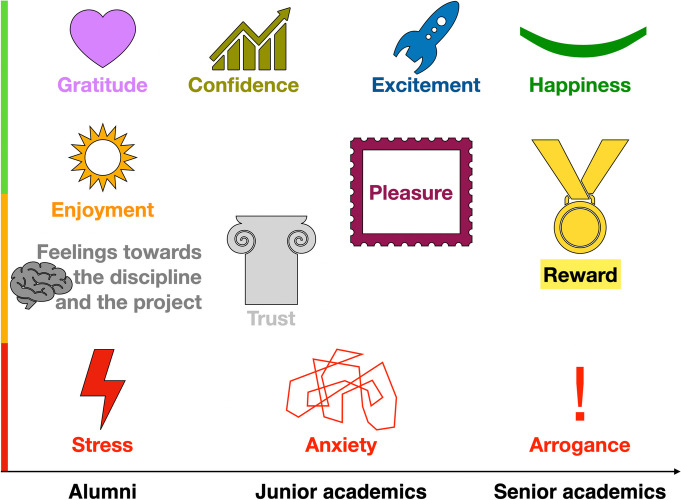
Results: The alumni recognised their master experience was intense and challenging, yet acknowledged that enjoyment and stress are two faces of the same coin. Many cited their peers as an inspiration to go beyond the limits but only one student mentioned gratitude, which was never mentioned by the academics. At least one alumnus and one junior academic mentioned trust and confidence, but not the senior academics. Anxiety and confidence (and lack of) dominated the interviews with junior academics, who used intense words when discussing the pleasures of science. Conversely, the senior academics dedicated few words to emotions and feelings, never talked about anxiety, trust or gratitude, and very briefly mentioned the reward linked to sharing their knowledge with the next generations.
Discussion: This work epitomises the importance of exploring emotions and feelings in neuroscience education. Talking more openly about emotions and reducing the pervasive narration of 'success stories' might be directions to follow, along with stressing the importance of cultivating self-efficacy, trust and gratitude since the early stages. Meetings between students and supervisors can play a key role in developing self-trust among the students. More focus should be placed on supporting the transition process between postgraduate studies and the subsequent steps of the academic ladder.
期刊介绍:
BMC Medical Education is an open access journal publishing original peer-reviewed research articles in relation to the training of healthcare professionals, including undergraduate, postgraduate, and continuing education. The journal has a special focus on curriculum development, evaluations of performance, assessment of training needs and evidence-based medicine.





 京公网安备 11010802042870号
京ICP备2023020795号-1
京公网安备 11010802042870号
京ICP备2023020795号-1

 分享
分享
 求助内容:
求助内容: 应助结果提醒方式:
 扫码关注我们
