{"title":"Epoxy Vitrimer with Excellent Mechanical Properties and High Tg for Detachable Structural Adhesives","authors":"Aiqing Dong, Qiguang Liu, Huarui Yao, Jiahao Ma, Jue Cheng, Junying Zhang","doi":"10.1021/acsami.4c22337","DOIUrl":null,"url":null,"abstract":"It is a long-standing challenge for thermoset resins to simultaneously achieve outstanding thermomechanical and mechanical properties as well as rapid network reconfiguration due to the trade-off between chemical bond transformation and stability of the network. The design of the vitrimer network topology is an effective strategy to address the above issues. Here, we prepared an epoxy vitrimer material (DGEBA–API–MHHPA) with excellent mechanical properties and high glass-transition temperature (<i>T</i><sub>g</sub>) by introducing rigid-flexible integrated side chains [1-(3-aminopropyl) imidazole (API)], which endow DGEBA–API–MHHPA multiple interactions including “internal antiplasticization” effect, intermolecular hydrogen bonds, and π–π interactions. Moreover, the introduction of Zn<sup>2+</sup> facilitates transesterification, enabling the fast rearrangement of the network. Specifically, the relaxation time of DGEBA–API<sub>0.2</sub>–MHHPA<sub>0.8</sub>–Zn reaches 65 s at 200 °C. Meanwhile, Zn<sup>2+</sup>–imidazole coordination bonds with energy dissipation improve the toughness of the vitrimer network. The resulting DGEBA–API<sub>0.2</sub>–MHHPA<sub>0.8</sub>–Zn exhibits self-healing and recyclable behaviors and possesses 80.3 MPa of tensile strength, 3.25 GPa of Young’s modulus, 7.2 MPa·m<sup>1/2</sup> of fracture toughness (<i>K</i><sub>IC</sub>), and <i>T</i><sub>g</sub> of 129 °C. Concurrently, DGEBA–API<sub>0.2</sub>–MHHPA<sub>0.8</sub>–Zn can be applied as detachable structural adhesives for various substrates and can be used as matrixes of recyclable and electrically self-healing composites. This skillful strategy can be widely referenced in the large-scale manufacturing of high-performance dynamic covalent epoxy resins and their composites with excellent mechanical and thermomechanical performance.","PeriodicalId":5,"journal":{"name":"ACS Applied Materials & Interfaces","volume":"17 1","pages":""},"PeriodicalIF":8.2000,"publicationDate":"2025-02-22","publicationTypes":"Journal Article","fieldsOfStudy":null,"isOpenAccess":false,"openAccessPdf":"","citationCount":"0","resultStr":null,"platform":"Semanticscholar","paperid":null,"PeriodicalName":"ACS Applied Materials & Interfaces","FirstCategoryId":"88","ListUrlMain":"https://doi.org/10.1021/acsami.4c22337","RegionNum":2,"RegionCategory":"材料科学","ArticlePicture":[],"TitleCN":null,"AbstractTextCN":null,"PMCID":null,"EPubDate":"","PubModel":"","JCR":"Q1","JCRName":"MATERIALS SCIENCE, MULTIDISCIPLINARY","Score":null,"Total":0}
引用次数: 0
Abstract
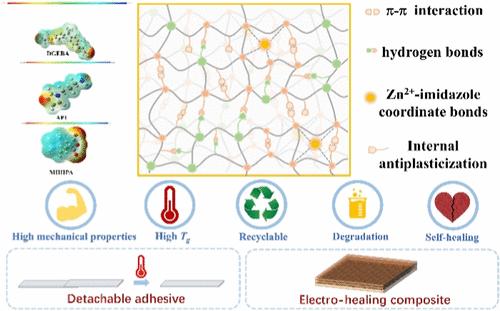
It is a long-standing challenge for thermoset resins to simultaneously achieve outstanding thermomechanical and mechanical properties as well as rapid network reconfiguration due to the trade-off between chemical bond transformation and stability of the network. The design of the vitrimer network topology is an effective strategy to address the above issues. Here, we prepared an epoxy vitrimer material (DGEBA–API–MHHPA) with excellent mechanical properties and high glass-transition temperature (Tg) by introducing rigid-flexible integrated side chains [1-(3-aminopropyl) imidazole (API)], which endow DGEBA–API–MHHPA multiple interactions including “internal antiplasticization” effect, intermolecular hydrogen bonds, and π–π interactions. Moreover, the introduction of Zn2+ facilitates transesterification, enabling the fast rearrangement of the network. Specifically, the relaxation time of DGEBA–API0.2–MHHPA0.8–Zn reaches 65 s at 200 °C. Meanwhile, Zn2+–imidazole coordination bonds with energy dissipation improve the toughness of the vitrimer network. The resulting DGEBA–API0.2–MHHPA0.8–Zn exhibits self-healing and recyclable behaviors and possesses 80.3 MPa of tensile strength, 3.25 GPa of Young’s modulus, 7.2 MPa·m1/2 of fracture toughness (KIC), and Tg of 129 °C. Concurrently, DGEBA–API0.2–MHHPA0.8–Zn can be applied as detachable structural adhesives for various substrates and can be used as matrixes of recyclable and electrically self-healing composites. This skillful strategy can be widely referenced in the large-scale manufacturing of high-performance dynamic covalent epoxy resins and their composites with excellent mechanical and thermomechanical performance.
期刊介绍:
ACS Applied Materials & Interfaces is a leading interdisciplinary journal that brings together chemists, engineers, physicists, and biologists to explore the development and utilization of newly-discovered materials and interfacial processes for specific applications. Our journal has experienced remarkable growth since its establishment in 2009, both in terms of the number of articles published and the impact of the research showcased. We are proud to foster a truly global community, with the majority of published articles originating from outside the United States, reflecting the rapid growth of applied research worldwide.



 京公网安备 11010802042870号
京ICP备2023020795号-1
京公网安备 11010802042870号
京ICP备2023020795号-1

 分享
分享
 求助内容:
求助内容: 应助结果提醒方式:
 扫码关注我们
