Shun Wang , Guoming Sun , Yanzhao Wang , Shuo Tian , Zuoxiu Xing , Wenyu Jiao , Qing Li , Mengke Wang
{"title":"Engineering gold nanoclusters anchored cobalt oxyhydroxide with bifunction for discriminative monitoring azodicarbonamide","authors":"Shun Wang , Guoming Sun , Yanzhao Wang , Shuo Tian , Zuoxiu Xing , Wenyu Jiao , Qing Li , Mengke Wang","doi":"10.1016/j.foodchem.2025.143563","DOIUrl":null,"url":null,"abstract":"<div><div>Precise and convenient detection of azodicarbonamide (ADC) is indispensable for safeguarding food safety and public health. Herein, a new ratio fluorescence strategy was strategically designed for monitoring ADC with excellent sensitivity and strong resistance to interference based on gold nanoclusters anchored cobalt oxyhydroxide nanocomposite (AuNCs@CoOOH). The AuNCs@CoOOH integrated two functions of CoOOH (quencher and mimetic oxidase) and fluorescence property of AuNCs, which can catalyze oxidation of non-fluorescent thiamine to fluorescent thiochrome. Meanwhile, the fluorescence emitted by AuNCs was attenuated by CoOOH via a fluorescence resonance energy transfer, forming a ratio response. Owing to analyte-initiated reduction of CoOOH, the AuNCs@CoOOH recognized glutathione. Coupling with specific reactions of ADC and glutathione, a ratio-based fluorescent platform is devised for sensitive detection of ADC, achieving a detection limit of 0.034 μM. The method proved an effective way for accurately monitoring ADC in flour samples, thereby enhancing its practical utility in ensuring food safety.</div></div>","PeriodicalId":318,"journal":{"name":"Food Chemistry","volume":"477 ","pages":"Article 143563"},"PeriodicalIF":9.8000,"publicationDate":"2025-06-15","publicationTypes":"Journal Article","fieldsOfStudy":null,"isOpenAccess":false,"openAccessPdf":"","citationCount":"0","resultStr":null,"platform":"Semanticscholar","paperid":null,"PeriodicalName":"Food Chemistry","FirstCategoryId":"97","ListUrlMain":"https://www.sciencedirect.com/science/article/pii/S0308814625008143","RegionNum":1,"RegionCategory":"农林科学","ArticlePicture":[],"TitleCN":null,"AbstractTextCN":null,"PMCID":null,"EPubDate":"2025/2/22 0:00:00","PubModel":"Epub","JCR":"Q1","JCRName":"CHEMISTRY, APPLIED","Score":null,"Total":0}
引用次数: 0
Abstract
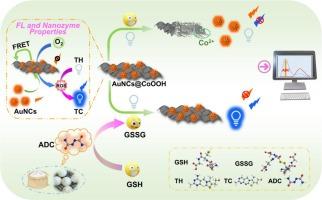
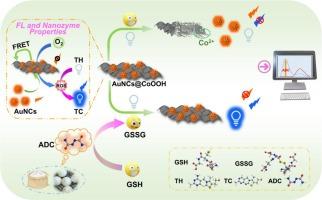
Precise and convenient detection of azodicarbonamide (ADC) is indispensable for safeguarding food safety and public health. Herein, a new ratio fluorescence strategy was strategically designed for monitoring ADC with excellent sensitivity and strong resistance to interference based on gold nanoclusters anchored cobalt oxyhydroxide nanocomposite (AuNCs@CoOOH). The AuNCs@CoOOH integrated two functions of CoOOH (quencher and mimetic oxidase) and fluorescence property of AuNCs, which can catalyze oxidation of non-fluorescent thiamine to fluorescent thiochrome. Meanwhile, the fluorescence emitted by AuNCs was attenuated by CoOOH via a fluorescence resonance energy transfer, forming a ratio response. Owing to analyte-initiated reduction of CoOOH, the AuNCs@CoOOH recognized glutathione. Coupling with specific reactions of ADC and glutathione, a ratio-based fluorescent platform is devised for sensitive detection of ADC, achieving a detection limit of 0.034 μM. The method proved an effective way for accurately monitoring ADC in flour samples, thereby enhancing its practical utility in ensuring food safety.
期刊介绍:
Food Chemistry publishes original research papers dealing with the advancement of the chemistry and biochemistry of foods or the analytical methods/ approach used. All papers should focus on the novelty of the research carried out.



 京公网安备 11010802042870号
京ICP备2023020795号-1
京公网安备 11010802042870号
京ICP备2023020795号-1

 分享
分享
 求助内容:
求助内容: 应助结果提醒方式:
 扫码关注我们
