{"title":"High-performance flexible supercapacitor based on PEDOT:PSS wrapped delaminated Ti3C2Tx composite: Experimental and DFT validation","authors":"Gourab Nandy , Swati Shaw , Subhradip Ghosh , Ashok Kumar Dasmahapatra","doi":"10.1016/j.polymer.2025.128185","DOIUrl":null,"url":null,"abstract":"<div><div>Exploring new electrode materials with cyclic stability and energy storage capacity is crucial for high-performance energy storage in portable electronics. Herein, we present PEDOT:PSS (PP)/delaminated MXene (d-Ti<sub>3</sub>C<sub>2</sub>T<sub>x</sub>) binary nanocomposites for electrode material for flexible supercapacitor (FSC). PP/d-Ti<sub>3</sub>C<sub>2</sub>T<sub>x</sub> (<em>1:2</em> wt ratio, P1M2) on activated carbon cloth results in an excellent specific capacitance of <em>718.</em>67 F g<sup>−1</sup> at a current density of <em>3.</em>5 A g<sup>−1</sup> in <em>1</em> M H<sub>2</sub>SO<sub>4</sub>. PEDOT chains wrap the d-Ti<sub>3</sub>C<sub>2</sub>T<sub>x</sub> nanosheets by an opposite electrostatic interaction, while PSS chains act as web-like carrier pathways between two adjacent nanosheets. First principle DFT simulations demonstrate that charge storage in PEDOT:PSS@Ti<sub>3</sub>C<sub>2</sub>T<sub>x</sub> is enhanced compared to PEDOT@Ti<sub>3</sub>C<sub>2</sub>T<sub>x</sub>, which describes the effect of PSS chains in the composite. Computationally obtained absorption spectra align well with experimental results, validating the proposed morphology. To employ the P1M2 electrode for FSC, P1M2-P1M2 symmetric solid-state supercapacitor (SSC) and P1M2-rGO asymmetric solid-state supercapacitor (ASC) have been fabricated using <em>1</em> M PVA-H<sub>2</sub>SO<sub>4</sub> gel electrolyte. P1M2-P1M2 SSC and P1M2-rGO ASC exhibit a high specific capacitance of <em>260.</em>23 F g<sup>−1</sup> (<em>0.</em>5 A g<sup>−1</sup>) and <em>176.</em>46 F g<sup>−1</sup> (<em>0.</em>1 A g<sup>−1</sup>) receptively. Larger potential window, excellent specific capacitance retention of <em>∼89 %</em> for <em>5000</em> GCD cycles, and great performance retention over the bending and twisting conditions make the ASC device a marvelous candidate for the portable energy storage device. The ASC device shows change in specific energy (specific power) from <em>35.</em>29 W h kg<sup>−1</sup> (240 W kg<sup>−1</sup>) to <em>26.</em>22 W h kg<sup>−1</sup> (1200 W kg<sup>−1</sup>). An assembly of three such ASC devices glows a red LED for <em>∼</em>2 min.</div></div>","PeriodicalId":405,"journal":{"name":"Polymer","volume":"323 ","pages":"Article 128185"},"PeriodicalIF":4.5000,"publicationDate":"2025-04-10","publicationTypes":"Journal Article","fieldsOfStudy":null,"isOpenAccess":false,"openAccessPdf":"","citationCount":"0","resultStr":null,"platform":"Semanticscholar","paperid":null,"PeriodicalName":"Polymer","FirstCategoryId":"92","ListUrlMain":"https://www.sciencedirect.com/science/article/pii/S0032386125001715","RegionNum":2,"RegionCategory":"化学","ArticlePicture":[],"TitleCN":null,"AbstractTextCN":null,"PMCID":null,"EPubDate":"2025/2/22 0:00:00","PubModel":"Epub","JCR":"Q2","JCRName":"POLYMER SCIENCE","Score":null,"Total":0}
引用次数: 0
Abstract
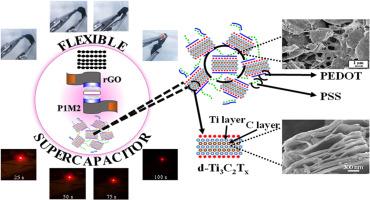
Exploring new electrode materials with cyclic stability and energy storage capacity is crucial for high-performance energy storage in portable electronics. Herein, we present PEDOT:PSS (PP)/delaminated MXene (d-Ti3C2Tx) binary nanocomposites for electrode material for flexible supercapacitor (FSC). PP/d-Ti3C2Tx (1:2 wt ratio, P1M2) on activated carbon cloth results in an excellent specific capacitance of 718.67 F g−1 at a current density of 3.5 A g−1 in 1 M H2SO4. PEDOT chains wrap the d-Ti3C2Tx nanosheets by an opposite electrostatic interaction, while PSS chains act as web-like carrier pathways between two adjacent nanosheets. First principle DFT simulations demonstrate that charge storage in PEDOT:PSS@Ti3C2Tx is enhanced compared to PEDOT@Ti3C2Tx, which describes the effect of PSS chains in the composite. Computationally obtained absorption spectra align well with experimental results, validating the proposed morphology. To employ the P1M2 electrode for FSC, P1M2-P1M2 symmetric solid-state supercapacitor (SSC) and P1M2-rGO asymmetric solid-state supercapacitor (ASC) have been fabricated using 1 M PVA-H2SO4 gel electrolyte. P1M2-P1M2 SSC and P1M2-rGO ASC exhibit a high specific capacitance of 260.23 F g−1 (0.5 A g−1) and 176.46 F g−1 (0.1 A g−1) receptively. Larger potential window, excellent specific capacitance retention of ∼89 % for 5000 GCD cycles, and great performance retention over the bending and twisting conditions make the ASC device a marvelous candidate for the portable energy storage device. The ASC device shows change in specific energy (specific power) from 35.29 W h kg−1 (240 W kg−1) to 26.22 W h kg−1 (1200 W kg−1). An assembly of three such ASC devices glows a red LED for ∼2 min.
探索具有循环稳定性和能量存储能力的新型电极材料对于便携式电子设备的高性能能量存储至关重要。在此,我们提出了PEDOT:PSS (PP)/分层MXene (d-Ti3C2Tx)二元纳米复合材料作为柔性超级电容器(FSC)的电极材料。活性炭布上的PP/d-Ti3C2Tx(1:2重量比,P1M2)在1M H2SO4中电流密度为3.5 a g-1时具有718.67 F -1的优良比电容。PEDOT链通过相反的静电相互作用包裹d-Ti3C2Tx纳米片,而PSS链作为两个相邻纳米片之间的网状载流子通道。第一原理DFT模拟表明,与PEDOT@Ti3C2Tx相比,PEDOT:PSS@Ti3C2Tx中的电荷存储增强,这描述了PSS链在复合材料中的作用。计算得到的吸收光谱与实验结果一致,验证了所提出的形态。为了将P1M2电极用于FSC,采用1M ppa - h2so4凝胶电解质制备了P1M2-P1M2对称型固态超级电容器(SSC)和P1M2- rgo不对称型固态超级电容器(ASC)。P1M2-P1M2 SSC和P1M2-rGO ASC的接收比电容分别为260.23 F -1 (0.5 a g-1)和176.46 F -1 (0.1 a g-1)。更大的电位窗口,在5000 GCD循环中优异的比电容保持率为89%,以及在弯曲和扭转条件下的良好性能保持率,使ASC器件成为便携式储能器件的绝佳候选者。ASC装置的比能量(比功率)从35.29 W h kg-1 (240 W kg-1)变化到26.22 W h kg-1 (1200 W kg-1)。由三个这样的ASC器件组成的组件发出红色LED发光约2分钟。
期刊介绍:
Polymer is an interdisciplinary journal dedicated to publishing innovative and significant advances in Polymer Physics, Chemistry and Technology. We welcome submissions on polymer hybrids, nanocomposites, characterisation and self-assembly. Polymer also publishes work on the technological application of polymers in energy and optoelectronics.
The main scope is covered but not limited to the following core areas:
Polymer Materials
Nanocomposites and hybrid nanomaterials
Polymer blends, films, fibres, networks and porous materials
Physical Characterization
Characterisation, modelling and simulation* of molecular and materials properties in bulk, solution, and thin films
Polymer Engineering
Advanced multiscale processing methods
Polymer Synthesis, Modification and Self-assembly
Including designer polymer architectures, mechanisms and kinetics, and supramolecular polymerization
Technological Applications
Polymers for energy generation and storage
Polymer membranes for separation technology
Polymers for opto- and microelectronics.





 京公网安备 11010802042870号
京ICP备2023020795号-1
京公网安备 11010802042870号
京ICP备2023020795号-1

 分享
分享
 求助内容:
求助内容: 应助结果提醒方式:
 扫码关注我们
