Rui Jiao, Yiwan Si, Pengzhi Ma, Jiyan Li, Zhaoqi Zhu, Hanxue Sun, An Li
{"title":"Constructing a solar-driven capture material for iodide removal from aquatic radio waste","authors":"Rui Jiao, Yiwan Si, Pengzhi Ma, Jiyan Li, Zhaoqi Zhu, Hanxue Sun, An Li","doi":"10.1016/j.seppur.2025.132237","DOIUrl":null,"url":null,"abstract":"<div><div>Radioactive elements have recently received much attention considering that it does serious harm to the human and environment. The solar-driven adsorption coupled interface evaporation process is a more efficient method for treating volatile radioactive iodide ions. Herein, a newly induced capture strategy was designed to obtain efficient solar-driven adsorption coupled interface evaporation material for high performance treatment of iodide ions via skillfully molecular design and pore size regulate process, in which 1,3-dichloroisoquinoline with smaller block structures serving as the trapper. In addition, the unique π-π interactions of conjugated microporous polymers (CMPs), as well as the excellent water transport channel penetrated by hydrogel, contribute to the capture of target ions. In this paper, the hollow microspheres CMPs-1 exhibited the highest iodide adsorption capacity (15.96 mg g<sup>−1</sup>), reaching equilibrium after 7 h of static adsorption in a 0.10 mmol L<sup>-1</sup> iodide ions solution. Under 1 sun, CMP-based porous composite hydrogel PCH-CMP-1 realized outstanding pure water interfacial evaporation rate (2.42 kg m<sup>−2</sup>h<sup>−1</sup>), which exceeded the evaporation rate reported in many other literatures. Based on the iodine adsorption capacity of CMPs-1 and the excellent interfacial evaporation ability of PCH-CMP-1, PCH-CMP-1 had a good interfacial evaporation rate for iodide ions solutions (1.50 kg m<sup>−2</sup>h<sup>−1</sup>), and the distillate did not contain iodide ions, in which some are adsorbed by the PCH-CMP-1 and some remain in the solution. With its extraordinary pore structure and excellent interfacial evaporation ability, the PCH-CMP-1 demonstrates the potential of an excellent solar-driven adsorption coupled interface evaporation materials for treating radioactive iodine.</div></div>","PeriodicalId":427,"journal":{"name":"Separation and Purification Technology","volume":"363 ","pages":"Article 132237"},"PeriodicalIF":9.0000,"publicationDate":"2025-02-22","publicationTypes":"Journal Article","fieldsOfStudy":null,"isOpenAccess":false,"openAccessPdf":"","citationCount":"0","resultStr":null,"platform":"Semanticscholar","paperid":null,"PeriodicalName":"Separation and Purification Technology","FirstCategoryId":"5","ListUrlMain":"https://www.sciencedirect.com/science/article/pii/S1383586625008342","RegionNum":1,"RegionCategory":"工程技术","ArticlePicture":[],"TitleCN":null,"AbstractTextCN":null,"PMCID":null,"EPubDate":"","PubModel":"","JCR":"Q1","JCRName":"ENGINEERING, CHEMICAL","Score":null,"Total":0}
引用次数: 0
Abstract
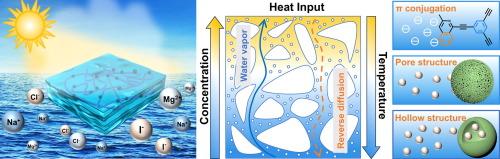
Radioactive elements have recently received much attention considering that it does serious harm to the human and environment. The solar-driven adsorption coupled interface evaporation process is a more efficient method for treating volatile radioactive iodide ions. Herein, a newly induced capture strategy was designed to obtain efficient solar-driven adsorption coupled interface evaporation material for high performance treatment of iodide ions via skillfully molecular design and pore size regulate process, in which 1,3-dichloroisoquinoline with smaller block structures serving as the trapper. In addition, the unique π-π interactions of conjugated microporous polymers (CMPs), as well as the excellent water transport channel penetrated by hydrogel, contribute to the capture of target ions. In this paper, the hollow microspheres CMPs-1 exhibited the highest iodide adsorption capacity (15.96 mg g−1), reaching equilibrium after 7 h of static adsorption in a 0.10 mmol L-1 iodide ions solution. Under 1 sun, CMP-based porous composite hydrogel PCH-CMP-1 realized outstanding pure water interfacial evaporation rate (2.42 kg m−2h−1), which exceeded the evaporation rate reported in many other literatures. Based on the iodine adsorption capacity of CMPs-1 and the excellent interfacial evaporation ability of PCH-CMP-1, PCH-CMP-1 had a good interfacial evaporation rate for iodide ions solutions (1.50 kg m−2h−1), and the distillate did not contain iodide ions, in which some are adsorbed by the PCH-CMP-1 and some remain in the solution. With its extraordinary pore structure and excellent interfacial evaporation ability, the PCH-CMP-1 demonstrates the potential of an excellent solar-driven adsorption coupled interface evaporation materials for treating radioactive iodine.
由于放射性元素对人类和环境的严重危害,近年来备受关注。太阳能驱动吸附耦合界面蒸发是处理挥发性放射性碘离子的一种更有效的方法。本文以具有较小嵌段结构的1,3-二氯异喹啉为捕集剂,通过巧妙的分子设计和孔径调节工艺,设计了一种新的诱导捕获策略,以获得高效的太阳能驱动吸附耦合界面蒸发材料,用于碘离子的高效处理。此外,共轭微孔聚合物(CMPs)独特的π-π相互作用,以及水凝胶穿透的良好的水输送通道,有助于捕获目标离子。在0.10 mmol L-1的碘离子溶液中,空心微球cmp -1在静态吸附7 h后达到平衡,具有最高的碘离子吸附量(15.96 mg g -1)。在1个太阳下,基于cmp的多孔复合水凝胶PCH-CMP-1实现了出色的纯水界面蒸发速率(2.42 kg m−2h−1),超过了许多文献报道的蒸发速率。基于PCH-CMP-1对碘的吸附能力和PCH-CMP-1优异的界面蒸发能力,PCH-CMP-1对碘离子溶液具有良好的界面蒸发速率(1.50 kg m−2h−1),馏分液中不含碘离子,部分碘离子被PCH-CMP-1吸附,部分碘离子留在溶液中。PCH-CMP-1具有独特的孔隙结构和优异的界面蒸发能力,是一种极好的太阳能驱动吸附耦合界面蒸发材料,具有处理放射性碘的潜力。
期刊介绍:
Separation and Purification Technology is a premier journal committed to sharing innovative methods for separation and purification in chemical and environmental engineering, encompassing both homogeneous solutions and heterogeneous mixtures. Our scope includes the separation and/or purification of liquids, vapors, and gases, as well as carbon capture and separation techniques. However, it's important to note that methods solely intended for analytical purposes are not within the scope of the journal. Additionally, disciplines such as soil science, polymer science, and metallurgy fall outside the purview of Separation and Purification Technology. Join us in advancing the field of separation and purification methods for sustainable solutions in chemical and environmental engineering.




 京公网安备 11010802042870号
京ICP备2023020795号-1
京公网安备 11010802042870号
京ICP备2023020795号-1

 分享
分享
 求助内容:
求助内容: 应助结果提醒方式:
 扫码关注我们
