Karel Pauk , Monika Hejdová , Aleš Imramovský , Dawid Zych , Sylwia Zimosz , Katarzyna Malarz , Robert Musioł , Aneta Slodek
{"title":"Fluorescent properties and bioimaging potential of phenyl-substituted symmetrical furan diketopyrrolopyrroles","authors":"Karel Pauk , Monika Hejdová , Aleš Imramovský , Dawid Zych , Sylwia Zimosz , Katarzyna Malarz , Robert Musioł , Aneta Slodek","doi":"10.1016/j.dyepig.2025.112700","DOIUrl":null,"url":null,"abstract":"<div><div>Three symmetrical D-A-D systems of <em>N</em>-alkylated 3,6-difuran-2,5-dihydro-pyrrolo[3,4-c]pyrrole-1,4-dione (<strong>EHDPP</strong>) with various π conjugated aromatic part based on furan moiety were designed, synthesised and fully characterised. These three different π-extended chromophores show different intramolecular charge transfer properties. Photophysical analysis of <strong>EHDPP</strong> derivatives revealed broad absorption in the 300–620 nm range, shifting absorption maxima by 60 nm with increasing π-conjugation. Emission studies showed intense fluorescence from 520 to 680 nm with 30–79 % quantum yields, which improved with increasing conjugation. The polarity of the solvent had minimal influence on the absorption spectra, but a slight positive solvatochromism was observed in the emission spectra, confirming the stabilised excited states with donor-acceptor characteristics. Low-temperature studies further revealed enhanced vibronic features and extended lifetimes, particularly for <strong>EHDPP-PF</strong> with 2-phenylfuran units, attributed to suppressing nonradiative processes. DFT analysis of molecular orbitals reveals increasing substituent contributions to HOMO and LUMO orbitals from furan to 2-phenylfuran, correlating with the enhanced donating ability of terminal groups. A preliminary biological study highlighted the potential of these derivatives as fluorescent cellular probes. The compounds exhibited strong fluorescence stability and negligible cytotoxicity at concentrations suitable for staining cellular compartments, making them promising candidates for biological imaging applications. These findings highlight the importance of terminal substituent modification in tuning the photophysical and electronic properties of <strong>EHDPP</strong> derivatives.</div></div>","PeriodicalId":302,"journal":{"name":"Dyes and Pigments","volume":"238 ","pages":"Article 112700"},"PeriodicalIF":4.2000,"publicationDate":"2025-07-01","publicationTypes":"Journal Article","fieldsOfStudy":null,"isOpenAccess":false,"openAccessPdf":"","citationCount":"0","resultStr":null,"platform":"Semanticscholar","paperid":null,"PeriodicalName":"Dyes and Pigments","FirstCategoryId":"88","ListUrlMain":"https://www.sciencedirect.com/science/article/pii/S0143720825000701","RegionNum":3,"RegionCategory":"工程技术","ArticlePicture":[],"TitleCN":null,"AbstractTextCN":null,"PMCID":null,"EPubDate":"2025/2/18 0:00:00","PubModel":"Epub","JCR":"Q2","JCRName":"CHEMISTRY, APPLIED","Score":null,"Total":0}
引用次数: 0
Abstract
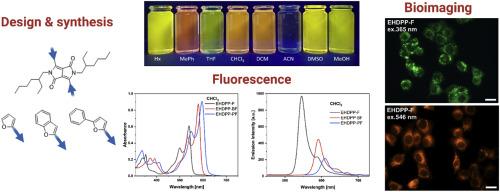
Three symmetrical D-A-D systems of N-alkylated 3,6-difuran-2,5-dihydro-pyrrolo[3,4-c]pyrrole-1,4-dione (EHDPP) with various π conjugated aromatic part based on furan moiety were designed, synthesised and fully characterised. These three different π-extended chromophores show different intramolecular charge transfer properties. Photophysical analysis of EHDPP derivatives revealed broad absorption in the 300–620 nm range, shifting absorption maxima by 60 nm with increasing π-conjugation. Emission studies showed intense fluorescence from 520 to 680 nm with 30–79 % quantum yields, which improved with increasing conjugation. The polarity of the solvent had minimal influence on the absorption spectra, but a slight positive solvatochromism was observed in the emission spectra, confirming the stabilised excited states with donor-acceptor characteristics. Low-temperature studies further revealed enhanced vibronic features and extended lifetimes, particularly for EHDPP-PF with 2-phenylfuran units, attributed to suppressing nonradiative processes. DFT analysis of molecular orbitals reveals increasing substituent contributions to HOMO and LUMO orbitals from furan to 2-phenylfuran, correlating with the enhanced donating ability of terminal groups. A preliminary biological study highlighted the potential of these derivatives as fluorescent cellular probes. The compounds exhibited strong fluorescence stability and negligible cytotoxicity at concentrations suitable for staining cellular compartments, making them promising candidates for biological imaging applications. These findings highlight the importance of terminal substituent modification in tuning the photophysical and electronic properties of EHDPP derivatives.
期刊介绍:
Dyes and Pigments covers the scientific and technical aspects of the chemistry and physics of dyes, pigments and their intermediates. Emphasis is placed on the properties of the colouring matters themselves rather than on their applications or the system in which they may be applied.
Thus the journal accepts research and review papers on the synthesis of dyes, pigments and intermediates, their physical or chemical properties, e.g. spectroscopic, surface, solution or solid state characteristics, the physical aspects of their preparation, e.g. precipitation, nucleation and growth, crystal formation, liquid crystalline characteristics, their photochemical, ecological or biological properties and the relationship between colour and chemical constitution. However, papers are considered which deal with the more fundamental aspects of colourant application and of the interactions of colourants with substrates or media.
The journal will interest a wide variety of workers in a range of disciplines whose work involves dyes, pigments and their intermediates, and provides a platform for investigators with common interests but diverse fields of activity such as cosmetics, reprographics, dye and pigment synthesis, medical research, polymers, etc.



 京公网安备 11010802042870号
京ICP备2023020795号-1
京公网安备 11010802042870号
京ICP备2023020795号-1

 分享
分享
 求助内容:
求助内容: 应助结果提醒方式:
 扫码关注我们
