Hongzhang Dai , Xin Li , Denghong Wang , Pingyang Gu , Shanbao Liu , Genhou Wang
{"title":"Geochemical and geochronological constraints on the petrogenesis of granitoids from the Ke’eryin area","authors":"Hongzhang Dai , Xin Li , Denghong Wang , Pingyang Gu , Shanbao Liu , Genhou Wang","doi":"10.1016/j.oregeorev.2025.106507","DOIUrl":null,"url":null,"abstract":"<div><div>Three granitic plutons with varying degrees of pegmatite development were selected from the Ke’eryin area to investigate the metallogenic characteristics of granitoids related to pegmatite-type rare metal mineralization in the Songpan-Garze Fold Belt (SGFB). Comparative studies, including chronological, geochemical, and isotopic analyses, were conducted on the parental rock (i.e., the Ke’eryin pluton) of lithium-bearing pegmatite in the Ke’eryin lithium ore field, SGFB, China. LA-ICP-MS zircon U-Pb dating revealed crystallization ages of 211.4±1.5 Ma, 209.1±0.9 Ma, and 204.0±1.5 Ma for the Siyuewu (SYW), Nahe (NH), and Elangshan (ELS) plutons, respectively. These findings suggest that all three granitoids were formed in the same tectonic environment as the Ke’eryin pluton. Geochemically, the plutons are enriched in large-ion lithophile elements (LILE) such as Rb, U, and Th, and light rare earth elements (LREE), while showing depletion in high-field-strength elements (HFSE) such as Nb, Ta, and Ti, and heavy rare earth elements (HREE). The plutons also exhibit low A/CNK and Zr + Nb + Ce + Y values, high [La/Yb]N and [Gd/Yb]N ratios, and low concentrations of Cr, Ni, Y, Yb, Sr, P<sub>2</sub>O<sub>5</sub>,and Zr, with a negative correlation between P<sub>2</sub>O<sub>5</sub> and SiO<sub>2</sub> concentrations. These characteristics indicate that the plutons can be classified as I-type granites, originating from the garnet-plagioclase stability field in the lower crust under granulite facies metamorphic conditions, which contrasts significantly with the Ke’eryin pluton. Zircon εHf(t) and corresponding T<sub>DMc</sub> values were determined to be −2.77 – −8.15 and 1.42–1.76 Ga for the SYW pluton; 1.81 – −3.26 (with only one spot >0) and 1.13–1.45 Ga for the NH pluton; and −12.81 – 1.62 (with most spots ranging from 0.18 to 1.62) and 1.14–2.05 Ga (with only one spot >1.44 Ga) for the ELS pluton. These results suggest that the three plutons were derived from the partial melting of the Paleoproterozoic to Neoproterozoic crust. The I<sub>Sr</sub> and εNd(t) values of the ELS pluton samples (I<sub>Sr</sub> = 0.706688–0.707127, εNd(t) = −3.99 – −5.08, T<sub>DM2</sub> = 1.31–1.40 Ga)closely correspond to those of the Western Yangtze Block. The SYW pluton samples (I<sub>Sr</sub> = 0.709392–0.712291, εNd(t) = −6.98 – −9.24, T<sub>DM2</sub> = 1.56–1.74 Ga) partially overlap with the isotopic range of the Triassic Xikang Group. Meanwhile, the NH pluton samples (I<sub>Sr</sub> = 0.707948–0.708368, εNd(t) = −6.90 – −7.45, T<sub>DM2</sub> = 1.55–1.59 Ga) exhibit isotopic values intermediate between those of the ELS and SYW plutons. Importantly, the Sr-Nd-Hf isotopic characteristics are consistent with pegmatite occurrences, suggesting that the assimilation of surrounding Triassic Xikang Group rocks may have contributed to the diverse isotopic compositions and the development of pegmatites. Based on these findings and the regional geological context, it is proposed that granitoids capable of hosting pegmatite-type rare metal deposits in the SGFB were likely emplaced during the tectonic transition or extensional phase of the post-collisional stage of the Indosinian orogeny. The source rocks for these granitoids are likely the high-maturity metasedimentary rocks of theTriassic Xikang Group.</div></div>","PeriodicalId":19644,"journal":{"name":"Ore Geology Reviews","volume":"179 ","pages":"Article 106507"},"PeriodicalIF":3.6000,"publicationDate":"2025-04-01","publicationTypes":"Journal Article","fieldsOfStudy":null,"isOpenAccess":false,"openAccessPdf":"","citationCount":"0","resultStr":null,"platform":"Semanticscholar","paperid":null,"PeriodicalName":"Ore Geology Reviews","FirstCategoryId":"89","ListUrlMain":"https://www.sciencedirect.com/science/article/pii/S0169136825000678","RegionNum":2,"RegionCategory":"地球科学","ArticlePicture":[],"TitleCN":null,"AbstractTextCN":null,"PMCID":null,"EPubDate":"2025/2/17 0:00:00","PubModel":"Epub","JCR":"Q1","JCRName":"GEOLOGY","Score":null,"Total":0}
引用次数: 0
Abstract
Three granitic plutons with varying degrees of pegmatite development were selected from the Ke’eryin area to investigate the metallogenic characteristics of granitoids related to pegmatite-type rare metal mineralization in the Songpan-Garze Fold Belt (SGFB). Comparative studies, including chronological, geochemical, and isotopic analyses, were conducted on the parental rock (i.e., the Ke’eryin pluton) of lithium-bearing pegmatite in the Ke’eryin lithium ore field, SGFB, China. LA-ICP-MS zircon U-Pb dating revealed crystallization ages of 211.4±1.5 Ma, 209.1±0.9 Ma, and 204.0±1.5 Ma for the Siyuewu (SYW), Nahe (NH), and Elangshan (ELS) plutons, respectively. These findings suggest that all three granitoids were formed in the same tectonic environment as the Ke’eryin pluton. Geochemically, the plutons are enriched in large-ion lithophile elements (LILE) such as Rb, U, and Th, and light rare earth elements (LREE), while showing depletion in high-field-strength elements (HFSE) such as Nb, Ta, and Ti, and heavy rare earth elements (HREE). The plutons also exhibit low A/CNK and Zr + Nb + Ce + Y values, high [La/Yb]N and [Gd/Yb]N ratios, and low concentrations of Cr, Ni, Y, Yb, Sr, P2O5,and Zr, with a negative correlation between P2O5 and SiO2 concentrations. These characteristics indicate that the plutons can be classified as I-type granites, originating from the garnet-plagioclase stability field in the lower crust under granulite facies metamorphic conditions, which contrasts significantly with the Ke’eryin pluton. Zircon εHf(t) and corresponding TDMc values were determined to be −2.77 – −8.15 and 1.42–1.76 Ga for the SYW pluton; 1.81 – −3.26 (with only one spot >0) and 1.13–1.45 Ga for the NH pluton; and −12.81 – 1.62 (with most spots ranging from 0.18 to 1.62) and 1.14–2.05 Ga (with only one spot >1.44 Ga) for the ELS pluton. These results suggest that the three plutons were derived from the partial melting of the Paleoproterozoic to Neoproterozoic crust. The ISr and εNd(t) values of the ELS pluton samples (ISr = 0.706688–0.707127, εNd(t) = −3.99 – −5.08, TDM2 = 1.31–1.40 Ga)closely correspond to those of the Western Yangtze Block. The SYW pluton samples (ISr = 0.709392–0.712291, εNd(t) = −6.98 – −9.24, TDM2 = 1.56–1.74 Ga) partially overlap with the isotopic range of the Triassic Xikang Group. Meanwhile, the NH pluton samples (ISr = 0.707948–0.708368, εNd(t) = −6.90 – −7.45, TDM2 = 1.55–1.59 Ga) exhibit isotopic values intermediate between those of the ELS and SYW plutons. Importantly, the Sr-Nd-Hf isotopic characteristics are consistent with pegmatite occurrences, suggesting that the assimilation of surrounding Triassic Xikang Group rocks may have contributed to the diverse isotopic compositions and the development of pegmatites. Based on these findings and the regional geological context, it is proposed that granitoids capable of hosting pegmatite-type rare metal deposits in the SGFB were likely emplaced during the tectonic transition or extensional phase of the post-collisional stage of the Indosinian orogeny. The source rocks for these granitoids are likely the high-maturity metasedimentary rocks of theTriassic Xikang Group.
期刊介绍:
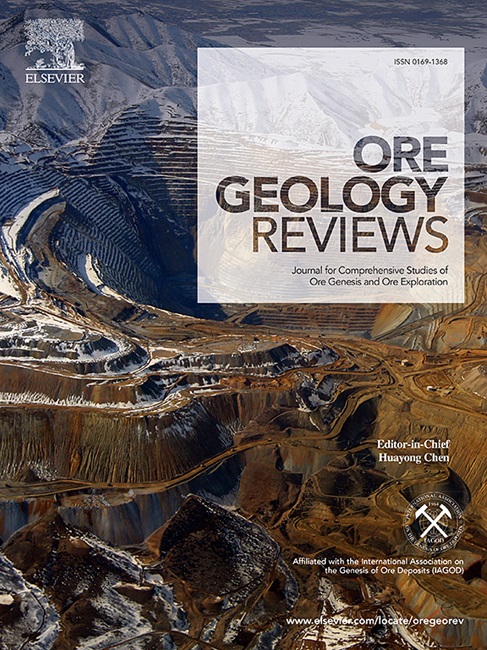
Ore Geology Reviews aims to familiarize all earth scientists with recent advances in a number of interconnected disciplines related to the study of, and search for, ore deposits. The reviews range from brief to longer contributions, but the journal preferentially publishes manuscripts that fill the niche between the commonly shorter journal articles and the comprehensive book coverages, and thus has a special appeal to many authors and readers.




 京公网安备 11010802042870号
京ICP备2023020795号-1
京公网安备 11010802042870号
京ICP备2023020795号-1

 分享
分享
 求助内容:
求助内容: 应助结果提醒方式:
 扫码关注我们
