The threshold for intracranial self-stimulation does not increase in rats exposed to chronic unpredictable stress – A systematic review and meta-analysis
{"title":"The threshold for intracranial self-stimulation does not increase in rats exposed to chronic unpredictable stress – A systematic review and meta-analysis","authors":"Jenny Paola Berrio Sanchez , Jenny Wilzopolski , Katharina Hohlbaum , Otto Kalliokoski","doi":"10.1016/j.bbr.2025.115483","DOIUrl":null,"url":null,"abstract":"<div><div>The chronic unpredictable stress model is a rodent model of stress-induced anhedonia. The sucrose preference test, often used to validate it, is unreliable. Intracranial self-stimulation offers an alternative and is often cited as supporting evidence of the model's validity. Our aim was to assess whether an increased self-stimulation threshold is found after stress and if such a change correlates with decreases in sweet consumption. We searched PubMed, Embase (ovid), and Web of Science for studies in rats exposed to chronic unpredictable stress that employed intracranial self-stimulation. Thresholds for stressed and control animals were pooled from 11 studies that collectively reported on 23 different experiments. Over 50 % of the data was contributed by one research group, so a three-level meta-analytical random effects model was fit to account for methodological differences between different networks of researchers. After this adjustment, we did not find that the self-stimulation thresholds were increased in stressed rats. Pioneering experiments with positive results failed to be replicated by others, although no specific factor could be pointed to as a likely explanation. What is more, the available evidence suggests a lack of connection between sweet preference and self-stimulation, although this relationship has been seldom investigated. No study reported correlation coefficients. Methods known to mitigate biases were frequently absent, as was a transparent report of crucial study details. Our findings challenge the claim made in support of the validity of the model. Further efforts would be well-invested in assessing how reliably other tests of anhedonia have found the effects of the chronic unpredictable stress model.</div></div>","PeriodicalId":8823,"journal":{"name":"Behavioural Brain Research","volume":"484 ","pages":"Article 115483"},"PeriodicalIF":2.3000,"publicationDate":"2025-04-27","publicationTypes":"Journal Article","fieldsOfStudy":null,"isOpenAccess":false,"openAccessPdf":"","citationCount":"0","resultStr":null,"platform":"Semanticscholar","paperid":null,"PeriodicalName":"Behavioural Brain Research","FirstCategoryId":"102","ListUrlMain":"https://www.sciencedirect.com/science/article/pii/S0166432825000695","RegionNum":3,"RegionCategory":"心理学","ArticlePicture":[],"TitleCN":null,"AbstractTextCN":null,"PMCID":null,"EPubDate":"2025/2/19 0:00:00","PubModel":"Epub","JCR":"Q2","JCRName":"BEHAVIORAL SCIENCES","Score":null,"Total":0}
引用次数: 0
Abstract
The chronic unpredictable stress model is a rodent model of stress-induced anhedonia. The sucrose preference test, often used to validate it, is unreliable. Intracranial self-stimulation offers an alternative and is often cited as supporting evidence of the model's validity. Our aim was to assess whether an increased self-stimulation threshold is found after stress and if such a change correlates with decreases in sweet consumption. We searched PubMed, Embase (ovid), and Web of Science for studies in rats exposed to chronic unpredictable stress that employed intracranial self-stimulation. Thresholds for stressed and control animals were pooled from 11 studies that collectively reported on 23 different experiments. Over 50 % of the data was contributed by one research group, so a three-level meta-analytical random effects model was fit to account for methodological differences between different networks of researchers. After this adjustment, we did not find that the self-stimulation thresholds were increased in stressed rats. Pioneering experiments with positive results failed to be replicated by others, although no specific factor could be pointed to as a likely explanation. What is more, the available evidence suggests a lack of connection between sweet preference and self-stimulation, although this relationship has been seldom investigated. No study reported correlation coefficients. Methods known to mitigate biases were frequently absent, as was a transparent report of crucial study details. Our findings challenge the claim made in support of the validity of the model. Further efforts would be well-invested in assessing how reliably other tests of anhedonia have found the effects of the chronic unpredictable stress model.
慢性不可预测应激模型是应激性快感缺乏的啮齿动物模型。通常用来验证它的蔗糖偏好测试是不可靠的。颅内自我刺激提供了另一种选择,并经常被引用作为支持该模型有效性的证据。我们的目的是评估压力后是否会发现自我刺激阈值的增加,以及这种变化是否与甜食消费量的减少有关。我们检索了PubMed、Embase (ovid)和Web of Science,寻找暴露于慢性不可预测压力下的大鼠采用颅内自我刺激的研究。应激动物和对照动物的阈值来自11项研究,这些研究总共报告了23个不同的实验。超过50%的数据是由一个研究小组贡献的,因此一个三层元分析随机效应模型适合于解释不同研究人员网络之间的方法差异。调整后,我们没有发现应激大鼠的自我刺激阈值升高。具有积极结果的开创性实验未能被其他人复制,尽管没有具体的因素可以作为一个可能的解释。更重要的是,现有证据表明,甜食偏好和自我刺激之间缺乏联系,尽管这种关系很少被调查。没有研究报告相关系数。通常没有已知的减轻偏差的方法,也没有对关键研究细节进行透明的报告。我们的发现对支持该模型有效性的主张提出了挑战。进一步的努力将充分投入到评估其他快感缺乏症测试发现慢性不可预测压力模型影响的可靠性上。
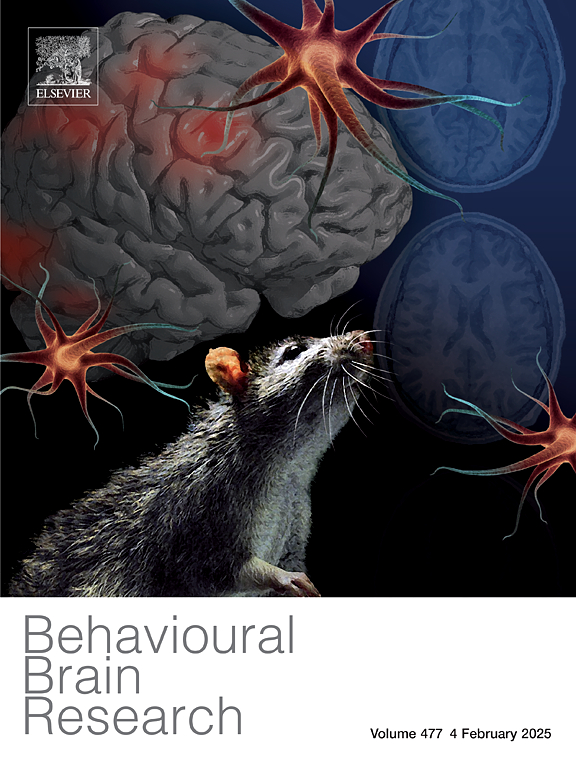
期刊介绍:
Behavioural Brain Research is an international, interdisciplinary journal dedicated to the publication of articles in the field of behavioural neuroscience, broadly defined. Contributions from the entire range of disciplines that comprise the neurosciences, behavioural sciences or cognitive sciences are appropriate, as long as the goal is to delineate the neural mechanisms underlying behaviour. Thus, studies may range from neurophysiological, neuroanatomical, neurochemical or neuropharmacological analysis of brain-behaviour relations, including the use of molecular genetic or behavioural genetic approaches, to studies that involve the use of brain imaging techniques, to neuroethological studies. Reports of original research, of major methodological advances, or of novel conceptual approaches are all encouraged. The journal will also consider critical reviews on selected topics.




 京公网安备 11010802042870号
京ICP备2023020795号-1
京公网安备 11010802042870号
京ICP备2023020795号-1

 分享
分享
 求助内容:
求助内容: 应助结果提醒方式:
 扫码关注我们
