Effect of changes trajectory of serum phosphate levels on the 28-day mortality risk in patients with sepsis: a retrospective cohort study from the MIMIC-IV database.
{"title":"Effect of changes trajectory of serum phosphate levels on the 28-day mortality risk in patients with sepsis: a retrospective cohort study from the MIMIC-IV database.","authors":"Rui Zhang, Dingxing Zhou","doi":"10.1186/s12879-025-10547-9","DOIUrl":null,"url":null,"abstract":"<p><strong>Background: </strong>Serum phosphate levels have been reported to be linked to the prognosis in critically ill patients. The purpose of this study was to analyze the impact of the trajectory of changes in serum phosphate levels on the short-term mortality risk in patients with sepsis.</p><p><strong>Methods: </strong>This retrospective cohort study used data on patients with sepsis from the 2008-2019 Medical Information Mart for Intensive Care IV (MIMIC-IV) database. Serum phosphate level trajectories were constructed using a latent growth mixture modeling (LGMM) based on four measurements of serum phosphate at six-hour intervals within 24 h of admission to the intensive care unit (ICU). The relationship between serum phosphate levels at ICU admission and serum phosphate level trajectories and the risk of 28-day mortality in patients with sepsis was analyzed using Cox regression models, and hazard ratio (HR) and 95% confidence interval (CI) were calculated.</p><p><strong>Results: </strong>Of these 1,703 patients with sepsis included, 566 (33.24%) died within 28 days. The median serum phosphate levels of the patients were 4.10 (3.00, 5.50) mg/dL. Four serum phosphate level trajectories were classified: normal-level-steady trend (trajectory 1), high-level-steady trend (trajectory 2), high-level-decreasing trend (trajectory 3), and high-level-increasing trend (trajectory 4). High serum phosphate levels at admission were associated with a higher risk of 28-day mortality (HR = 1.05, 95%CI: 1.01-1.09) in patients with sepsis. For trajectories, trajectory 2 (HR = 1.27, 95%CI: 1.05-1.54) related to an increased risk of 28-day mortality compared with trajectory 1, whereas trajectory 4 (HR = 1.69, 95%CI: 0.99-2.91, P = 0.056) may be related. There was no significant difference in 28-day mortality between patients on trajectory 3 and trajectory 1 (P = 0.280). Subgroup analyses demonstrated that patients with trajectory 2 were linked to a higher risk of 28-day mortality in different population subgroups (P < 0.05).</p><p><strong>Conclusion: </strong>Stable trajectories of high serum phosphate levels are an important risk factor for short-term mortality in patients with sepsis.</p>","PeriodicalId":8981,"journal":{"name":"BMC Infectious Diseases","volume":"25 1","pages":"245"},"PeriodicalIF":3.0000,"publicationDate":"2025-02-21","publicationTypes":"Journal Article","fieldsOfStudy":null,"isOpenAccess":false,"openAccessPdf":"https://www.ncbi.nlm.nih.gov/pmc/articles/PMC11844063/pdf/","citationCount":"0","resultStr":null,"platform":"Semanticscholar","paperid":null,"PeriodicalName":"BMC Infectious Diseases","FirstCategoryId":"3","ListUrlMain":"https://doi.org/10.1186/s12879-025-10547-9","RegionNum":3,"RegionCategory":"医学","ArticlePicture":[],"TitleCN":null,"AbstractTextCN":null,"PMCID":null,"EPubDate":"","PubModel":"","JCR":"Q2","JCRName":"INFECTIOUS DISEASES","Score":null,"Total":0}
引用次数: 0
Abstract
Background: Serum phosphate levels have been reported to be linked to the prognosis in critically ill patients. The purpose of this study was to analyze the impact of the trajectory of changes in serum phosphate levels on the short-term mortality risk in patients with sepsis.
Methods: This retrospective cohort study used data on patients with sepsis from the 2008-2019 Medical Information Mart for Intensive Care IV (MIMIC-IV) database. Serum phosphate level trajectories were constructed using a latent growth mixture modeling (LGMM) based on four measurements of serum phosphate at six-hour intervals within 24 h of admission to the intensive care unit (ICU). The relationship between serum phosphate levels at ICU admission and serum phosphate level trajectories and the risk of 28-day mortality in patients with sepsis was analyzed using Cox regression models, and hazard ratio (HR) and 95% confidence interval (CI) were calculated.
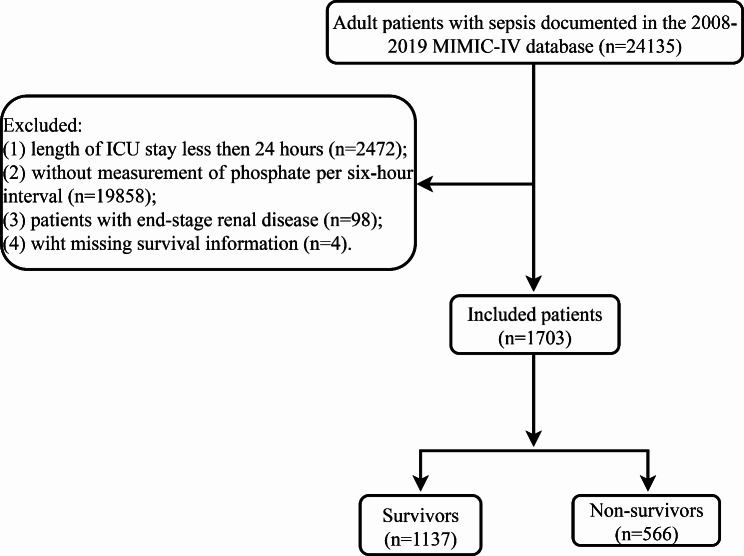
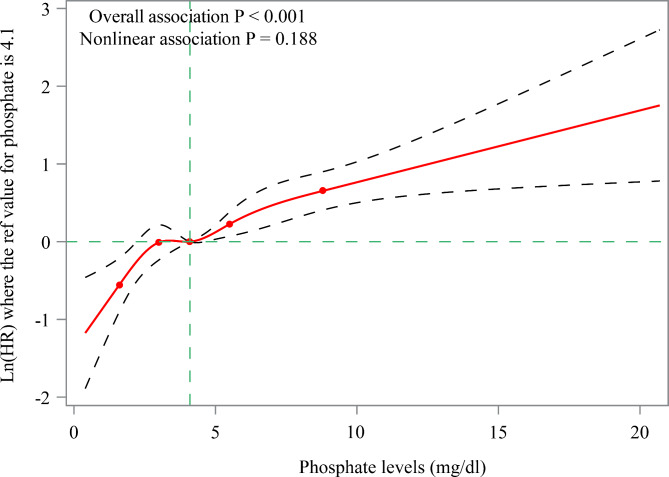
Results: Of these 1,703 patients with sepsis included, 566 (33.24%) died within 28 days. The median serum phosphate levels of the patients were 4.10 (3.00, 5.50) mg/dL. Four serum phosphate level trajectories were classified: normal-level-steady trend (trajectory 1), high-level-steady trend (trajectory 2), high-level-decreasing trend (trajectory 3), and high-level-increasing trend (trajectory 4). High serum phosphate levels at admission were associated with a higher risk of 28-day mortality (HR = 1.05, 95%CI: 1.01-1.09) in patients with sepsis. For trajectories, trajectory 2 (HR = 1.27, 95%CI: 1.05-1.54) related to an increased risk of 28-day mortality compared with trajectory 1, whereas trajectory 4 (HR = 1.69, 95%CI: 0.99-2.91, P = 0.056) may be related. There was no significant difference in 28-day mortality between patients on trajectory 3 and trajectory 1 (P = 0.280). Subgroup analyses demonstrated that patients with trajectory 2 were linked to a higher risk of 28-day mortality in different population subgroups (P < 0.05).
Conclusion: Stable trajectories of high serum phosphate levels are an important risk factor for short-term mortality in patients with sepsis.
期刊介绍:
BMC Infectious Diseases is an open access, peer-reviewed journal that considers articles on all aspects of the prevention, diagnosis and management of infectious and sexually transmitted diseases in humans, as well as related molecular genetics, pathophysiology, and epidemiology.




 京公网安备 11010802042870号
京ICP备2023020795号-1
京公网安备 11010802042870号
京ICP备2023020795号-1

 分享
分享
 求助内容:
求助内容: 应助结果提醒方式:
 扫码关注我们
