Effect on Response Rates of Adding a QR Code to Patient Consent Forms for Qualitative Research in Patients With Cancer: Pilot Randomized Controlled Trial.
Rebecca Wyse, Erin Forbes, Grace Norton, Priscilla Viana Da Silva, Kristy Fakes, Sally Ann Johnston, Stephen R Smith, Alison Zucca
{"title":"Effect on Response Rates of Adding a QR Code to Patient Consent Forms for Qualitative Research in Patients With Cancer: Pilot Randomized Controlled Trial.","authors":"Rebecca Wyse, Erin Forbes, Grace Norton, Priscilla Viana Da Silva, Kristy Fakes, Sally Ann Johnston, Stephen R Smith, Alison Zucca","doi":"10.2196/66681","DOIUrl":null,"url":null,"abstract":"<p><strong>Background: </strong>The successful conduct of health and medical research is largely dependent on participant recruitment. Effective, yet inexpensive methods of increasing response rates for all types of research are required. QR codes are now commonplace, and despite having been extensively used to recruit study participants, a search of the literature failed to reveal any randomized trial investigating the effect of adding a QR code on qualitative research response rates.</p><p><strong>Objective: </strong>This study aimed to collect data on rates of response, consent, and decline among patients with cancer, and the average time taken to respond following randomization to receive either a QR code or no QR code on the patient consent form for a qualitative research study.</p><p><strong>Methods: </strong>This was a pilot randomized controlled trial (RCT) embedded within a qualitative research study. In total, 40 eligible patients received a recruitment pack for the qualitative study, which included an information statement, a consent form, and an addressed, stamped envelope to return their consent form. Patients were randomized 1:1 to the control (standard recruitment pack only) or intervention group (standard recruitment pack including modified consent form with a QR code).</p><p><strong>Results: </strong>In total, 27 out of 40 patients (age: mean 63.0, SD 14.8 years; 45% female) responded to the consent form. A lower proportion of the QR code group (60%) responded (odd ratio [OR] 0.57, 95% CI 0.14-2.37; P=.44), compared to 75% of the standard recruitment group. However, a higher proportion of the QR group (35%) consented (OR 1.84, 95% CI 0.41-8.29; P=.43), compared to the standard recruitment group (20%). A lower proportion of the QR group (25%) declined (OR 0.34, 95% CI 0.09-1.38; P=.13) relative to the standard recruitment group (55%). The mean response time of the QR code group was 16 days (rate ratio [RR] 0.79, 95% CI 0.47-1.35; P=.39) compared to 19 days for the standard recruitment group. None of the age-adjusted analyses were statistically significant.</p><p><strong>Conclusions: </strong>This underpowered pilot study did not find any evidence that offering an option to respond through a QR code on a patient consent form for a qualitative study increased the overall patient response rate (combined rate of consent and decline). However, there was a nonsignificant trend, indicating that more patients who received the QR code consented compared to those who did not receive the QR code. This study provides useful preliminary data on the potential impact of QR codes on patient response rates to invitations to participate in qualitative research and can be used to inform fully powered RCTs.</p><p><strong>Trial registration: </strong>OSF Registries 10.17605/OSF.IO/PJ25X; https://doi.org/10.17605/OSF.IO/PJ25X.</p>","PeriodicalId":14841,"journal":{"name":"JMIR Formative Research","volume":"9 ","pages":"e66681"},"PeriodicalIF":2.0000,"publicationDate":"2025-02-21","publicationTypes":"Journal Article","fieldsOfStudy":null,"isOpenAccess":false,"openAccessPdf":"https://www.ncbi.nlm.nih.gov/pmc/articles/PMC11890127/pdf/","citationCount":"0","resultStr":null,"platform":"Semanticscholar","paperid":null,"PeriodicalName":"JMIR Formative Research","FirstCategoryId":"1085","ListUrlMain":"https://doi.org/10.2196/66681","RegionNum":0,"RegionCategory":null,"ArticlePicture":[],"TitleCN":null,"AbstractTextCN":null,"PMCID":null,"EPubDate":"","PubModel":"","JCR":"Q3","JCRName":"HEALTH CARE SCIENCES & SERVICES","Score":null,"Total":0}
引用次数: 0
Abstract
Background: The successful conduct of health and medical research is largely dependent on participant recruitment. Effective, yet inexpensive methods of increasing response rates for all types of research are required. QR codes are now commonplace, and despite having been extensively used to recruit study participants, a search of the literature failed to reveal any randomized trial investigating the effect of adding a QR code on qualitative research response rates.
Objective: This study aimed to collect data on rates of response, consent, and decline among patients with cancer, and the average time taken to respond following randomization to receive either a QR code or no QR code on the patient consent form for a qualitative research study.
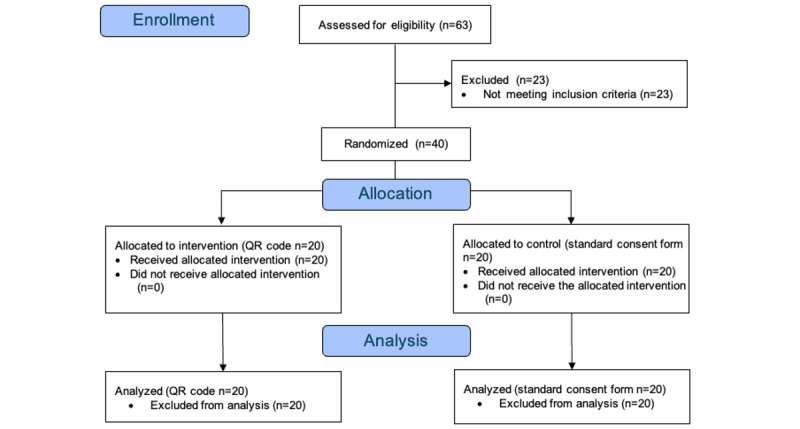
Methods: This was a pilot randomized controlled trial (RCT) embedded within a qualitative research study. In total, 40 eligible patients received a recruitment pack for the qualitative study, which included an information statement, a consent form, and an addressed, stamped envelope to return their consent form. Patients were randomized 1:1 to the control (standard recruitment pack only) or intervention group (standard recruitment pack including modified consent form with a QR code).
Results: In total, 27 out of 40 patients (age: mean 63.0, SD 14.8 years; 45% female) responded to the consent form. A lower proportion of the QR code group (60%) responded (odd ratio [OR] 0.57, 95% CI 0.14-2.37; P=.44), compared to 75% of the standard recruitment group. However, a higher proportion of the QR group (35%) consented (OR 1.84, 95% CI 0.41-8.29; P=.43), compared to the standard recruitment group (20%). A lower proportion of the QR group (25%) declined (OR 0.34, 95% CI 0.09-1.38; P=.13) relative to the standard recruitment group (55%). The mean response time of the QR code group was 16 days (rate ratio [RR] 0.79, 95% CI 0.47-1.35; P=.39) compared to 19 days for the standard recruitment group. None of the age-adjusted analyses were statistically significant.
Conclusions: This underpowered pilot study did not find any evidence that offering an option to respond through a QR code on a patient consent form for a qualitative study increased the overall patient response rate (combined rate of consent and decline). However, there was a nonsignificant trend, indicating that more patients who received the QR code consented compared to those who did not receive the QR code. This study provides useful preliminary data on the potential impact of QR codes on patient response rates to invitations to participate in qualitative research and can be used to inform fully powered RCTs.




 京公网安备 11010802042870号
京ICP备2023020795号-1
京公网安备 11010802042870号
京ICP备2023020795号-1

 分享
分享
 求助内容:
求助内容: 应助结果提醒方式:
 扫码关注我们
