{"title":"In-situ generation of Co-Fe bimetallic electrocatalysts on lignosulfonate-derived graphene by direct laser writing for wearable glucose biosensors","authors":"Zuhao Wang, Xiaoyun Bi, Liangzhang Tang, Honghan Sun, Zhibo Cao, Can Jiang","doi":"10.1016/j.snb.2025.137506","DOIUrl":null,"url":null,"abstract":"<div><div>Wearable biosensors are promising tools for real-time analysis and tracking of human physiological dynamics. However, their fabrication often requires additional electrocatalysts deposited on inert electrode materials, which consistently limits large-scale application. In this study, cobalt-iron Prussian blue analogues (Co-Fe PBA)-mediated sodium lignosulfonate (LS) nanohybrids (PBA-LS) were incorporated into carboxylated nitrile butadiene rubber (XNBR) by latex compounding technology to yield a flexible substrate (PLX). Through CO<sub>2</sub> direct laser writing (DLW), PBA-LS was in-situ transformed into Co-Fe transition metal compound-doped laser-induced graphene (TMC@LIG) electrodes on the PLX surface. For non-invasive and real-time sweat glucose detection, a wearable glucose biosensor was fabricated by directly loading glucose oxidase (GOx) on TMC@LIG, followed by simple microfluidic packaging and connection to a portable miniature electrochemical workstation. The resulting enzymatic glucose biosensor exhibited a sensitivity of 31.28 μA mM⁻¹ cm⁻² and a detection limit of 25 μM. To enhance pathological diagnosis and analysis after identifying health issues through the wearable glucose biosensor, this study further developed a non-enzymatic TMC@LIG-based glucose sensor in an alkaline system with higher sensitivity (340.68 μA mM⁻¹ cm⁻²), a lower detection limit (10 μM), and a wide detection range (0.01–8 mM), enabling precise body fluid analysis. The two TMC@LIG-based biosensors facilitate comprehensive glucose health monitoring and analysis on the same platform, which offers new insights into the rapid fabrication and systematic application of glucose biosensors.</div></div>","PeriodicalId":425,"journal":{"name":"Sensors and Actuators B: Chemical","volume":"432 ","pages":"Article 137506"},"PeriodicalIF":3.7000,"publicationDate":"2025-06-01","publicationTypes":"Journal Article","fieldsOfStudy":null,"isOpenAccess":false,"openAccessPdf":"","citationCount":"0","resultStr":null,"platform":"Semanticscholar","paperid":null,"PeriodicalName":"Sensors and Actuators B: Chemical","FirstCategoryId":"92","ListUrlMain":"https://www.sciencedirect.com/science/article/pii/S0925400525002813","RegionNum":1,"RegionCategory":"化学","ArticlePicture":[],"TitleCN":null,"AbstractTextCN":null,"PMCID":null,"EPubDate":"2025/2/23 0:00:00","PubModel":"Epub","JCR":"Q1","JCRName":"CHEMISTRY, ANALYTICAL","Score":null,"Total":0}
引用次数: 0
Abstract
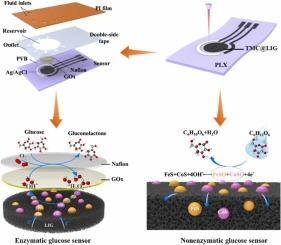
Wearable biosensors are promising tools for real-time analysis and tracking of human physiological dynamics. However, their fabrication often requires additional electrocatalysts deposited on inert electrode materials, which consistently limits large-scale application. In this study, cobalt-iron Prussian blue analogues (Co-Fe PBA)-mediated sodium lignosulfonate (LS) nanohybrids (PBA-LS) were incorporated into carboxylated nitrile butadiene rubber (XNBR) by latex compounding technology to yield a flexible substrate (PLX). Through CO2 direct laser writing (DLW), PBA-LS was in-situ transformed into Co-Fe transition metal compound-doped laser-induced graphene (TMC@LIG) electrodes on the PLX surface. For non-invasive and real-time sweat glucose detection, a wearable glucose biosensor was fabricated by directly loading glucose oxidase (GOx) on TMC@LIG, followed by simple microfluidic packaging and connection to a portable miniature electrochemical workstation. The resulting enzymatic glucose biosensor exhibited a sensitivity of 31.28 μA mM⁻¹ cm⁻² and a detection limit of 25 μM. To enhance pathological diagnosis and analysis after identifying health issues through the wearable glucose biosensor, this study further developed a non-enzymatic TMC@LIG-based glucose sensor in an alkaline system with higher sensitivity (340.68 μA mM⁻¹ cm⁻²), a lower detection limit (10 μM), and a wide detection range (0.01–8 mM), enabling precise body fluid analysis. The two TMC@LIG-based biosensors facilitate comprehensive glucose health monitoring and analysis on the same platform, which offers new insights into the rapid fabrication and systematic application of glucose biosensors.
期刊介绍:
Sensors & Actuators, B: Chemical is an international journal focused on the research and development of chemical transducers. It covers chemical sensors and biosensors, chemical actuators, and analytical microsystems. The journal is interdisciplinary, aiming to publish original works showcasing substantial advancements beyond the current state of the art in these fields, with practical applicability to solving meaningful analytical problems. Review articles are accepted by invitation from an Editor of the journal.



 京公网安备 11010802042870号
京ICP备2023020795号-1
京公网安备 11010802042870号
京ICP备2023020795号-1

 分享
分享
 求助内容:
求助内容: 应助结果提醒方式:
 扫码关注我们
