Andong Hu , Bing Li , Shang Yang , Chaohui Yang , Jie Ye , Yuefei Huang , Shungui Zhou , Guangqian Wang
{"title":"Unlocking interfacial electron transfer in biophotoelectrochemical processes: Role of extracellular polymeric substances in aquatic environments","authors":"Andong Hu , Bing Li , Shang Yang , Chaohui Yang , Jie Ye , Yuefei Huang , Shungui Zhou , Guangqian Wang","doi":"10.1016/j.watres.2025.123375","DOIUrl":null,"url":null,"abstract":"<div><div>The biophotoelectrochemical process (BPECs) integrates the light-absorbing capabilities of nano-semiconductors with the catalytic efficiency of microorganisms, demonstrating significant potential for the development, utilization, transformation, and ecological restoration of water resources. In aquatic environments, extracellular polymeric substances (EPS) serve as a critical interfacial barrier between microorganisms and semiconductor materials, with the underlying electron transfer mechanisms playing a pivotal role in determining the efficiency of bio-photochemical reactions. Despite their importance, the rapidity and complexity of the electron transfer process within EPS pose significant challenges to a comprehensive understanding of BPECs. In this study, an in-situ characterization strategy was employed to rapidly and accurately analyze the components and pathways of photogenerated electron transfer involving EPS at interfaces. The findings indicate that EPS significantly accelerates the transfer of photogenerated electrons within BPECs. Specifically, proteins and redox-active substances within EPS act as efficient conduits for electron transfer, accounting for up to 84.2% of the increased speed in electron transfer rates at bio-abiotic interfaces. Conversely, polysaccharides within EPS impede the electron transfer process but serve as substrates that facilitate methane (CH<sub>4</sub>) production. The in-situ characterization approach used in this research provides valuable insights into the interfacial electron transfer mechanisms of EPS in BPECs, emphasizing their relevance in aquatic environments. This study establishes a theoretical framework for designing high-performance BPECs, with significant implications for the energy utilization of water resources and the transformation of water pollutants.</div></div>","PeriodicalId":443,"journal":{"name":"Water Research","volume":"278 ","pages":"Article 123375"},"PeriodicalIF":12.4000,"publicationDate":"2025-06-15","publicationTypes":"Journal Article","fieldsOfStudy":null,"isOpenAccess":false,"openAccessPdf":"","citationCount":"0","resultStr":null,"platform":"Semanticscholar","paperid":null,"PeriodicalName":"Water Research","FirstCategoryId":"93","ListUrlMain":"https://www.sciencedirect.com/science/article/pii/S004313542500288X","RegionNum":1,"RegionCategory":"环境科学与生态学","ArticlePicture":[],"TitleCN":null,"AbstractTextCN":null,"PMCID":null,"EPubDate":"2025/2/23 0:00:00","PubModel":"Epub","JCR":"Q1","JCRName":"ENGINEERING, ENVIRONMENTAL","Score":null,"Total":0}
引用次数: 0
Abstract
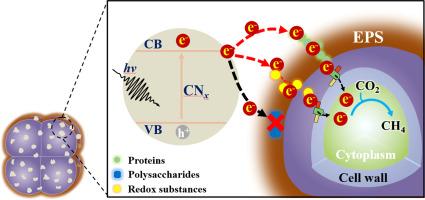
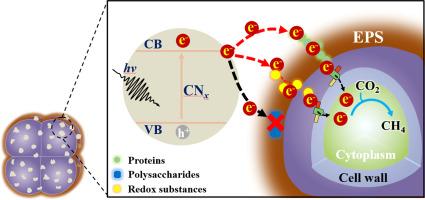
The biophotoelectrochemical process (BPECs) integrates the light-absorbing capabilities of nano-semiconductors with the catalytic efficiency of microorganisms, demonstrating significant potential for the development, utilization, transformation, and ecological restoration of water resources. In aquatic environments, extracellular polymeric substances (EPS) serve as a critical interfacial barrier between microorganisms and semiconductor materials, with the underlying electron transfer mechanisms playing a pivotal role in determining the efficiency of bio-photochemical reactions. Despite their importance, the rapidity and complexity of the electron transfer process within EPS pose significant challenges to a comprehensive understanding of BPECs. In this study, an in-situ characterization strategy was employed to rapidly and accurately analyze the components and pathways of photogenerated electron transfer involving EPS at interfaces. The findings indicate that EPS significantly accelerates the transfer of photogenerated electrons within BPECs. Specifically, proteins and redox-active substances within EPS act as efficient conduits for electron transfer, accounting for up to 84.2% of the increased speed in electron transfer rates at bio-abiotic interfaces. Conversely, polysaccharides within EPS impede the electron transfer process but serve as substrates that facilitate methane (CH4) production. The in-situ characterization approach used in this research provides valuable insights into the interfacial electron transfer mechanisms of EPS in BPECs, emphasizing their relevance in aquatic environments. This study establishes a theoretical framework for designing high-performance BPECs, with significant implications for the energy utilization of water resources and the transformation of water pollutants.
期刊介绍:
Water Research, along with its open access companion journal Water Research X, serves as a platform for publishing original research papers covering various aspects of the science and technology related to the anthropogenic water cycle, water quality, and its management worldwide. The audience targeted by the journal comprises biologists, chemical engineers, chemists, civil engineers, environmental engineers, limnologists, and microbiologists. The scope of the journal include:
•Treatment processes for water and wastewaters (municipal, agricultural, industrial, and on-site treatment), including resource recovery and residuals management;
•Urban hydrology including sewer systems, stormwater management, and green infrastructure;
•Drinking water treatment and distribution;
•Potable and non-potable water reuse;
•Sanitation, public health, and risk assessment;
•Anaerobic digestion, solid and hazardous waste management, including source characterization and the effects and control of leachates and gaseous emissions;
•Contaminants (chemical, microbial, anthropogenic particles such as nanoparticles or microplastics) and related water quality sensing, monitoring, fate, and assessment;
•Anthropogenic impacts on inland, tidal, coastal and urban waters, focusing on surface and ground waters, and point and non-point sources of pollution;
•Environmental restoration, linked to surface water, groundwater and groundwater remediation;
•Analysis of the interfaces between sediments and water, and between water and atmosphere, focusing specifically on anthropogenic impacts;
•Mathematical modelling, systems analysis, machine learning, and beneficial use of big data related to the anthropogenic water cycle;
•Socio-economic, policy, and regulations studies.



 京公网安备 11010802042870号
京ICP备2023020795号-1
京公网安备 11010802042870号
京ICP备2023020795号-1

 分享
分享
 求助内容:
求助内容: 应助结果提醒方式:
 扫码关注我们
