Guangpeng Ma , Xinpu Zhou , Yuange Cao , Xianfeng Guan , Wanzhen Wu , Shuyu Zhang , Cuicui Li , Zhenyang Kong , Shuang Wang
{"title":"Sulfonated polyaniline coated Prussian blue analog derived Mn-Fe oxide composite electrode for all-solid-state flexible supercapacitors","authors":"Guangpeng Ma , Xinpu Zhou , Yuange Cao , Xianfeng Guan , Wanzhen Wu , Shuyu Zhang , Cuicui Li , Zhenyang Kong , Shuang Wang","doi":"10.1016/j.cej.2025.160942","DOIUrl":null,"url":null,"abstract":"<div><div>Polyaniline (PANi) is extensively utilized for supercapacitors because of its peculiar doping mechanism and excellent redox properties. However, since its one-dimensional molecular chains usually exist in an aggregated and disordered structure, the PANi backbone is subject to deformation and degradation during charging and discharging processes, which leads to its low actual specific capacitance and rapid structural collapse. To address these challenges, we propose the synthesis of a sulfonated polyaniline (SPANi) structure by one-step copolymerization, which immobilizes the sulfonic acid group (−SO<sub>3</sub>H) onto the PANi backbone. The presence of −SO<sub>3</sub>H helps to promote the redox reaction of PANi to proceed and augment the pseudocapacitive properties. Subsequently, SPANi is further polymerized in-situ on Mn-Fe oxide (MFO) derived from Prussian blue analog to prepare a novel conductive polymer-encapsulated bimetallic oxide hollow nanocube composite material, designated as SPANi/MFO. It demonstrates a remarkable specific capacitance of 597.06 F g<sup>−1</sup> at 1 A g<sup>−1</sup> owing to its superior structural, and maintains 89.05 % of its initial capacity after 10,000 cycles. Assembly of supercapacitors with PAAM/H<sub>2</sub>SO<sub>4</sub> gel electrolyte demonstrates a notable specific capacitance of 177.43 F g<sup>−1</sup> and cycling performance of 90.32 % after 10,000 cycles, the device also exhibits an energy density of 15.77 Wh kg<sup>−1</sup> (400 W kg<sup>−1</sup>). This paper provides a useful method to prepare modified PANi coated functional nanomaterial composite electrodes for supercapacitors.</div></div>","PeriodicalId":270,"journal":{"name":"Chemical Engineering Journal","volume":"508 ","pages":"Article 160942"},"PeriodicalIF":13.2000,"publicationDate":"2025-02-23","publicationTypes":"Journal Article","fieldsOfStudy":null,"isOpenAccess":false,"openAccessPdf":"","citationCount":"0","resultStr":null,"platform":"Semanticscholar","paperid":null,"PeriodicalName":"Chemical Engineering Journal","FirstCategoryId":"5","ListUrlMain":"https://www.sciencedirect.com/science/article/pii/S1385894725017632","RegionNum":1,"RegionCategory":"工程技术","ArticlePicture":[],"TitleCN":null,"AbstractTextCN":null,"PMCID":null,"EPubDate":"","PubModel":"","JCR":"Q1","JCRName":"ENGINEERING, CHEMICAL","Score":null,"Total":0}
引用次数: 0
Abstract
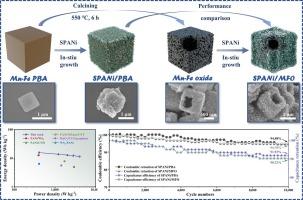
Polyaniline (PANi) is extensively utilized for supercapacitors because of its peculiar doping mechanism and excellent redox properties. However, since its one-dimensional molecular chains usually exist in an aggregated and disordered structure, the PANi backbone is subject to deformation and degradation during charging and discharging processes, which leads to its low actual specific capacitance and rapid structural collapse. To address these challenges, we propose the synthesis of a sulfonated polyaniline (SPANi) structure by one-step copolymerization, which immobilizes the sulfonic acid group (−SO3H) onto the PANi backbone. The presence of −SO3H helps to promote the redox reaction of PANi to proceed and augment the pseudocapacitive properties. Subsequently, SPANi is further polymerized in-situ on Mn-Fe oxide (MFO) derived from Prussian blue analog to prepare a novel conductive polymer-encapsulated bimetallic oxide hollow nanocube composite material, designated as SPANi/MFO. It demonstrates a remarkable specific capacitance of 597.06 F g−1 at 1 A g−1 owing to its superior structural, and maintains 89.05 % of its initial capacity after 10,000 cycles. Assembly of supercapacitors with PAAM/H2SO4 gel electrolyte demonstrates a notable specific capacitance of 177.43 F g−1 and cycling performance of 90.32 % after 10,000 cycles, the device also exhibits an energy density of 15.77 Wh kg−1 (400 W kg−1). This paper provides a useful method to prepare modified PANi coated functional nanomaterial composite electrodes for supercapacitors.
聚苯胺由于其独特的掺杂机理和优异的氧化还原性能,在超级电容器中得到了广泛的应用。然而,由于其一维分子链通常以聚集无序的结构存在,在充放电过程中,聚苯胺骨架容易发生变形和降解,导致其实际比电容低,结构崩溃快。为了解决这些挑战,我们提出了一步共聚法合成磺化聚苯胺(SPANi)结构,该结构将磺酸基(- SO3H)固定在PANi主链上。−SO3H的存在有助于促进聚苯胺的氧化还原反应进行,并增强其赝电容性。随后,将SPANi在源自普鲁士蓝类似物的Mn-Fe氧化物(MFO)上原位聚合,制备了一种新型导电聚合物包封的双金属氧化物空心纳米立方复合材料,命名为SPANi/MFO。由于其优越的结构,在1 a g−1时的比电容为597.06 F g−1,并且在10,000次循环后保持89.05 %的初始容量。用PAAM/H2SO4凝胶电解质组装的超级电容器具有177.43 F g−1的显著比电容和10000次循环后90.32 %的循环性能,其能量密度为15.77 Wh kg−1(400 W kg−1)。本文提供了一种制备改性聚苯胺包覆超级电容器功能纳米复合电极的有效方法。
期刊介绍:
The Chemical Engineering Journal is an international research journal that invites contributions of original and novel fundamental research. It aims to provide an international platform for presenting original fundamental research, interpretative reviews, and discussions on new developments in chemical engineering. The journal welcomes papers that describe novel theory and its practical application, as well as those that demonstrate the transfer of techniques from other disciplines. It also welcomes reports on carefully conducted experimental work that is soundly interpreted. The main focus of the journal is on original and rigorous research results that have broad significance. The Catalysis section within the Chemical Engineering Journal focuses specifically on Experimental and Theoretical studies in the fields of heterogeneous catalysis, molecular catalysis, and biocatalysis. These studies have industrial impact on various sectors such as chemicals, energy, materials, foods, healthcare, and environmental protection.



 京公网安备 11010802042870号
京ICP备2023020795号-1
京公网安备 11010802042870号
京ICP备2023020795号-1

 分享
分享
 求助内容:
求助内容: 应助结果提醒方式:
 扫码关注我们
