Correlation of visceral adiposity index and dietary profile with cardiovascular disease based on decision tree modeling: a cross-sectional study of NHANES.
{"title":"Correlation of visceral adiposity index and dietary profile with cardiovascular disease based on decision tree modeling: a cross-sectional study of NHANES.","authors":"Shiyong Xu, Yirou Cai, Haizhen Hu, Changlin Zhai","doi":"10.1186/s40001-025-02340-w","DOIUrl":null,"url":null,"abstract":"<p><strong>Background: </strong>Visceral adiposity index (VAI) and diets are associated with the risk of cardiovascular disease (CVD). It is unclear how well VAI and diet predict CVD.</p><p><strong>Methods: </strong>Data were obtained from the National Health and Nutrition Examination Survey (NHANES 2017-2018). Demographic data, diets, biochemical examination, and questionnaire information were collected. VAI was calculated using body mass index, waist circumference, triglycerides, and high-density lipoprotein cholesterol. Binary logistic regression was adopted to examine the correlation of VAI and diets with CVD. A decision tree model was developed to predict CVD risk according to different factors.</p><p><strong>Results: </strong>2104 participants (mean age: 50.87 ± 17.35 years, 48.38% males) were included. Participants with high levels of VAI (≥ 2.18) had an elevated risk of CVD compared to those with low levels of VAI (≤ 0.76) (OR = 1.654, 95% CI: 1.025-2.669, P = 0.039). Compared with the low protein intake level (≤ 50.34 g), the upper intermediate (72.10-99.92 g) (OR = 0.445, 95% CI: 0.257-0.770, P = 0.004) and high (≥ 99.93 g) levels of protein intake (OR = 0.450, 95% CI: 0.236-0.858, P = 0.015) reduced CVD risk. The decision tree model unveiled that VAI, protein intake, and dietary fiber intake were predictors for CVD.</p><p><strong>Conclusion: </strong>VAI and protein intake levels are independently associated with CVD risk and have predictive power for CVD. These findings can provide insights into the development of appropriate lifestyle and treatment strategies for patients to reduce the incidence of CVD.</p>","PeriodicalId":11949,"journal":{"name":"European Journal of Medical Research","volume":"30 1","pages":"123"},"PeriodicalIF":3.4000,"publicationDate":"2025-02-22","publicationTypes":"Journal Article","fieldsOfStudy":null,"isOpenAccess":false,"openAccessPdf":"https://www.ncbi.nlm.nih.gov/pmc/articles/PMC11847326/pdf/","citationCount":"0","resultStr":null,"platform":"Semanticscholar","paperid":null,"PeriodicalName":"European Journal of Medical Research","FirstCategoryId":"3","ListUrlMain":"https://doi.org/10.1186/s40001-025-02340-w","RegionNum":3,"RegionCategory":"医学","ArticlePicture":[],"TitleCN":null,"AbstractTextCN":null,"PMCID":null,"EPubDate":"","PubModel":"","JCR":"Q2","JCRName":"MEDICINE, RESEARCH & EXPERIMENTAL","Score":null,"Total":0}
引用次数: 0
Abstract
Background: Visceral adiposity index (VAI) and diets are associated with the risk of cardiovascular disease (CVD). It is unclear how well VAI and diet predict CVD.
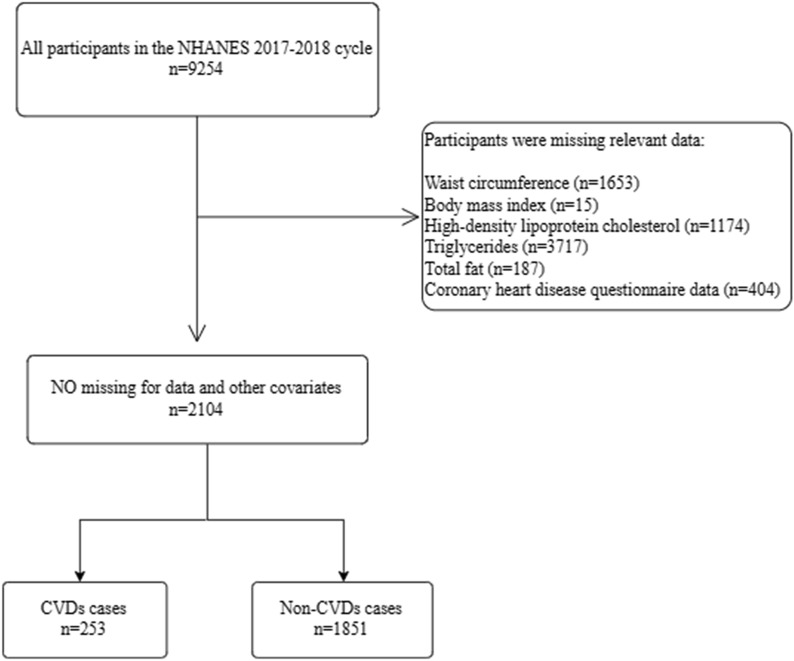
Methods: Data were obtained from the National Health and Nutrition Examination Survey (NHANES 2017-2018). Demographic data, diets, biochemical examination, and questionnaire information were collected. VAI was calculated using body mass index, waist circumference, triglycerides, and high-density lipoprotein cholesterol. Binary logistic regression was adopted to examine the correlation of VAI and diets with CVD. A decision tree model was developed to predict CVD risk according to different factors.
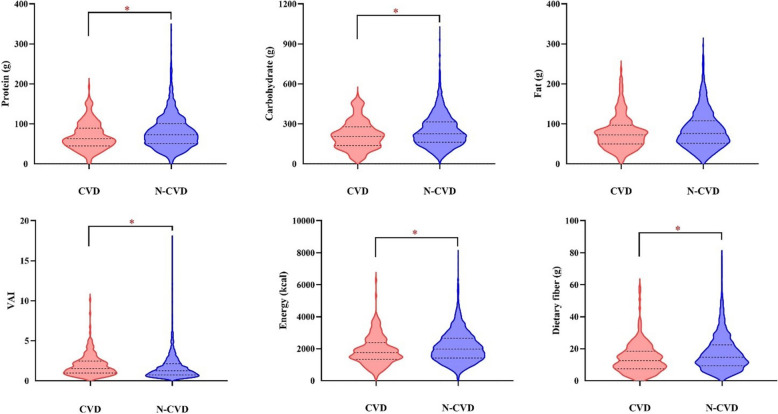
Results: 2104 participants (mean age: 50.87 ± 17.35 years, 48.38% males) were included. Participants with high levels of VAI (≥ 2.18) had an elevated risk of CVD compared to those with low levels of VAI (≤ 0.76) (OR = 1.654, 95% CI: 1.025-2.669, P = 0.039). Compared with the low protein intake level (≤ 50.34 g), the upper intermediate (72.10-99.92 g) (OR = 0.445, 95% CI: 0.257-0.770, P = 0.004) and high (≥ 99.93 g) levels of protein intake (OR = 0.450, 95% CI: 0.236-0.858, P = 0.015) reduced CVD risk. The decision tree model unveiled that VAI, protein intake, and dietary fiber intake were predictors for CVD.
Conclusion: VAI and protein intake levels are independently associated with CVD risk and have predictive power for CVD. These findings can provide insights into the development of appropriate lifestyle and treatment strategies for patients to reduce the incidence of CVD.
期刊介绍:
European Journal of Medical Research publishes translational and clinical research of international interest across all medical disciplines, enabling clinicians and other researchers to learn about developments and innovations within these disciplines and across the boundaries between disciplines. The journal publishes high quality research and reviews and aims to ensure that the results of all well-conducted research are published, regardless of their outcome.




 京公网安备 11010802042870号
京ICP备2023020795号-1
京公网安备 11010802042870号
京ICP备2023020795号-1

 分享
分享
 求助内容:
求助内容: 应助结果提醒方式:
 扫码关注我们
