{"title":"Polymeric Nanofibers via Green Electrospinning for Safe Food Engineering","authors":"Weiqiang Wang, Xingjian Yang, Hongyi Yin, Yi Lu, Hailong Dou, Yanan Liu, Deng-Guang Yu","doi":"10.1002/marc.202401152","DOIUrl":null,"url":null,"abstract":"<p>Electrospun functional nanofibers enable controlled release of the loaded active ingredient and an adjustable dissolution rate. However, the widespread use of toxic organic solvents in electrospinning poses risks to human health and the environment whereas increasing production costs and complexity. This article examines the application of eco-friendly electrospinning technologies in food engineering, with a focus on water-based and melt electrospinning methods. It provides a detailed analysis of water-soluble biopolymers and synthetic polymers, highlighting their current applications and challenges in food engineering. Water-based electrospinning is proposed as a sustainable alternative, offering scalability and reduced environmental impact. This transition is essential for advancing food engineering toward more sustainable and environmentally responsible practices.</p>","PeriodicalId":205,"journal":{"name":"Macromolecular Rapid Communications","volume":"46 10","pages":""},"PeriodicalIF":4.3000,"publicationDate":"2025-02-22","publicationTypes":"Journal Article","fieldsOfStudy":null,"isOpenAccess":false,"openAccessPdf":"","citationCount":"0","resultStr":null,"platform":"Semanticscholar","paperid":null,"PeriodicalName":"Macromolecular Rapid Communications","FirstCategoryId":"92","ListUrlMain":"https://onlinelibrary.wiley.com/doi/10.1002/marc.202401152","RegionNum":3,"RegionCategory":"化学","ArticlePicture":[],"TitleCN":null,"AbstractTextCN":null,"PMCID":null,"EPubDate":"","PubModel":"","JCR":"Q2","JCRName":"POLYMER SCIENCE","Score":null,"Total":0}
引用次数: 0
Abstract
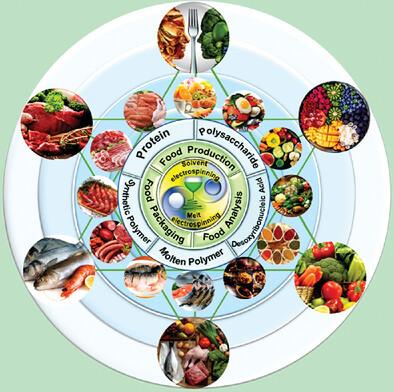
Electrospun functional nanofibers enable controlled release of the loaded active ingredient and an adjustable dissolution rate. However, the widespread use of toxic organic solvents in electrospinning poses risks to human health and the environment whereas increasing production costs and complexity. This article examines the application of eco-friendly electrospinning technologies in food engineering, with a focus on water-based and melt electrospinning methods. It provides a detailed analysis of water-soluble biopolymers and synthetic polymers, highlighting their current applications and challenges in food engineering. Water-based electrospinning is proposed as a sustainable alternative, offering scalability and reduced environmental impact. This transition is essential for advancing food engineering toward more sustainable and environmentally responsible practices.
期刊介绍:
Macromolecular Rapid Communications publishes original research in polymer science, ranging from chemistry and physics of polymers to polymers in materials science and life sciences.



 京公网安备 11010802042870号
京ICP备2023020795号-1
京公网安备 11010802042870号
京ICP备2023020795号-1

 分享
分享
 求助内容:
求助内容: 应助结果提醒方式:
 扫码关注我们
