Lipoprotein(a) in familial dyslipidemias: The effect on cardiovascular prognosis in patients with familial hypercholesterolemia or familial combined hyperlipidemia
{"title":"Lipoprotein(a) in familial dyslipidemias: The effect on cardiovascular prognosis in patients with familial hypercholesterolemia or familial combined hyperlipidemia","authors":"Ioannis Skoumas , Ioannis Andrikou , Spyridon Simantiris , Kalliopi Grigoriou , Ioanna Dima , Dimitrios Terentes-Printzios , Angelos Papanikolaou , Karolina Akinosoglou , Konstantinos Tsioufis , Charalambos Vlachopoulos","doi":"10.1016/j.numecd.2025.103867","DOIUrl":null,"url":null,"abstract":"<div><h3>Background and aims</h3><div>Familial dyslipidemias are associated with increased cardiovascular risk. Increased lipoprotein(a) [Lp(a)] is considered as the most prevalent monogenic lipid disorder. The objective of the study was to identify the cardiovascular prognosis of patients with familial dyslipidemias (heterozygous familial hypercholesterolemia (FH) or familial combined hyperlipidemia (FCH)), without cardiovascular disease at baseline, investigating in parallel the effect of Lp(a).</div></div><div><h3>Methods and results</h3><div>909 patients with FH (n = 433, mean age 44.2 ± 12.8 years) or FCH (n = 476, mean age 49.0 ± 11.1 years) were evaluated during a mean period of 10 years. The main endpoint was the composite of major cardiovascular events. The incidence of major cardiovascular events in the total population was 6.6 %, while greater in patients with FH compared to patients with FCH (8.1 % vs 5.5 %, <em>p</em> = 0.03). Multiple Cox regression analysis revealed that FH patients had greater cardiovascular risk compared to FCH patients (HR 2.17, 95 % CI 1.10–4.26, <em>p</em> = 0.02). In FH patients, increased baseline Lp(a) (≥30 mg/dl) was an independent predictor of adverse cardiovascular events (HR 2.37 95 % CI 1.41–4.90, <em>p</em> = 0.02), whereas in FCH patients was not. In FCH patients the presence of diabetes at baseline was a strong independent prognosticator of adverse cardiovascular events (HR 3.56 95 % CI 1.19–11.33, <em>p</em> = 0.03), after adjustment for confounders.</div></div><div><h3>Conclusions</h3><div>FH patients demonstrate double cardiovascular risk compared to FCH patients. In FH patients increased Lp(a) doubles the cardiovascular risk, beyond low density lipoprotein cholesterol. In FCH patients the presence of diabetes triples the cardiovascular risk, beyond Lp(a) which does not seem to convey an independent prognostic value.</div></div>","PeriodicalId":49722,"journal":{"name":"Nutrition Metabolism and Cardiovascular Diseases","volume":"35 7","pages":"Article 103867"},"PeriodicalIF":3.7000,"publicationDate":"2025-01-23","publicationTypes":"Journal Article","fieldsOfStudy":null,"isOpenAccess":false,"openAccessPdf":"","citationCount":"0","resultStr":null,"platform":"Semanticscholar","paperid":null,"PeriodicalName":"Nutrition Metabolism and Cardiovascular Diseases","FirstCategoryId":"3","ListUrlMain":"https://www.sciencedirect.com/science/article/pii/S0939475325000213","RegionNum":3,"RegionCategory":"医学","ArticlePicture":[],"TitleCN":null,"AbstractTextCN":null,"PMCID":null,"EPubDate":"","PubModel":"","JCR":"Q2","JCRName":"CARDIAC & CARDIOVASCULAR SYSTEMS","Score":null,"Total":0}
引用次数: 0
Abstract
Background and aims
Familial dyslipidemias are associated with increased cardiovascular risk. Increased lipoprotein(a) [Lp(a)] is considered as the most prevalent monogenic lipid disorder. The objective of the study was to identify the cardiovascular prognosis of patients with familial dyslipidemias (heterozygous familial hypercholesterolemia (FH) or familial combined hyperlipidemia (FCH)), without cardiovascular disease at baseline, investigating in parallel the effect of Lp(a).
Methods and results
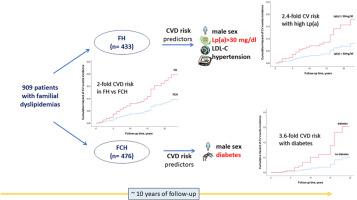
909 patients with FH (n = 433, mean age 44.2 ± 12.8 years) or FCH (n = 476, mean age 49.0 ± 11.1 years) were evaluated during a mean period of 10 years. The main endpoint was the composite of major cardiovascular events. The incidence of major cardiovascular events in the total population was 6.6 %, while greater in patients with FH compared to patients with FCH (8.1 % vs 5.5 %, p = 0.03). Multiple Cox regression analysis revealed that FH patients had greater cardiovascular risk compared to FCH patients (HR 2.17, 95 % CI 1.10–4.26, p = 0.02). In FH patients, increased baseline Lp(a) (≥30 mg/dl) was an independent predictor of adverse cardiovascular events (HR 2.37 95 % CI 1.41–4.90, p = 0.02), whereas in FCH patients was not. In FCH patients the presence of diabetes at baseline was a strong independent prognosticator of adverse cardiovascular events (HR 3.56 95 % CI 1.19–11.33, p = 0.03), after adjustment for confounders.
Conclusions
FH patients demonstrate double cardiovascular risk compared to FCH patients. In FH patients increased Lp(a) doubles the cardiovascular risk, beyond low density lipoprotein cholesterol. In FCH patients the presence of diabetes triples the cardiovascular risk, beyond Lp(a) which does not seem to convey an independent prognostic value.
背景和目的:家族性血脂异常与心血管风险增加有关。脂蛋白升高(a) [Lp(a)]被认为是最常见的单基因脂质紊乱。该研究的目的是确定家族性血脂异常(杂合子家族性高胆固醇血症(FH)或家族性合并高脂血症(FCH))患者的心血管预后,基线时无心血管疾病,同时调查Lp(a)的影响。方法与结果:909例FH (n = 433,平均年龄44.2±12.8岁)或FCH (n = 476,平均年龄49.0±11.1岁)患者,平均随访时间为10年。主要终点是主要心血管事件的综合。总体人群中主要心血管事件的发生率为6.6%,而FH患者的发生率高于FCH患者(8.1% vs 5.5%, p = 0.03)。多因素Cox回归分析显示,FH患者心血管风险高于FCH患者(HR 2.17, 95% CI 1.10-4.26, p = 0.02)。在FH患者中,基线Lp(a)升高(≥30 mg/dl)是不良心血管事件的独立预测因子(HR 2.37 95% CI 1.41-4.90, p = 0.02),而在FCH患者中则不是。在FCH患者中,基线时糖尿病的存在是不良心血管事件的一个强有力的独立预后因素(HR 3.56 95% CI 1.19-11.33, p = 0.03)。结论:与FCH患者相比,FH患者表现出双倍的心血管风险。在FH患者中,Lp(a)升高使心血管风险加倍,超过低密度脂蛋白胆固醇。在FCH患者中,糖尿病的存在使心血管风险增加三倍,超过Lp(a),这似乎没有传达一个独立的预后价值。
期刊介绍:
Nutrition, Metabolism & Cardiovascular Diseases is a forum designed to focus on the powerful interplay between nutritional and metabolic alterations, and cardiovascular disorders. It aims to be a highly qualified tool to help refine strategies against the nutrition-related epidemics of metabolic and cardiovascular diseases. By presenting original clinical and experimental findings, it introduces readers and authors into a rapidly developing area of clinical and preventive medicine, including also vascular biology. Of particular concern are the origins, the mechanisms and the means to prevent and control diabetes, atherosclerosis, hypertension, and other nutrition-related diseases.



 京公网安备 11010802042870号
京ICP备2023020795号-1
京公网安备 11010802042870号
京ICP备2023020795号-1

 分享
分享
 求助内容:
求助内容: 应助结果提醒方式:
 扫码关注我们
