Anuradha Wickramarachchi, Shakila Tonni, Sonali Majumdar, Sarvnaz Karimi, Sulev Kõks, Brendan Hosking, Jordi Rambla, Natalie A Twine, Yatish Jain, Denis C Bauer
{"title":"AskBeacon-performing genomic data exchange and analytics with natural language.","authors":"Anuradha Wickramarachchi, Shakila Tonni, Sonali Majumdar, Sarvnaz Karimi, Sulev Kõks, Brendan Hosking, Jordi Rambla, Natalie A Twine, Yatish Jain, Denis C Bauer","doi":"10.1093/bioinformatics/btaf079","DOIUrl":null,"url":null,"abstract":"<p><strong>Motivation: </strong>Enabling clinicians and researchers to directly interact with global genomic data resources by removing technological barriers is vital for medical genomics. AskBeacon enables large language models (LLMs) to be applied to securely shared cohorts via the Global Alliance for Genomics and Health Beacon protocol. By simply \"asking\" Beacon, actionable insights can be gained, analyzed, and made publication-ready.</p><p><strong>Results: </strong>In the Parkinson's Progression Markers Initiative (PPMI), we use natural language to ask whether the sex-differences observed in Parkinson's disease are due to X-linked or autosomal markers. AskBeacon returns a publication-ready visualization showing that for PPMI the autosomal marker occurred 1.4 times more often in males with Parkinson's disease than females, compared to no differences for the X-linked marker. We evaluate commercial and open-weight LLM models, as well as different architectures to identify the best strategy for translating research questions to Beacon queries. AskBeacon implements extensive safety guardrails to ensure that genomic data is not exposed to the LLM directly, and that generated code for data extraction, analysis and visualization process is sanitized and hallucination resistant, so data cannot be leaked or falsified.</p><p><strong>Availability and implementation: </strong>AskBeacon is available at https://github.com/aehrc/AskBeacon.</p>","PeriodicalId":93899,"journal":{"name":"Bioinformatics (Oxford, England)","volume":" ","pages":""},"PeriodicalIF":5.4000,"publicationDate":"2025-03-04","publicationTypes":"Journal Article","fieldsOfStudy":null,"isOpenAccess":false,"openAccessPdf":"https://www.ncbi.nlm.nih.gov/pmc/articles/PMC11889448/pdf/","citationCount":"0","resultStr":null,"platform":"Semanticscholar","paperid":null,"PeriodicalName":"Bioinformatics (Oxford, England)","FirstCategoryId":"1085","ListUrlMain":"https://doi.org/10.1093/bioinformatics/btaf079","RegionNum":0,"RegionCategory":null,"ArticlePicture":[],"TitleCN":null,"AbstractTextCN":null,"PMCID":null,"EPubDate":"","PubModel":"","JCR":"","JCRName":"","Score":null,"Total":0}
引用次数: 0
Abstract
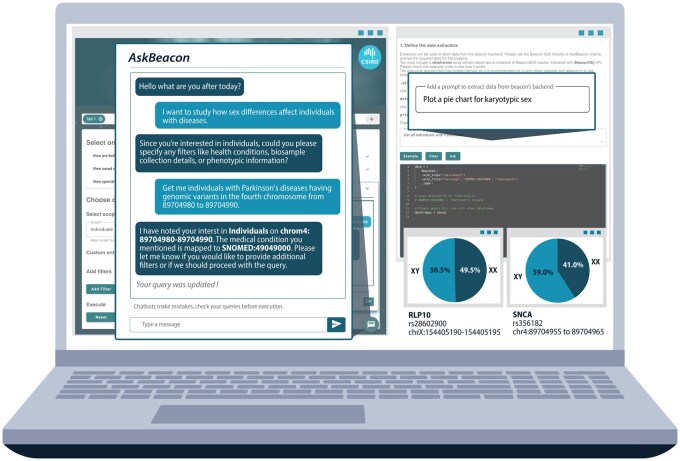
Motivation: Enabling clinicians and researchers to directly interact with global genomic data resources by removing technological barriers is vital for medical genomics. AskBeacon enables large language models (LLMs) to be applied to securely shared cohorts via the Global Alliance for Genomics and Health Beacon protocol. By simply "asking" Beacon, actionable insights can be gained, analyzed, and made publication-ready.
Results: In the Parkinson's Progression Markers Initiative (PPMI), we use natural language to ask whether the sex-differences observed in Parkinson's disease are due to X-linked or autosomal markers. AskBeacon returns a publication-ready visualization showing that for PPMI the autosomal marker occurred 1.4 times more often in males with Parkinson's disease than females, compared to no differences for the X-linked marker. We evaluate commercial and open-weight LLM models, as well as different architectures to identify the best strategy for translating research questions to Beacon queries. AskBeacon implements extensive safety guardrails to ensure that genomic data is not exposed to the LLM directly, and that generated code for data extraction, analysis and visualization process is sanitized and hallucination resistant, so data cannot be leaked or falsified.
Availability and implementation: AskBeacon is available at https://github.com/aehrc/AskBeacon.




 京公网安备 11010802042870号
京ICP备2023020795号-1
京公网安备 11010802042870号
京ICP备2023020795号-1

 分享
分享

 求助内容:
求助内容: 应助结果提醒方式:
 扫码关注我们
