{"title":"MiNEApy: enhancing enrichment network analysis in metabolic networks.","authors":"Vikash Pandey","doi":"10.1093/bioinformatics/btaf077","DOIUrl":null,"url":null,"abstract":"<p><strong>Motivation: </strong>Modeling genome-scale metabolic networks (GEMs) helps understand metabolic fluxes in cells at a specific state under defined environmental conditions or perturbations. Elementary flux modes (EFMs) are powerful tools for simplifying complex metabolic networks into smaller, more manageable pathways. However, the enumeration of all EFMs, especially within GEMs, poses significant challenges due to computational complexity. Additionally, traditional EFM approaches often fail to capture essential aspects of metabolism, such as co-factor balancing and by-product generation. The previously developed Minimum Network Enrichment Analysis (MiNEA) method addresses these limitations by enumerating alternative minimal networks for given biomass building blocks and metabolic tasks. MiNEA facilitates a deeper understanding of metabolic task flexibility and context-specific metabolic routes by integrating condition-specific transcriptomics, proteomics, and metabolomics data. This approach offers significant improvements in the analysis of metabolic pathways, providing more comprehensive insights into cellular metabolism.</p><p><strong>Results: </strong>Here, I present MiNEApy, a Python package reimplementation of MiNEA, which computes minimal networks and performs enrichment analysis. I demonstrate the application of MiNEApy on both a small-scale and a genome-scale model of the bacterium Escherichia coli, showcasing its ability to conduct minimal network enrichment analysis using minimal networks and context-specific data.</p><p><strong>Availability and implementation: </strong>MiNEApy can be accessed at: https://github.com/vpandey-om/mineapy.</p>","PeriodicalId":93899,"journal":{"name":"Bioinformatics (Oxford, England)","volume":" ","pages":""},"PeriodicalIF":5.4000,"publicationDate":"2025-03-04","publicationTypes":"Journal Article","fieldsOfStudy":null,"isOpenAccess":false,"openAccessPdf":"https://www.ncbi.nlm.nih.gov/pmc/articles/PMC11889450/pdf/","citationCount":"0","resultStr":null,"platform":"Semanticscholar","paperid":null,"PeriodicalName":"Bioinformatics (Oxford, England)","FirstCategoryId":"1085","ListUrlMain":"https://doi.org/10.1093/bioinformatics/btaf077","RegionNum":0,"RegionCategory":null,"ArticlePicture":[],"TitleCN":null,"AbstractTextCN":null,"PMCID":null,"EPubDate":"","PubModel":"","JCR":"","JCRName":"","Score":null,"Total":0}
引用次数: 0
Abstract
Motivation: Modeling genome-scale metabolic networks (GEMs) helps understand metabolic fluxes in cells at a specific state under defined environmental conditions or perturbations. Elementary flux modes (EFMs) are powerful tools for simplifying complex metabolic networks into smaller, more manageable pathways. However, the enumeration of all EFMs, especially within GEMs, poses significant challenges due to computational complexity. Additionally, traditional EFM approaches often fail to capture essential aspects of metabolism, such as co-factor balancing and by-product generation. The previously developed Minimum Network Enrichment Analysis (MiNEA) method addresses these limitations by enumerating alternative minimal networks for given biomass building blocks and metabolic tasks. MiNEA facilitates a deeper understanding of metabolic task flexibility and context-specific metabolic routes by integrating condition-specific transcriptomics, proteomics, and metabolomics data. This approach offers significant improvements in the analysis of metabolic pathways, providing more comprehensive insights into cellular metabolism.
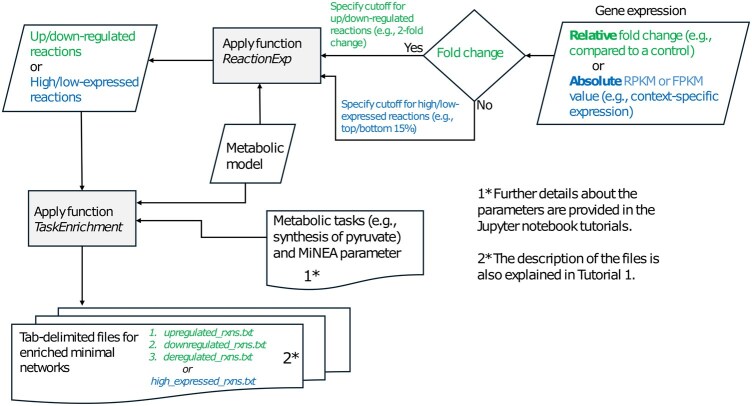
Results: Here, I present MiNEApy, a Python package reimplementation of MiNEA, which computes minimal networks and performs enrichment analysis. I demonstrate the application of MiNEApy on both a small-scale and a genome-scale model of the bacterium Escherichia coli, showcasing its ability to conduct minimal network enrichment analysis using minimal networks and context-specific data.
Availability and implementation: MiNEApy can be accessed at: https://github.com/vpandey-om/mineapy.



 京公网安备 11010802042870号
京ICP备2023020795号-1
京公网安备 11010802042870号
京ICP备2023020795号-1

 分享
分享

 求助内容:
求助内容: 应助结果提醒方式:
 扫码关注我们
