The effects of blood flow restriction combined with endurance training on athletes' aerobic capacity, lower limb muscle strength, anaerobic power and sports performance: a meta-analysis.
{"title":"The effects of blood flow restriction combined with endurance training on athletes' aerobic capacity, lower limb muscle strength, anaerobic power and sports performance: a meta-analysis.","authors":"Kuan Dong, Jing Tang, Chengli Xu, Wenliang Gui, Jing Tian, Buongo Chun, Dong Li, Liqing Wang","doi":"10.1186/s13102-025-01072-y","DOIUrl":null,"url":null,"abstract":"<p><strong>Objective: </strong>To evaluate the effects of blood flow restriction (BFR) combined with endurance training on aerobic capacity, lower limb muscle strength, anaerobic power, and sports performance to supply effective scientific guidance for training. Two reviewers independently screened the literature, extracted data, and assessed the risk of bias of the included studies. We searched PubMed, Medline, Cochrane, SPORTDiscus and Web of Science databases up to 28 October 2024. Two reviewers independently screened the literature, extracted data, and assessed the risk of bias of the included studies. We calculated the effect size using standardized mean difference values and the random effects model. The results showed a medium effect size on maximal oxygen uptake (V̇O<sub>2</sub>max), a large effect size on lower limb muscle strength, a small effect size on anaerobic power and sports performance. In conclusion, while BFR training during endurance training had a significant positive effect on lower limb muscle strength and moderate improvement in V̇O<sub>2</sub>max, its impact on anaerobic power and sports performance was relatively small. These findings suggest that BFR training may be effective for enhancing muscle strength and aerobic capacity, but its benefits on anaerobic power and sport-specific performance may be limited. Therefore, it is important to carefully design BFR training programs to target specific outcomes.</p>","PeriodicalId":48585,"journal":{"name":"BMC Sports Science Medicine and Rehabilitation","volume":"17 1","pages":"24"},"PeriodicalIF":2.8000,"publicationDate":"2025-02-22","publicationTypes":"Journal Article","fieldsOfStudy":null,"isOpenAccess":false,"openAccessPdf":"https://www.ncbi.nlm.nih.gov/pmc/articles/PMC11847382/pdf/","citationCount":"0","resultStr":null,"platform":"Semanticscholar","paperid":null,"PeriodicalName":"BMC Sports Science Medicine and Rehabilitation","FirstCategoryId":"3","ListUrlMain":"https://doi.org/10.1186/s13102-025-01072-y","RegionNum":3,"RegionCategory":"医学","ArticlePicture":[],"TitleCN":null,"AbstractTextCN":null,"PMCID":null,"EPubDate":"","PubModel":"","JCR":"Q1","JCRName":"REHABILITATION","Score":null,"Total":0}
引用次数: 0
Abstract
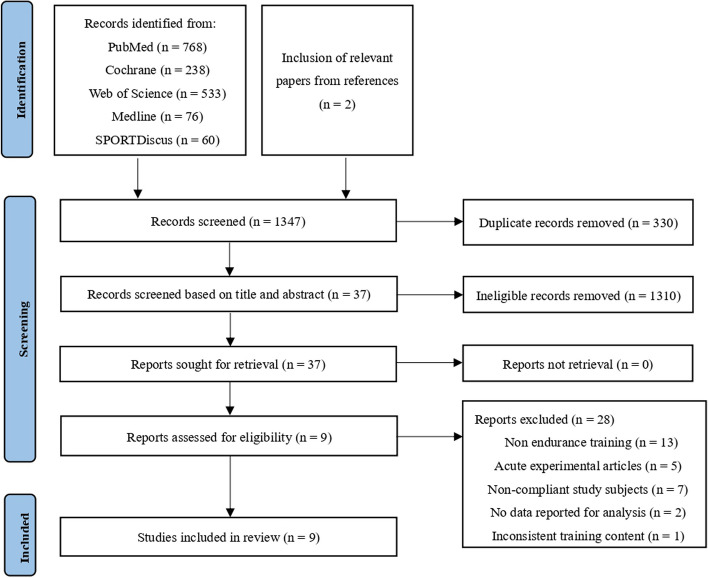
Objective: To evaluate the effects of blood flow restriction (BFR) combined with endurance training on aerobic capacity, lower limb muscle strength, anaerobic power, and sports performance to supply effective scientific guidance for training. Two reviewers independently screened the literature, extracted data, and assessed the risk of bias of the included studies. We searched PubMed, Medline, Cochrane, SPORTDiscus and Web of Science databases up to 28 October 2024. Two reviewers independently screened the literature, extracted data, and assessed the risk of bias of the included studies. We calculated the effect size using standardized mean difference values and the random effects model. The results showed a medium effect size on maximal oxygen uptake (V̇O2max), a large effect size on lower limb muscle strength, a small effect size on anaerobic power and sports performance. In conclusion, while BFR training during endurance training had a significant positive effect on lower limb muscle strength and moderate improvement in V̇O2max, its impact on anaerobic power and sports performance was relatively small. These findings suggest that BFR training may be effective for enhancing muscle strength and aerobic capacity, but its benefits on anaerobic power and sport-specific performance may be limited. Therefore, it is important to carefully design BFR training programs to target specific outcomes.
目的:评价血流量限制(BFR)联合耐力训练对有氧能力、下肢肌力、无氧能力及运动成绩的影响,为训练提供有效的科学指导。两名审稿人独立筛选文献,提取数据,并评估纳入研究的偏倚风险。我们检索了PubMed、Medline、Cochrane、SPORTDiscus和Web of Science数据库,检索时间截止到2024年10月28日。两名审稿人独立筛选文献,提取数据,并评估纳入研究的偏倚风险。我们使用标准化平均差值和随机效应模型计算效应大小。结果显示,对最大摄氧量(V * O2max)的影响中等,对下肢肌力的影响较大,对无氧能力和运动表现的影响较小。综上所述,耐力训练期间的BFR训练对下肢肌力有显著的正向作用,对vo2max有中等程度的改善,但对无氧能力和运动表现的影响相对较小。这些发现表明,BFR训练可能对增强肌肉力量和有氧能力有效,但其对无氧能力和运动特定表现的益处可能有限。因此,精心设计BFR训练计划以达到特定的效果是很重要的。
期刊介绍:
BMC Sports Science, Medicine and Rehabilitation is an open access, peer reviewed journal that considers articles on all aspects of sports medicine and the exercise sciences, including rehabilitation, traumatology, cardiology, physiology, and nutrition.





 京公网安备 11010802042870号
京ICP备2023020795号-1
京公网安备 11010802042870号
京ICP备2023020795号-1

 分享
分享
 求助内容:
求助内容: 应助结果提醒方式:
 扫码关注我们
