Ying Zeng, Zheng Li, Yeqin Feng, Manzhou Chi, Hongjin Lv and Guo-Yu Yang
{"title":"Dual-functional composite coating with flame-retardant and antibacterial properties for flexible polyurethane foams†","authors":"Ying Zeng, Zheng Li, Yeqin Feng, Manzhou Chi, Hongjin Lv and Guo-Yu Yang","doi":"10.1039/D4TA07870E","DOIUrl":null,"url":null,"abstract":"<p >Dual functionalization of polyurethane (PU) foam to achieve both flame-retardant and antibacterial properties is crucial for meeting stringent fire safety and hygiene standards. Herein, an efficient dual-functional coating, PDA@CS-POM, is developed by combining a transition metal-substituted polyoxometalate (POM), [Co<small><sub>4</sub></small>(H<small><sub>2</sub></small>O)<small><sub>2</sub></small>(PW<small><sub>9</sub></small>O<small><sub>34</sub></small>)<small><sub>2</sub></small>]<small><sup>10−</sup></small>, with a catecholamine-tethered polycation (PDA@CS(+)) prepared with polydopamine (PDA) and chitosan (CS), through a straightforward layer-by-layer (LbL) assembly method. The catecholamine groups in PDA@CS enable effective LbL assembly on hydrophobic silicon wafers and flexible PU foams without substrate pre-treatment. In particular, the PDA@CS-POM coating achieves a growth rate of 11.3 nm per BL, more than twice that of the reference CS-POM coating without PDA. Compression-recovery cycles demonstrate that the PDA@CS-POM coating increased the toughness of the PU foam while maintaining its inherent resilience. Assessments including limiting oxygen index (LOI), cone colorimetry, zone of inhibition, and colony culture tests confirm the efficient flame-retardant and antibacterial properties of the PDA@CS-POM coated PU foams. These dual-functional properties of the PDA@CS-POM coating positively correlate with the effects of the POM in inhibiting foam degradation, improving graphitization/aromatization of char barrier, and disrupting bacteria redox processes or cytoskeleton dynamics.</p>","PeriodicalId":82,"journal":{"name":"Journal of Materials Chemistry A","volume":" 14","pages":" 9830-9840"},"PeriodicalIF":9.5000,"publicationDate":"2025-02-24","publicationTypes":"Journal Article","fieldsOfStudy":null,"isOpenAccess":false,"openAccessPdf":"","citationCount":"0","resultStr":null,"platform":"Semanticscholar","paperid":null,"PeriodicalName":"Journal of Materials Chemistry A","FirstCategoryId":"88","ListUrlMain":"https://pubs.rsc.org/en/content/articlelanding/2025/ta/d4ta07870e","RegionNum":2,"RegionCategory":"材料科学","ArticlePicture":[],"TitleCN":null,"AbstractTextCN":null,"PMCID":null,"EPubDate":"","PubModel":"","JCR":"Q1","JCRName":"CHEMISTRY, PHYSICAL","Score":null,"Total":0}
引用次数: 0
Abstract
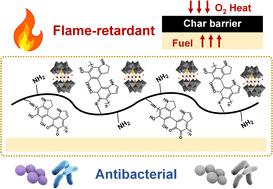
Dual functionalization of polyurethane (PU) foam to achieve both flame-retardant and antibacterial properties is crucial for meeting stringent fire safety and hygiene standards. Herein, an efficient dual-functional coating, PDA@CS-POM, is developed by combining a transition metal-substituted polyoxometalate (POM), [Co4(H2O)2(PW9O34)2]10−, with a catecholamine-tethered polycation (PDA@CS(+)) prepared with polydopamine (PDA) and chitosan (CS), through a straightforward layer-by-layer (LbL) assembly method. The catecholamine groups in PDA@CS enable effective LbL assembly on hydrophobic silicon wafers and flexible PU foams without substrate pre-treatment. In particular, the PDA@CS-POM coating achieves a growth rate of 11.3 nm per BL, more than twice that of the reference CS-POM coating without PDA. Compression-recovery cycles demonstrate that the PDA@CS-POM coating increased the toughness of the PU foam while maintaining its inherent resilience. Assessments including limiting oxygen index (LOI), cone colorimetry, zone of inhibition, and colony culture tests confirm the efficient flame-retardant and antibacterial properties of the PDA@CS-POM coated PU foams. These dual-functional properties of the PDA@CS-POM coating positively correlate with the effects of the POM in inhibiting foam degradation, improving graphitization/aromatization of char barrier, and disrupting bacteria redox processes or cytoskeleton dynamics.
期刊介绍:
The Journal of Materials Chemistry A, B & C covers a wide range of high-quality studies in the field of materials chemistry, with each section focusing on specific applications of the materials studied. Journal of Materials Chemistry A emphasizes applications in energy and sustainability, including topics such as artificial photosynthesis, batteries, and fuel cells. Journal of Materials Chemistry B focuses on applications in biology and medicine, while Journal of Materials Chemistry C covers applications in optical, magnetic, and electronic devices. Example topic areas within the scope of Journal of Materials Chemistry A include catalysis, green/sustainable materials, sensors, and water treatment, among others.



 京公网安备 11010802042870号
京ICP备2023020795号-1
京公网安备 11010802042870号
京ICP备2023020795号-1

 分享
分享
 求助内容:
求助内容: 应助结果提醒方式:
 扫码关注我们
