Woojoong Kim, Kyuho Lee, Sanghyeon Choi, Eunje Park, Gwanho Kim, Jebong Ha, Yeeun Kim, Jihye Jang, Ji Hye Oh, HoYeon Kim, Wei Jiang, Jioh Yoo, Taebin Kim, Yeonji Kim, Kwan-Nyeong Kim, Juntaek Hong, Ali Javey, Dong-wook Rha, Tae-Woo Lee, Keehoon Kang, Gunuk Wang, Cheolmin Park
{"title":"Electrochemiluminescent tactile visual synapse enabling in situ health monitoring","authors":"Woojoong Kim, Kyuho Lee, Sanghyeon Choi, Eunje Park, Gwanho Kim, Jebong Ha, Yeeun Kim, Jihye Jang, Ji Hye Oh, HoYeon Kim, Wei Jiang, Jioh Yoo, Taebin Kim, Yeonji Kim, Kwan-Nyeong Kim, Juntaek Hong, Ali Javey, Dong-wook Rha, Tae-Woo Lee, Keehoon Kang, Gunuk Wang, Cheolmin Park","doi":"10.1038/s41563-025-02124-x","DOIUrl":null,"url":null,"abstract":"Tactile visual synapses combine the functionality of tactile artificial synapses with the ability to visualize their activity in real time and provide a direct and intuitive visualization of the activity, offering an efficient route for in situ health monitoring. Herein we present a tactile visual synapse that enables in situ monitoring of finger rehabilitation and electrocardiogram analysis. Repetitive finger flexion and various arrhythmias are monitored and visually guided using the developed tactile visual synapse combined with an electrical and optical output feedback algorithm. The tactile visual synapse has the structure of an electrochemical transistor comprising an elastomeric top gate as a tactile receptor and an electrochemiluminescent ion gel as a light-emitting layer stacked on a polymeric semiconductor layer, forming an electrical synaptic channel between source and drain electrodes. The low-power (~34 μW) visualization of the tactile synaptic activity associated with the repetitive motions of fingers and heartbeats enables the development of a convenient and efficient personalized healthcare system. A tactile visual artificial synapse provides a route for in situ health monitoring. Here the authors report an electrochemical transistor comprising a top gate as a tactile receptor and a light-emitting ion gel layer stacked on a polymeric semiconductor to monitor finger motions and heartbeats.","PeriodicalId":19058,"journal":{"name":"Nature Materials","volume":"24 6","pages":"925-934"},"PeriodicalIF":38.5000,"publicationDate":"2025-02-24","publicationTypes":"Journal Article","fieldsOfStudy":null,"isOpenAccess":false,"openAccessPdf":"","citationCount":"0","resultStr":null,"platform":"Semanticscholar","paperid":null,"PeriodicalName":"Nature Materials","FirstCategoryId":"88","ListUrlMain":"https://www.nature.com/articles/s41563-025-02124-x","RegionNum":1,"RegionCategory":"材料科学","ArticlePicture":[],"TitleCN":null,"AbstractTextCN":null,"PMCID":null,"EPubDate":"","PubModel":"","JCR":"Q1","JCRName":"CHEMISTRY, PHYSICAL","Score":null,"Total":0}
引用次数: 0
Abstract
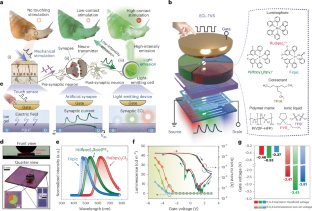
Tactile visual synapses combine the functionality of tactile artificial synapses with the ability to visualize their activity in real time and provide a direct and intuitive visualization of the activity, offering an efficient route for in situ health monitoring. Herein we present a tactile visual synapse that enables in situ monitoring of finger rehabilitation and electrocardiogram analysis. Repetitive finger flexion and various arrhythmias are monitored and visually guided using the developed tactile visual synapse combined with an electrical and optical output feedback algorithm. The tactile visual synapse has the structure of an electrochemical transistor comprising an elastomeric top gate as a tactile receptor and an electrochemiluminescent ion gel as a light-emitting layer stacked on a polymeric semiconductor layer, forming an electrical synaptic channel between source and drain electrodes. The low-power (~34 μW) visualization of the tactile synaptic activity associated with the repetitive motions of fingers and heartbeats enables the development of a convenient and efficient personalized healthcare system. A tactile visual artificial synapse provides a route for in situ health monitoring. Here the authors report an electrochemical transistor comprising a top gate as a tactile receptor and a light-emitting ion gel layer stacked on a polymeric semiconductor to monitor finger motions and heartbeats.
期刊介绍:
Nature Materials is a monthly multi-disciplinary journal aimed at bringing together cutting-edge research across the entire spectrum of materials science and engineering. It covers all applied and fundamental aspects of the synthesis/processing, structure/composition, properties, and performance of materials. The journal recognizes that materials research has an increasing impact on classical disciplines such as physics, chemistry, and biology.
Additionally, Nature Materials provides a forum for the development of a common identity among materials scientists and encourages interdisciplinary collaboration. It takes an integrated and balanced approach to all areas of materials research, fostering the exchange of ideas between scientists involved in different disciplines.
Nature Materials is an invaluable resource for scientists in academia and industry who are active in discovering and developing materials and materials-related concepts. It offers engaging and informative papers of exceptional significance and quality, with the aim of influencing the development of society in the future.




 京公网安备 11010802042870号
京ICP备2023020795号-1
京公网安备 11010802042870号
京ICP备2023020795号-1

 分享
分享
 求助内容:
求助内容: 应助结果提醒方式:
 扫码关注我们
