Jiali Li, Xinni Yao, Jiateng Ma, Chuang Liu, Wenjun Hong, Haigang Wu, Minjie Li and Liang-Hong Guo
{"title":"Recent advances in the electrochemiluminescence detection of small molecule drugs","authors":"Jiali Li, Xinni Yao, Jiateng Ma, Chuang Liu, Wenjun Hong, Haigang Wu, Minjie Li and Liang-Hong Guo","doi":"10.1039/D4AN01562B","DOIUrl":null,"url":null,"abstract":"<p >The detection of small molecule drugs is crucial in clinical treatment and environmental protection by facilitating the optimization of therapeutic regimens, preventing adverse drug reactions and monitoring environmental pollution. Electrochemiluminescence (ECL) is widely employed in the detection of small molecule drugs due to its high sensitivity and low background signal. This review highlights advancements from the last five years or so in ECL detection methods based on ECL reactions between luminophores and drugs as well as those based on affinity reactions between recognition molecules and drugs. Studies on affinity-based sensors including immunosensors, aptamer sensors, molecularly imprinted sensors, and composite material sensors are summarized. The review reveals that innovations in ECL luminophores, electrode materials and recognition materials are key areas of focus in this field. Nanomaterials play fundamentally important roles in enhancing the performance of ECL detection by acting as carriers of conventional luminophores, highly efficient luminescent materials, catalytically active electrode materials, and selective and stable recognition elements. With further advances in multiple drug detection, instrument miniaturization, on-site and point of care detection, and therapeutic monitoring, ECL is expected to play more significant roles in the detection of small molecule drugs.</p>","PeriodicalId":63,"journal":{"name":"Analyst","volume":" 6","pages":" 1048-1065"},"PeriodicalIF":3.3000,"publicationDate":"2025-02-24","publicationTypes":"Journal Article","fieldsOfStudy":null,"isOpenAccess":false,"openAccessPdf":"","citationCount":"0","resultStr":null,"platform":"Semanticscholar","paperid":null,"PeriodicalName":"Analyst","FirstCategoryId":"92","ListUrlMain":"https://pubs.rsc.org/en/content/articlelanding/2025/an/d4an01562b","RegionNum":3,"RegionCategory":"化学","ArticlePicture":[],"TitleCN":null,"AbstractTextCN":null,"PMCID":null,"EPubDate":"","PubModel":"","JCR":"Q2","JCRName":"CHEMISTRY, ANALYTICAL","Score":null,"Total":0}
引用次数: 0
Abstract
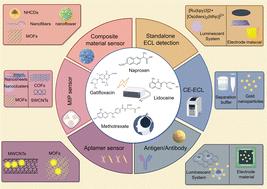
The detection of small molecule drugs is crucial in clinical treatment and environmental protection by facilitating the optimization of therapeutic regimens, preventing adverse drug reactions and monitoring environmental pollution. Electrochemiluminescence (ECL) is widely employed in the detection of small molecule drugs due to its high sensitivity and low background signal. This review highlights advancements from the last five years or so in ECL detection methods based on ECL reactions between luminophores and drugs as well as those based on affinity reactions between recognition molecules and drugs. Studies on affinity-based sensors including immunosensors, aptamer sensors, molecularly imprinted sensors, and composite material sensors are summarized. The review reveals that innovations in ECL luminophores, electrode materials and recognition materials are key areas of focus in this field. Nanomaterials play fundamentally important roles in enhancing the performance of ECL detection by acting as carriers of conventional luminophores, highly efficient luminescent materials, catalytically active electrode materials, and selective and stable recognition elements. With further advances in multiple drug detection, instrument miniaturization, on-site and point of care detection, and therapeutic monitoring, ECL is expected to play more significant roles in the detection of small molecule drugs.




 京公网安备 11010802042870号
京ICP备2023020795号-1
京公网安备 11010802042870号
京ICP备2023020795号-1

 分享
分享
 求助内容:
求助内容: 应助结果提醒方式:
 扫码关注我们
