Junsheng Wang, Gege He, Jinke Shen, Xiaozhen Lv, Hongyu Mi, Shun Lu
{"title":"Phosphorus Incorporation Increases the Oxygen Electrocatalytic Activity of Co–N Catalysts","authors":"Junsheng Wang, Gege He, Jinke Shen, Xiaozhen Lv, Hongyu Mi, Shun Lu","doi":"10.1021/acs.langmuir.4c04952","DOIUrl":null,"url":null,"abstract":"Transition metal and nitrogen codoped graphitic carbon materials with Co–N bonds serve as key non-noble-metal catalysts for the oxygen evolution reaction (OER). To enhance catalytic efficiency, we explore the anchoring of Co–N bonds on nitrogen-doped graphitic carbon (NC) substrates with varied phosphorus content. The catalyst is synthesized through a straightforward sintering and phosphating process of ZIF@DCA in a tube furnace. X-ray photoelectron spectroscopy (XPS) demonstrated that the Co–N bonds effectively formed an efficient charge transfer channel, removing the barrier that separated the Co–N active site from the work electrode surface. Phosphorus is uniformly distributed across the Co–N substrate, ensuring the exposure of most Co–N active sites during the electrochemical reaction. With favorable structural and electronic attributes, P/Co–N-2 showcases the lowest overpotentials at 10 and 300 mA cm<sup>–2</sup>, which are 200 and 300 mV, respectively. Additionally, it demonstrates stable performance over 100 h in 1 M KOH, outperforming other similar materials and RuO<sub>2</sub>. This study offers critical insights for the rational design of Co–N structures, exploring the interplay between structure, composition, and activity in electrochemical reactions.","PeriodicalId":50,"journal":{"name":"Langmuir","volume":"128 1","pages":""},"PeriodicalIF":3.9000,"publicationDate":"2025-02-23","publicationTypes":"Journal Article","fieldsOfStudy":null,"isOpenAccess":false,"openAccessPdf":"","citationCount":"0","resultStr":null,"platform":"Semanticscholar","paperid":null,"PeriodicalName":"Langmuir","FirstCategoryId":"92","ListUrlMain":"https://doi.org/10.1021/acs.langmuir.4c04952","RegionNum":2,"RegionCategory":"化学","ArticlePicture":[],"TitleCN":null,"AbstractTextCN":null,"PMCID":null,"EPubDate":"","PubModel":"","JCR":"Q2","JCRName":"CHEMISTRY, MULTIDISCIPLINARY","Score":null,"Total":0}
引用次数: 0
Abstract
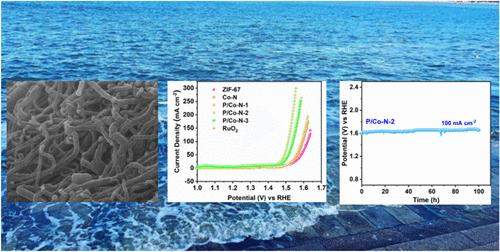
Transition metal and nitrogen codoped graphitic carbon materials with Co–N bonds serve as key non-noble-metal catalysts for the oxygen evolution reaction (OER). To enhance catalytic efficiency, we explore the anchoring of Co–N bonds on nitrogen-doped graphitic carbon (NC) substrates with varied phosphorus content. The catalyst is synthesized through a straightforward sintering and phosphating process of ZIF@DCA in a tube furnace. X-ray photoelectron spectroscopy (XPS) demonstrated that the Co–N bonds effectively formed an efficient charge transfer channel, removing the barrier that separated the Co–N active site from the work electrode surface. Phosphorus is uniformly distributed across the Co–N substrate, ensuring the exposure of most Co–N active sites during the electrochemical reaction. With favorable structural and electronic attributes, P/Co–N-2 showcases the lowest overpotentials at 10 and 300 mA cm–2, which are 200 and 300 mV, respectively. Additionally, it demonstrates stable performance over 100 h in 1 M KOH, outperforming other similar materials and RuO2. This study offers critical insights for the rational design of Co–N structures, exploring the interplay between structure, composition, and activity in electrochemical reactions.
具有Co-N键的过渡金属和氮共掺杂石墨碳材料是析氧反应(OER)的关键非贵金属催化剂。为了提高催化效率,我们探索了不同磷含量的氮掺杂石墨碳(NC)衬底上Co-N键的锚定。催化剂是通过在管式炉中ZIF@DCA的直接烧结和磷化工艺合成的。x射线光电子能谱(XPS)表明,Co-N键有效地形成了一个有效的电荷转移通道,消除了Co-N活性位点与工作电极表面之间的屏障。磷均匀分布在Co-N衬底上,确保在电化学反应中暴露大多数Co-N活性位点。由于具有良好的结构和电子特性,P/ Co-N-2在10和300 mA cm-2时的过电位最低,分别为200和300 mV。此外,它在1 M KOH中表现出超过100小时的稳定性能,优于其他类似材料和RuO2。这项研究为Co-N结构的合理设计提供了重要的见解,探索了电化学反应中结构、组成和活性之间的相互作用。
期刊介绍:
Langmuir is an interdisciplinary journal publishing articles in the following subject categories:
Colloids: surfactants and self-assembly, dispersions, emulsions, foams
Interfaces: adsorption, reactions, films, forces
Biological Interfaces: biocolloids, biomolecular and biomimetic materials
Materials: nano- and mesostructured materials, polymers, gels, liquid crystals
Electrochemistry: interfacial charge transfer, charge transport, electrocatalysis, electrokinetic phenomena, bioelectrochemistry
Devices and Applications: sensors, fluidics, patterning, catalysis, photonic crystals
However, when high-impact, original work is submitted that does not fit within the above categories, decisions to accept or decline such papers will be based on one criteria: What Would Irving Do?
Langmuir ranks #2 in citations out of 136 journals in the category of Physical Chemistry with 113,157 total citations. The journal received an Impact Factor of 4.384*.
This journal is also indexed in the categories of Materials Science (ranked #1) and Multidisciplinary Chemistry (ranked #5).



 京公网安备 11010802042870号
京ICP备2023020795号-1
京公网安备 11010802042870号
京ICP备2023020795号-1

 分享
分享
 求助内容:
求助内容: 应助结果提醒方式:
 扫码关注我们
