James A. Brissenden, Yitong Yin, Michael Vesia, Taraz G. Lee
{"title":"Errors of attention adaptively warp spatial cognition","authors":"James A. Brissenden, Yitong Yin, Michael Vesia, Taraz G. Lee","doi":"10.1038/s41562-025-02109-5","DOIUrl":null,"url":null,"abstract":"Adaptation is the process by which we adjust internal models of the body, world and mind in response to sensory feedback. Although adaptation is studied extensively in the context of motor control, there is limited evidence that cognitive functions such as working memory are subject to the same error-driven adaptive control mechanism. To examine the possibility that internal spatial representations undergo adaptation, we had participants perform a task that interleaved a perceptual discrimination task and a spatial working memory task. Perceptual discrimination trials (85% of trials) presented an initial peripheral cue to exogenously capture attention, immediately followed by a displaced target stimulus. This sequence of events served to repeatedly induce a covert attentional allocation error. Interleaved spatial working memory trials (15% of trials) presented a stimulus at a pseudorandom peripheral location followed by a delay interval. On half of the working memory trials, the stimulus was surreptitiously presented at the same location as the initial attentional cue. We found that as attentional errors accumulated over the course of the experiment, participants’ spatial recall shifted to counteract the attentional error. The magnitude of this shift was proportional to the number of induced errors. Recall performance recovered rapidly following the offset of error trials. Multiple control experiments ruled out alternative explanations for these results, such as oculomotor confounds and attentional biases unrelated to error. These findings indicate that the computational mechanisms governing the adaptation of motor commands appear to similarly serve to adjust and calibrate spatial cognition. Brissenden et al. demonstrate that spatial cognition adaptively shifts to counteract errors in the allocation of visual attention, indicating error-driven learning mechanisms previously ascribed solely to motor control contribute to visual cognition.","PeriodicalId":19074,"journal":{"name":"Nature Human Behaviour","volume":"9 4","pages":"769-780"},"PeriodicalIF":15.9000,"publicationDate":"2025-02-24","publicationTypes":"Journal Article","fieldsOfStudy":null,"isOpenAccess":false,"openAccessPdf":"","citationCount":"0","resultStr":null,"platform":"Semanticscholar","paperid":null,"PeriodicalName":"Nature Human Behaviour","FirstCategoryId":"102","ListUrlMain":"https://www.nature.com/articles/s41562-025-02109-5","RegionNum":1,"RegionCategory":"心理学","ArticlePicture":[],"TitleCN":null,"AbstractTextCN":null,"PMCID":null,"EPubDate":"","PubModel":"","JCR":"Q1","JCRName":"MULTIDISCIPLINARY SCIENCES","Score":null,"Total":0}
引用次数: 0
Abstract
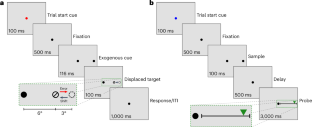
Adaptation is the process by which we adjust internal models of the body, world and mind in response to sensory feedback. Although adaptation is studied extensively in the context of motor control, there is limited evidence that cognitive functions such as working memory are subject to the same error-driven adaptive control mechanism. To examine the possibility that internal spatial representations undergo adaptation, we had participants perform a task that interleaved a perceptual discrimination task and a spatial working memory task. Perceptual discrimination trials (85% of trials) presented an initial peripheral cue to exogenously capture attention, immediately followed by a displaced target stimulus. This sequence of events served to repeatedly induce a covert attentional allocation error. Interleaved spatial working memory trials (15% of trials) presented a stimulus at a pseudorandom peripheral location followed by a delay interval. On half of the working memory trials, the stimulus was surreptitiously presented at the same location as the initial attentional cue. We found that as attentional errors accumulated over the course of the experiment, participants’ spatial recall shifted to counteract the attentional error. The magnitude of this shift was proportional to the number of induced errors. Recall performance recovered rapidly following the offset of error trials. Multiple control experiments ruled out alternative explanations for these results, such as oculomotor confounds and attentional biases unrelated to error. These findings indicate that the computational mechanisms governing the adaptation of motor commands appear to similarly serve to adjust and calibrate spatial cognition. Brissenden et al. demonstrate that spatial cognition adaptively shifts to counteract errors in the allocation of visual attention, indicating error-driven learning mechanisms previously ascribed solely to motor control contribute to visual cognition.
期刊介绍:
Nature Human Behaviour is a journal that focuses on publishing research of outstanding significance into any aspect of human behavior.The research can cover various areas such as psychological, biological, and social bases of human behavior.It also includes the study of origins, development, and disorders related to human behavior.The primary aim of the journal is to increase the visibility of research in the field and enhance its societal reach and impact.




 京公网安备 11010802042870号
京ICP备2023020795号-1
京公网安备 11010802042870号
京ICP备2023020795号-1

 分享
分享
 求助内容:
求助内容: 应助结果提醒方式:
 扫码关注我们
