Katherine A. Yates, Carolina Alvarez, Todd A. Schwartz, Serena Savage-Guin, Jordan B. Renner, Catherine J. Bakewell, Minna J. Kohler, Janice Lin, Jonathan Samuels, Tessa Walker, Yvonne M. Golightly, Amanda E. Nelson
{"title":"Associations and Diagnostic Accuracy of Ultrasound Features in Knee Osteoarthritis: Cross-Sectional Results From a Large Community-Based Cohort","authors":"Katherine A. Yates, Carolina Alvarez, Todd A. Schwartz, Serena Savage-Guin, Jordan B. Renner, Catherine J. Bakewell, Minna J. Kohler, Janice Lin, Jonathan Samuels, Tessa Walker, Yvonne M. Golightly, Amanda E. Nelson","doi":"10.1002/art.43139","DOIUrl":null,"url":null,"abstract":"<div>\n \n <section>\n \n <h3> Objective</h3>\n \n <p>Our study objectives were (1) to determine associations among ultrasound (US) features of knee osteoarthritis (KOA), radiographic KOA (rKOA), and patient-reported symptoms and (2) to determine diagnostic accuracy of US definitions for rKOA, in a community-based cohort.</p>\n </section>\n \n <section>\n \n <h3> Methods</h3>\n \n <p>Participants enrolled in the Johnston County Health Study (JoCoHS; 2019–2024, n = 902) provided demographics, comorbidities, clinical features, and symptoms, along with imaging with standardized acquisition and scoring protocols. Logistic regression models provided odds ratios adjusted for age, sex, race, ethnicity, body mass index (BMI), education level, comorbidities, and knee injury for associations among US features and KOA outcomes. Diagnostic accuracy was assessed using standard metrics with rKOA as the gold standard.</p>\n </section>\n \n <section>\n \n <h3> Results</h3>\n \n <p>Complete imaging data were available for 861 participants (1,711 knees): 34% men, 25% Black, 10% Hispanic, mean age 55 years, and mean BMI 33. Half of knees were symptomatic, one-third had rKOA, and one in five had symptomatic rKOA. US-identified osteophytes, effusion, meniscal extrusion, cartilage damage, calcium crystals, and popliteal cysts were associated with KOA outcomes. A US definition including both mild osteophytes and mild cartilage damage gave an area under the receiver operating characteristic curve of 0.76 for diagnosing rKOA (validated in an external cohort).</p>\n </section>\n \n <section>\n \n <h3> Conclusion</h3>\n \n <p>We identified common US features in participants with and without KOA, along with significant associations between US features and rKOA, symptomatic rKOA, and symptoms. US-based diagnosis of rKOA shows promise for general use. US is a valuable and accessible modality for assessment of knee OA features in clinical and research settings, including those with limited resources.</p>\n \n <div>\n <figure>\n <div><picture>\n <source></source></picture><p></p>\n </div>\n </figure>\n </div>\n </section>\n </div>","PeriodicalId":129,"journal":{"name":"Arthritis & Rheumatology","volume":"77 8","pages":"996-1005"},"PeriodicalIF":10.9000,"publicationDate":"2025-02-24","publicationTypes":"Journal Article","fieldsOfStudy":null,"isOpenAccess":false,"openAccessPdf":"","citationCount":"0","resultStr":null,"platform":"Semanticscholar","paperid":null,"PeriodicalName":"Arthritis & Rheumatology","FirstCategoryId":"3","ListUrlMain":"https://acrjournals.onlinelibrary.wiley.com/doi/10.1002/art.43139","RegionNum":1,"RegionCategory":"医学","ArticlePicture":[],"TitleCN":null,"AbstractTextCN":null,"PMCID":null,"EPubDate":"","PubModel":"","JCR":"Q1","JCRName":"RHEUMATOLOGY","Score":null,"Total":0}
引用次数: 0
Abstract
Objective
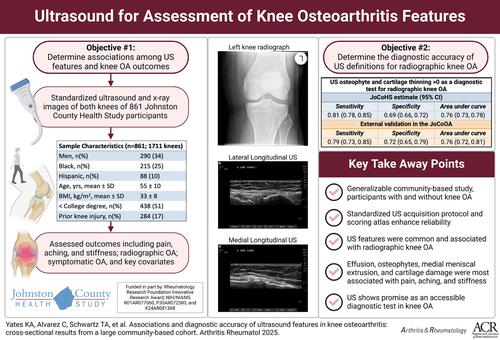
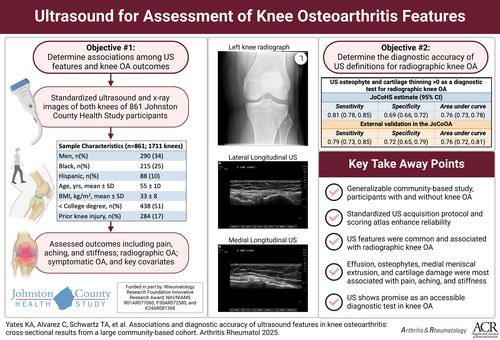
Our study objectives were (1) to determine associations among ultrasound (US) features of knee osteoarthritis (KOA), radiographic KOA (rKOA), and patient-reported symptoms and (2) to determine diagnostic accuracy of US definitions for rKOA, in a community-based cohort.
Methods
Participants enrolled in the Johnston County Health Study (JoCoHS; 2019–2024, n = 902) provided demographics, comorbidities, clinical features, and symptoms, along with imaging with standardized acquisition and scoring protocols. Logistic regression models provided odds ratios adjusted for age, sex, race, ethnicity, body mass index (BMI), education level, comorbidities, and knee injury for associations among US features and KOA outcomes. Diagnostic accuracy was assessed using standard metrics with rKOA as the gold standard.
Results
Complete imaging data were available for 861 participants (1,711 knees): 34% men, 25% Black, 10% Hispanic, mean age 55 years, and mean BMI 33. Half of knees were symptomatic, one-third had rKOA, and one in five had symptomatic rKOA. US-identified osteophytes, effusion, meniscal extrusion, cartilage damage, calcium crystals, and popliteal cysts were associated with KOA outcomes. A US definition including both mild osteophytes and mild cartilage damage gave an area under the receiver operating characteristic curve of 0.76 for diagnosing rKOA (validated in an external cohort).
Conclusion
We identified common US features in participants with and without KOA, along with significant associations between US features and rKOA, symptomatic rKOA, and symptoms. US-based diagnosis of rKOA shows promise for general use. US is a valuable and accessible modality for assessment of knee OA features in clinical and research settings, including those with limited resources.
期刊介绍:
Arthritis & Rheumatology is the official journal of the American College of Rheumatology and focuses on the natural history, pathophysiology, treatment, and outcome of rheumatic diseases. It is a peer-reviewed publication that aims to provide the highest quality basic and clinical research in this field. The journal covers a wide range of investigative areas and also includes review articles, editorials, and educational material for researchers and clinicians. Being recognized as a leading research journal in rheumatology, Arthritis & Rheumatology serves the global community of rheumatology investigators and clinicians.