Guo-Xing Li, Xingyi Lyu, Au Nguyen, Rong Kou, Christy George, Siyu Wu, Ruipeng Li, Ke Wang, Tao Li, Donghai Wang
{"title":"Fine-Tuning Li-Ion Solvation Structure by Enhanced Solvent-Diluent Interactions for Long-Cycling Lithium Metal Batteries","authors":"Guo-Xing Li, Xingyi Lyu, Au Nguyen, Rong Kou, Christy George, Siyu Wu, Ruipeng Li, Ke Wang, Tao Li, Donghai Wang","doi":"10.1002/aenm.202405680","DOIUrl":null,"url":null,"abstract":"<p>Achieving durable lithium (Li) metal anodes in liquid electrolytes remains challenging, primarily due to the instability of the formed solid-electrolyte interphases (SEIs). Modulating the Li-ion solvation structures is pivotal in forming a stable SEI for stabilizing Li metal anodes. Here a strategy is developed to fine-tune the Li-ion solvation structures through enhanced dipole–dipole interactions between the Li-ion-coordinated solvent and the non-Li-ion-coordinating diluent, for creating a stable SEI in the developed binary salt electrolyte. The enhanced dipole–dipole interactions weaken the coordination between Li-ions and the solvents while strengthening the interaction between Li-ions and dual anions, thereby facilitating the Li-ion transport and a robust anion-derived SEI with a distinct bilayer structure. Consequently, the developed electrolyte exhibited exceptional electrochemical performance in high energy-density Li||LiNi<sub>0.8</sub>Mn<sub>0.1</sub>Co<sub>0.1</sub>O<sub>2</sub> (NMC811) cells, with long calendar life, stable cyclability at 1 C, and reliable operation between 25 and −20 °C, and it also demonstrat remarkable cycling stability for a Li||NMC811 pouch cell with projected energy density of 402 Wh kg<sup>−1</sup>, maintaining 80% capacity retention over 606 cycles under practical conditions.</p>","PeriodicalId":111,"journal":{"name":"Advanced Energy Materials","volume":"15 19","pages":""},"PeriodicalIF":26.0000,"publicationDate":"2025-02-24","publicationTypes":"Journal Article","fieldsOfStudy":null,"isOpenAccess":false,"openAccessPdf":"https://onlinelibrary.wiley.com/doi/epdf/10.1002/aenm.202405680","citationCount":"0","resultStr":null,"platform":"Semanticscholar","paperid":null,"PeriodicalName":"Advanced Energy Materials","FirstCategoryId":"88","ListUrlMain":"https://advanced.onlinelibrary.wiley.com/doi/10.1002/aenm.202405680","RegionNum":1,"RegionCategory":"材料科学","ArticlePicture":[],"TitleCN":null,"AbstractTextCN":null,"PMCID":null,"EPubDate":"","PubModel":"","JCR":"Q1","JCRName":"CHEMISTRY, PHYSICAL","Score":null,"Total":0}
引用次数: 0
Abstract
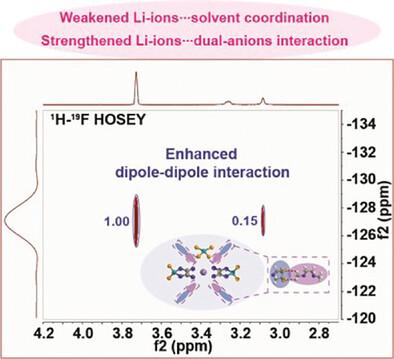
Achieving durable lithium (Li) metal anodes in liquid electrolytes remains challenging, primarily due to the instability of the formed solid-electrolyte interphases (SEIs). Modulating the Li-ion solvation structures is pivotal in forming a stable SEI for stabilizing Li metal anodes. Here a strategy is developed to fine-tune the Li-ion solvation structures through enhanced dipole–dipole interactions between the Li-ion-coordinated solvent and the non-Li-ion-coordinating diluent, for creating a stable SEI in the developed binary salt electrolyte. The enhanced dipole–dipole interactions weaken the coordination between Li-ions and the solvents while strengthening the interaction between Li-ions and dual anions, thereby facilitating the Li-ion transport and a robust anion-derived SEI with a distinct bilayer structure. Consequently, the developed electrolyte exhibited exceptional electrochemical performance in high energy-density Li||LiNi0.8Mn0.1Co0.1O2 (NMC811) cells, with long calendar life, stable cyclability at 1 C, and reliable operation between 25 and −20 °C, and it also demonstrat remarkable cycling stability for a Li||NMC811 pouch cell with projected energy density of 402 Wh kg−1, maintaining 80% capacity retention over 606 cycles under practical conditions.
期刊介绍:
Established in 2011, Advanced Energy Materials is an international, interdisciplinary, English-language journal that focuses on materials used in energy harvesting, conversion, and storage. It is regarded as a top-quality journal alongside Advanced Materials, Advanced Functional Materials, and Small.
With a 2022 Impact Factor of 27.8, Advanced Energy Materials is considered a prime source for the best energy-related research. The journal covers a wide range of topics in energy-related research, including organic and inorganic photovoltaics, batteries and supercapacitors, fuel cells, hydrogen generation and storage, thermoelectrics, water splitting and photocatalysis, solar fuels and thermosolar power, magnetocalorics, and piezoelectronics.
The readership of Advanced Energy Materials includes materials scientists, chemists, physicists, and engineers in both academia and industry. The journal is indexed in various databases and collections, such as Advanced Technologies & Aerospace Database, FIZ Karlsruhe, INSPEC (IET), Science Citation Index Expanded, Technology Collection, and Web of Science, among others.







 京公网安备 11010802042870号
京ICP备2023020795号-1
京公网安备 11010802042870号
京ICP备2023020795号-1

 分享
分享
 求助内容:
求助内容: 应助结果提醒方式:
 扫码关注我们
