{"title":"How Do Organic Batteries Work? Theoretical and Design Principles of Electrode Materials for All-Organic Batteries","authors":"Robin Wessling, Philipp Penert, Birgit Esser","doi":"10.1002/aenm.202500150","DOIUrl":null,"url":null,"abstract":"<p>Post-Li battery technologies are becoming increasingly important. The diverse range of electrically powered devices requires a diversification of electrochemical energy storage technologies. Organic electrode materials are of particular importance for alternative batteries, not only because of the natural abundance of their constituting elements and low toxicity, but also because of the operating principle of their redox reactions and their compatibility with many types of battery chemistries, including multivalent metal and anionic batteries. All-organic batteries are a still a “young” field of research but offer promising opportunities in terms of mechanical and processing properties. In the development of batteries using organic electrode materials the understanding of their redox mechanisms, of the different cell types and the correct interpretation of data is of utmost importance. This comprehensive review offers insight into the working principle of organic-based batteries, into material design considerations, structure-property relations, highlighting the importance of standardized terminology, and into the characterization of newly developed organic electrode materials in battery cells, distinguishing between half-cells and full-cells.</p>","PeriodicalId":111,"journal":{"name":"Advanced Energy Materials","volume":"15 17","pages":""},"PeriodicalIF":26.0000,"publicationDate":"2025-02-24","publicationTypes":"Journal Article","fieldsOfStudy":null,"isOpenAccess":false,"openAccessPdf":"https://onlinelibrary.wiley.com/doi/epdf/10.1002/aenm.202500150","citationCount":"0","resultStr":null,"platform":"Semanticscholar","paperid":null,"PeriodicalName":"Advanced Energy Materials","FirstCategoryId":"88","ListUrlMain":"https://advanced.onlinelibrary.wiley.com/doi/10.1002/aenm.202500150","RegionNum":1,"RegionCategory":"材料科学","ArticlePicture":[],"TitleCN":null,"AbstractTextCN":null,"PMCID":null,"EPubDate":"","PubModel":"","JCR":"Q1","JCRName":"CHEMISTRY, PHYSICAL","Score":null,"Total":0}
引用次数: 0
Abstract
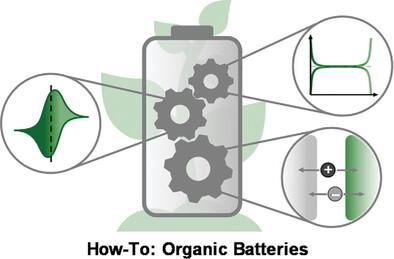
Post-Li battery technologies are becoming increasingly important. The diverse range of electrically powered devices requires a diversification of electrochemical energy storage technologies. Organic electrode materials are of particular importance for alternative batteries, not only because of the natural abundance of their constituting elements and low toxicity, but also because of the operating principle of their redox reactions and their compatibility with many types of battery chemistries, including multivalent metal and anionic batteries. All-organic batteries are a still a “young” field of research but offer promising opportunities in terms of mechanical and processing properties. In the development of batteries using organic electrode materials the understanding of their redox mechanisms, of the different cell types and the correct interpretation of data is of utmost importance. This comprehensive review offers insight into the working principle of organic-based batteries, into material design considerations, structure-property relations, highlighting the importance of standardized terminology, and into the characterization of newly developed organic electrode materials in battery cells, distinguishing between half-cells and full-cells.
期刊介绍:
Established in 2011, Advanced Energy Materials is an international, interdisciplinary, English-language journal that focuses on materials used in energy harvesting, conversion, and storage. It is regarded as a top-quality journal alongside Advanced Materials, Advanced Functional Materials, and Small.
With a 2022 Impact Factor of 27.8, Advanced Energy Materials is considered a prime source for the best energy-related research. The journal covers a wide range of topics in energy-related research, including organic and inorganic photovoltaics, batteries and supercapacitors, fuel cells, hydrogen generation and storage, thermoelectrics, water splitting and photocatalysis, solar fuels and thermosolar power, magnetocalorics, and piezoelectronics.
The readership of Advanced Energy Materials includes materials scientists, chemists, physicists, and engineers in both academia and industry. The journal is indexed in various databases and collections, such as Advanced Technologies & Aerospace Database, FIZ Karlsruhe, INSPEC (IET), Science Citation Index Expanded, Technology Collection, and Web of Science, among others.






 京公网安备 11010802042870号
京ICP备2023020795号-1
京公网安备 11010802042870号
京ICP备2023020795号-1

 分享
分享
 求助内容:
求助内容: 应助结果提醒方式:
 扫码关注我们
