Zhixian Wu, Xueyong Zheng, Chunli Jiang, Junhan Xie, Weimin Liu, Bo Li, Hechun Lin, Hui Peng* and Chunhua Luo*,
{"title":"Peptide-Engineered Interface to Improve the Efficiency of Pure Red Tin Halide Perovskite LEDs by Controlling Crystallization and Reducing Oxidation","authors":"Zhixian Wu, Xueyong Zheng, Chunli Jiang, Junhan Xie, Weimin Liu, Bo Li, Hechun Lin, Hui Peng* and Chunhua Luo*, ","doi":"10.1021/acsaelm.4c01935","DOIUrl":null,"url":null,"abstract":"<p >Tin (Sn)-based perovskite light-emitting diodes (PeLEDs) have garnered significant attention owing to their superior optoelectronic properties, affordable solution processing, and environmental friendliness. However, the properties of Sn-PeLEDs trail those of their lead (Pb) counterparts. The main obstacle is the easy oxidation of Sn<sup>2+</sup> to Sn<sup>4+</sup> as well as fast crystallization, leading to poor film quality with many defects. Herein, a convenient and effective interface engineering strategy is reported to fabricate (2-thiopheneethylamine)<sub>2</sub>SnI<sub>4</sub> (TEA<sub>2</sub>SnI<sub>4</sub>) PeLEDs by introducing different peptides into the PEDOT:PSS hole-transport layer (HTL). Benefiting from the interaction between the peptide molecules and the Sn-perovskite nuclei, the crystallization dynamics are effectively adjusted, leading to an improved film morphology. At the same time, the multiple functional groups of peptides can suppress Sn<sup>2+</sup> oxidation and passivate interface defects. Therefore, perovskite films with improved luminescence efficiency are obtained. The perovskite films are further used for the fabrication of pure red PeLEDs with enhanced performance. In particular, the optimized devices based on Leu-Gly-Gly (LGG) achieve a peak external quantum efficiency of 0.5% and a brightness of 136 cd m<sup>–2</sup>, which are about 2 and 3 times larger, respectively, than those of the reference device. This research offers a general strategy to improve the performance of Sn-PeLEDs via peptide interface engineering.</p>","PeriodicalId":3,"journal":{"name":"ACS Applied Electronic Materials","volume":"7 4","pages":"1423–1431 1423–1431"},"PeriodicalIF":4.7000,"publicationDate":"2025-02-14","publicationTypes":"Journal Article","fieldsOfStudy":null,"isOpenAccess":false,"openAccessPdf":"","citationCount":"0","resultStr":null,"platform":"Semanticscholar","paperid":null,"PeriodicalName":"ACS Applied Electronic Materials","FirstCategoryId":"88","ListUrlMain":"https://pubs.acs.org/doi/10.1021/acsaelm.4c01935","RegionNum":3,"RegionCategory":"材料科学","ArticlePicture":[],"TitleCN":null,"AbstractTextCN":null,"PMCID":null,"EPubDate":"","PubModel":"","JCR":"Q1","JCRName":"ENGINEERING, ELECTRICAL & ELECTRONIC","Score":null,"Total":0}
引用次数: 0
Abstract
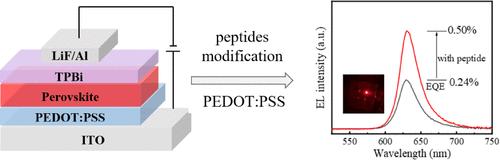
Tin (Sn)-based perovskite light-emitting diodes (PeLEDs) have garnered significant attention owing to their superior optoelectronic properties, affordable solution processing, and environmental friendliness. However, the properties of Sn-PeLEDs trail those of their lead (Pb) counterparts. The main obstacle is the easy oxidation of Sn2+ to Sn4+ as well as fast crystallization, leading to poor film quality with many defects. Herein, a convenient and effective interface engineering strategy is reported to fabricate (2-thiopheneethylamine)2SnI4 (TEA2SnI4) PeLEDs by introducing different peptides into the PEDOT:PSS hole-transport layer (HTL). Benefiting from the interaction between the peptide molecules and the Sn-perovskite nuclei, the crystallization dynamics are effectively adjusted, leading to an improved film morphology. At the same time, the multiple functional groups of peptides can suppress Sn2+ oxidation and passivate interface defects. Therefore, perovskite films with improved luminescence efficiency are obtained. The perovskite films are further used for the fabrication of pure red PeLEDs with enhanced performance. In particular, the optimized devices based on Leu-Gly-Gly (LGG) achieve a peak external quantum efficiency of 0.5% and a brightness of 136 cd m–2, which are about 2 and 3 times larger, respectively, than those of the reference device. This research offers a general strategy to improve the performance of Sn-PeLEDs via peptide interface engineering.
期刊介绍:
ACS Applied Electronic Materials is an interdisciplinary journal publishing original research covering all aspects of electronic materials. The journal is devoted to reports of new and original experimental and theoretical research of an applied nature that integrate knowledge in the areas of materials science, engineering, optics, physics, and chemistry into important applications of electronic materials. Sample research topics that span the journal's scope are inorganic, organic, ionic and polymeric materials with properties that include conducting, semiconducting, superconducting, insulating, dielectric, magnetic, optoelectronic, piezoelectric, ferroelectric and thermoelectric.
Indexed/Abstracted:
Web of Science SCIE
Scopus
CAS
INSPEC
Portico




 京公网安备 11010802042870号
京ICP备2023020795号-1
京公网安备 11010802042870号
京ICP备2023020795号-1

 分享
分享
 求助内容:
求助内容: 应助结果提醒方式:
 扫码关注我们
